


Since the White House issued the executive order titled “Restriction on Entry of Certain Nonimmigrant Workers,” requiring payment of $100,000 for foreign nationals seeking entry into the U.S. in H-1B status, U.S. Citizenship & Immigration Services (USCIS) has published guidance on its website to address ongoing ambiguities.
USCIS clarifies that the following categories of H-1B petitions filed September 21, 2025, or later are subject to the payment:
- Petitions filed “on behalf of beneficiaries who are outside the United States and do not have a valid H-1B visa”;
- Petitions requesting “consular notification, port of entry notification, or pre-flight inspection for an alien in the United States”; and
- Petitions requesting a change of status to H-1B, or an amendment to or extension of H-1B stay, where USCIS determines that the beneficiary “is ineligible for a change of status or an amendment or extension of stay (e.g., is not in a valid nonimmigrant visa status or if the alien departs the United States prior to adjudication of a change of status request).”
The guidance further states that the $100,000 payment does not apply to:
- Any previously issued and currently valid H-1B visas, or any petitions submitted prior to the effective date;
- Petitions filed on or after September 21, 2025, that request a change of status to H-1B or an amendment to or extension of H-1B stay for a beneficiary inside the U.S., if the request is granted. Notably, beneficiaries of these petitions will not be subject to the $100,000 payment if they subsequently depart the U.S. and apply for a visa based on the approved petition and/or seek to reenter the U.S. on a current H-1B visa.
This guidance clarifies several important questions. First, the payment does not apply to beneficiaries who are currently in the U.S. in any status and seek a change of status to H-1B or an amendment or extension of their current H-1B status, as long as USCIS approves the request. If for some reason USCIS determines that the beneficiary is ineligible for the requested change of status, amendment, or extension, then the $100,000 payment will be required.
Second, for those beneficiaries who are selected in the H-1B visa lottery in 2026, the $100,000 payment will not be required as long as the foreign national employee remains in the U.S. when 1) the H-1B petition is filed; 2) the petitioning employer requests a change of the foreign national’s status to H-1B on the requested start date (on or after October 1, 2026); and 3) USCIS approves the request.
Finally, an H-1B petition requesting consular notification, port of entry notification, or pre-flight inspection — whether the beneficiary is already within the U.S. or abroad — will be subject to this payment.
In issuing this executive order, the administration is asserting the authority established in the Immigration and Nationality Act for the president to prescribe “limitations and exceptions” on foreign nationals entering the U.S. (215(a) and to “impose on the entry of aliens any restrictions he may deem to be appropriate” when the entry of “any aliens or any class of aliens” is “detrimental to the interests of the United States” (212(a)). Litigation, including a lawsuit filed by the U.S. Chamber of Commerce, has challenged this $100,000 payment and is currently pending.
This article was originally published on Law360 and is republished here with permission as it originally appeared on October 29, 2025.
This article is part of a regular column in which each installment features observations on one state’s attorney general enforcement news and trends, and the compliance implications.
Since beginning his tenure in 2019, Illinois Attorney General Kwame Raoul has strategically positioned himself as a leading figure among Democratic state attorneys general.
His efforts are not merely for show; Raoul has systematically strengthened his office to advance Illinois’ policy objectives and establish it as a prominent force among state regulatory bodies. Businesses operating in Illinois should heed Raoul’s office and remain vigilant regarding its activities.
Many Democratic attorneys general have responded to the federal government’s recent shift in enforcement priorities. Large blue states, such as California with Attorney General Rob Bonta, and New York with Attorney General Letitia James, have dedicated significant resources to opposing the Trump administration’s policies and activities since January.
There is also a push by these states to fill the perceived enforcement gaps in the wake of reduced staffing and funding for the Consumer Financial Protection Bureau, U.S. Department of Housing and Urban Development, and U.S. Environmental Protection Agency, among others.
Illinois, another large blue state, is presenting itself as a leader alongside California and New York.
Illinois’ 42nd Attorney General
While the press frequently notes the efforts of Bonta and James, less attention has been devoted to Raoul.
Raoul is the 42nd attorney general of Illinois, a position he has held since 2019. Prior to his tenure as attorney general, he represented Illinois’ 13th Senate district, the same seat left vacant by Barack Obama in 2004 when he was elected to the U.S. Senate.
While serving as a state senator, he also worked at Quarles & Brady LLP as a partner in their labor and employment group.
Now, in his role as attorney general, Raoul is making concerted efforts comparable to those of Bonta and James, positioning himself as a key player in state-level regulatory enforcement.
He is not only aligning his positions with those of these states, but also enhancing the capacity of the Office of the Illinois Attorney General. He is securing the necessary resources to function effectively as a regulatory authority and to attract and retain talent for achieving his long-term goals.
Through examining the actions taken by the Office of the Illinois Attorney General, a picture of how Raoul plans to raise his office’s profile becomes clear.
Opposing Regulation Moves by the Trump Administration
Out of the many priorities held by the Illinois attorney general in 2025, opposing the regulatory and government action by the Trump administration is at the top of the list.
At the beginning of the year, Raoul announced his opposition to the Laken Riley Act, which mandates the detention without bond of noncitizens arrested for committing certain crimes, reflecting the administration’s more aggressive stance on immigration enforcement.[1] He has taken several other stands in the field of immigration, including defending temporary protected status for immigrants from around the world.[2]
By February, Raoul joined 17 other attorneys general in State of New York v. Trump, filing a lawsuit in the U.S. District Court for the Southern District of New York against the Trump administration for providing Elon Musk and the Department of Government Efficiency with unauthorized access to the U.S. Department of the Treasury’s central payment system, which houses many Americans’ most sensitive personal information.[3]
Illinois participated in another coalition to protect the CFPB.[4] Along with 23 other attorneys general, Raoul filed an amicus brief before the U.S. District Court for the District of Maryland on Feb. 19, in Mayor and City Council of Baltimore v. Consumer Financial Protection Bureau, alleging that Trump’s directive for the CFPB to stop all ongoing work and halt any future investigations harms consumers.
On Sept. 3, Raoul joined 22 other attorneys general in submitting a comment letter in opposition to the U.S. Department of Veterans Affairs’ proposed federal rule eliminating abortion care and counseling at VA facilities and from VA benefits packages.[5]
Raoul filed another amicus brief on Sept. 15 in District of Columbia v. Trump, supporting District of Columbia Attorney General Brian Schwalb’s challenge to the allegedly unlawful deployment of National Guard troops to D.C.[6] As widely reported, Chicago has also been a candidate for the deployment of federal service members.[7]
On Sept. 24, Raoul sought a preliminary injunction along with 22 other attorneys general in California v. U.S. Department of Health and Human Services, to prevent the Trump administration from enforcing the defund provision found in the recently enacted federal budget reconciliation law, which would prohibit Medicaid reimbursements to facilities that provide abortion care.[8]
Substantive Actions
While Raoul has been busy developing the bona fides to join New York and California as a leading state opposing the enforcement priorities and government actions of the Trump administration, he continues to pursue state-level law enforcement objectives.
These objectives arise in areas concerning labor and wages, unfair or deceptive acts and practices, fraud on the government, and environmental matters.
Considering Raoul’s background as an attorney practicing labor and employment law, it is no shock that his office aggressively pursues labor-related issues. Many of the cases prosecuted by Raoul’s office involve failure to pay overtime,[9] failure to pay fair wages,[10] or wage-fixing practices.[11]
Efforts have been made to protect workers on the macro level as well. Between March and April, Raoul took three separate efforts to safeguard the National Labor Relations Board and its ability to protect American workers’ right to unionize.[12]
Right before the Labor Day weekend, Raoul published a new report, highlighting efforts taken to protect Illinois workers.[13] The report expounds upon Raoul’s achievements in this regard, including those of the Workplace Rights Bureau of the Attorney General’s Office, which has collected “more than $27 million in owed wages and restitution for workers and collected $935,000 in penalties against companies alleged to have discriminated against workers on the basis of race or sex” since it was created in 2020.[14]
Raoul also closed several high-profile matters in 2025.
Alternative retail energy suppliers have been a focus of this administration. Raoul recently secured a $12 million settlement from Direct Energy Services LLC in April and an $8.4 million settlement from Clearview Energy Inc. in September.[15]
At the end of 2024, in collaboration with the FTC, Raoul obtained an $11.25 million settlement with DoorDash for alleged unfair and deceptive acts and practices.[16] On May 22, the Trump International Hotel settled an environmental matter involving the discharge of water into the Chicago River for $4.8 million.[17]
Despite his recent focus on opposing the Trump administration, Raoul continues to pursue bread-and-butter attorney general matters in Illinois. He is expected to maintain this focus at an increased pace as he aims to expand the size and quality of the legal talent pool of the Office of the Illinois Attorney General to pursue his objectives.
Interstate Collaboration
Raoul has also prioritized interstate collaboration to achieve shared policy objectives. With lowered federal regulatory activity comes increased state regulatory activity. One way for states to match the resources and effectiveness of federal regulation is by combining their knowledge and resources to achieve a similar level of effectiveness.
As evidenced by the numerous coalitions, attorneys general have discovered that concentrating the power of various attorneys general is an effective enforcement tool. While states have been collaborating for more than 30 years in enforcement actions and litigation, they are increasingly doing so in the modern era with greater effect.
Raoul’s collaborative focus has not been exclusively on opposition to the federal government. He has also engaged in bipartisan collaboration efforts.
For example, in January, Raoul announced a coordinated action with nine attorneys general against disposable e-cigarette producers and distributors. This coalition has sent letters, served subpoenas and civil investigative demands, and filed lawsuits against e-cigarette retailers, including Raoul’s suit, Illinois v. Chicago Merchandise Co., filed on Jan. 16.[18]
In August, Raoul also joined a bipartisan coalition of 22 state attorneys general who sent a comment letter to the Centers for Disease Control and Prevention and HHS to support continuation of the National Youth Tobacco Survey, which is an annual study to assess the use of smoking and vaping among middle and high school students.[19]
Office Growth
One signal that Raoul is intent on increasing the profile of the office is his effort to expand it. Since 2019, Raoul has made headway toward increasing the quantity and improving the quality of lawyers employed by the Office of the Illinois Attorney General.
Between the fiscal years of 2016 and 2025, the Illinois state budgets reveal a notable increase in the agency’s submitted headcount. From 2016 to 2020, the actual headcount remained constant at 760 employees.
However, the Illinois state budget for 2026 sets an ambitious target, aiming for a headcount of 877 employees by the end of fiscal year 2026. This represents a 23.3% increase from the previously stagnant numbers observed between 2016 and 2020.[20]
The office is looking to fill 45 attorney positions.[21] These positions are located throughout the state in a wide range of divisions, including consumer fraud, environmental enforcement, high-tech crimes, Medicaid fraud, privacy and data security, workplace rights, and many more.
Not only is Raoul hiring more attorneys than ever before, but the state has also substantially increased salaries to retain them. Most full-time assistant attorney general positions across the state now come with an annual compensation ranging from $82,000 to $107,550.[22] Complex litigation counsel positions are posted with a yearly salary range of $110,000 to $140,000.[23] Roles also include robust benefits.
These salary bands are significantly higher than they were prior to Raoul’s tenure. In 2016, the highest paid assistant attorney general received $84,480, and the highest paid complex litigation counsel received $83,256, both of which are right around or well below the minimum salary for the roles today.[24]
In 2017, wages for various assistant attorney general positions started at $57,000.[25] As a former legislator, Raoul has been largely successful in securing legislative support, and it seems he has materially improved the resourcing of his office for the long term.
By making these changes, Raoul is planning for a future of more robust enforcement activity and to attract and retain legal talent to carry out objectives. By seeking growth opportunities, both internally through new hires and externally through more frequent collaboration with other state attorney general offices, Raoul’s office will be better equipped to handle substantive enforcement issues, as well as complex investigations and litigation.
Recommendation for Companies Operating in Illinois
Companies operating in Illinois should be aware that Raoul is strengthening his office to address perceived regulatory gaps in federal oversight, particularly in sectors such as consumer finance, energy, the environment and consumer protection.
Democratic attorneys general, including Raoul, are expected to creatively leverage existing state laws, such as unfair or deceptive acts or practices, and federal laws with parallel enforcement authority, like the Health Insurance Portability and Accountability Act, Consumer Financial Protection Act, and Children’s Online Privacy Protection Act, to regulate businesses.
Additionally, attorneys general are likely to continue using state antitrust and environmental protection laws to pursue the largest companies. As the regulatory landscape evolves over the coming years, we may even see increased legislative activity aimed at providing regulators with additional resources and enforcement tools.
Given Raoul’s focus on labor-related issues, companies with workers in Illinois must be diligent in complying with state-specific labor laws and regulations. Some exemplar areas to focus on are as follows.
Minimum Wage Compliance
Ensure that the company’s pay structure meets or exceeds Illinois’ minimum wage requirements, which are higher than the federal minimum wage.
Employee Breaks and Rest Days
Illinois mandates breaks and at least one day of rest for all employees. It’s crucial to incorporate these requirements into scheduling and human resources policies.
Worker Classification
Properly classify workers according to Illinois law to avoid misclassification issues, which can lead to legal complications and penalties.
Temporary and Contract Workers
The Illinois Day and Temporary Labor Services Act requires that temporary workers who work a certain number of hours annually receive the same benefits as full-time employees. Ensure your company policies reflect this requirement.
Accessibility and Leave Laws
Stay updated on Illinois’ leave and accessibility laws to ensure compliance, including family leave and disability accommodations.
As Raoul has an aggressive enforcement stance, companies should regularly review their compliance with these labor laws to mitigate risks.
Raoul is also expected to continue actively enforcing consumer protection laws, including the Illinois Consumer Fraud and Deceptive Business Practices Act. He frequently targets specific industries, such as alternative retail energy suppliers, to influence industry practices.
Some of the consumer protection issues that Raoul has focused on include the following.
Undisclosed Fees
Raoul aggressively targets companies lacking transparency in their pricing before consumers enter the “checkout” phase of a purchase. Companies should ensure transparent pricing and avoid charges that could be considered junk fees.
Misleading Statements
Companies offering products and services to consumers that fail to fulfill promises face increased scrutiny. Illinois businesses should ensure marketing claims are substantiated and clear, with no misleading statements.
Credit Practices
As a supporter of the Predatory Loan Prevention Act, Raoul targets high-interest consumer credit providers. Claims under the act often accompany consumer protection claims, particularly if loan terms are concealed or consumers are perceived to have been misled about any promotional period or the specific terms of repayment.
Lenders should review the Predatory Loan Prevention Act and adhere to state usury laws and disclosure requirements as applicable.
Conclusion
As attorneys general in both red and blue states react to the changing federal agency priorities, particularly the Federal Trade Commission and CFPB, state attorneys general will fill the perceived void by directing the allocation of resources based on their state-level constituency and personal/professional priorities.
It is inevitable that attorneys general use their scarce resources in ways that are different from one another, potentially widening regulatory differences between states. As this trend continues, it will likely lead to more varied compliance requirements.
This evolving landscape will complicate national compliance strategies for companies operating in multiple jurisdictions. Businesses must stay informed about local regulatory changes and ensure compliance across different regions, as regulations and enforcement priorities can vary significantly.
[1] Attorney General Raoul Joins Coalition Urging U.S. Senate to Oppose Laken Riley Act, Office of the Illinois Attorney General Kwame Raoul (Jan. 16, 2025), https://illinoisattorneygeneral.gov/news/story/attorney-general-raoul-joins-coalition-urging-us-senate-to-oppose-laken-riley-act.
[2] Attorney General Raoul Joins Coalition to Defend Temporary Protected Status for Haitians and Venezuelans, Office of the Illinois Attorney General Kwame Raoul (Mar. 25, 2025), https://illinoisattorneygeneral.gov/news/story/attorney-general-raoul-joins-coalition-to-defend-temporary-protected-status-for-haitians-and-venezuelans-3-25-25; Attorney General Raoul Defends Temporary Protected Status for Immigrants from Honduras, Nepal, Nicaragua, Office of the Illinois Attorney General Kwame Raoul (Jul. 21, 2025), https://illinoisattorneygeneral.gov/news/story/attorney-general-raoul-defends-temporary-protected-status-for-immigrants-from-honduras-nepal-nicaragua.
[3] Attorney General Raoul Joins Coalition in Filing Lawsuit to Stop Elon Musk and Doge’s Attack on Americans, Office of the Illinois Attorney General Kwame Raoul (Feb. 7, 2025), https://illinoisattorneygeneral.gov/news/story/attorney-general-raoul-joins-coalition-in-filing-lawsuit-to-stop-elon-musk-and-doges-attack-on-americans.
[4] Attorney General Raoul Joins Coalition to Defend Consumer Financial Protection Bureau, Office of the Illinois Attorney General Kwame Raoul (Feb. 20, 2025), https://illinoisattorneygeneral.gov/news/story/attorney-general-raoul-joins-coalition-to-defend-consumer-financial-protection-bureau.
[5] Attorney General Raoul Opposes Trump Administration’s Proposed Rollback of Abortion Care for Veterans and Their Families, Office of the Illinois Attorney General Kwame Raoul (Sep. 4, 2025), https://illinoisattorneygeneral.gov/news/story/attorney-general-raoul-opposes-trump-administrations-proposed-rollback-of-abortion-care-for-veterans-and-their-families.
[6] Attorney General Raoul Supports D.C.’s Challenge to Trump’s National Guard Takeover, Office of the Illinois Attorney General Kwame Raoul (Sep. 15, 2025), https://illinoisattorneygeneral.gov/news/story/attorney-general-raoul-supports-dcs-challenge-to-trumps-national-guard-takeover-9-15-25.
[7] Shia Kapos, JB Pritzker blasts plan for National Guard deployment to Chicago, Politico (Sep. 29, 2025 at 18:53 ET), https://www.politico.com/news/2025/09/29/jackbooted-thugs-pritzker-blasts-plan-for-national-guard-deployment-00585709.
[8] Attorney General Raoul Seeks Preliminary Injunction to Block Trump Administration from Defunding Planned Parenthood & Other Health Centers, Office of the Illinois Attorney General Kwame Raoul (Sep. 24, 2025), https://illinoisattorneygeneral.gov/news/story/attorney-general-raoul-seeks-preliminary-injunction-to-block-trump-administration-from-defunding-planned-parenthood-and-other-health-centers.
[9] Attorney General Raoul Recovers More Than $600,000 in Unpaid Overtime Wages for Misclassified Temporary Workers, Office of the Illinois Attorney General Kwame Raoul (Jul. 23, 2025), https://illinoisattorneygeneral.gov/news/story/attorney-general-raoul-recovers-more-than-600-000-in-unpaid-overtime-wages-for-misclassified-temporary-workers.
[10] Attorney General Raoul Files Lawsuit Against Transcription Company and Owner for Unpaid Wages, Office of the Illinois Attorney General Kwame Raoul (Aug. 25, 2025), https://illinoisattorneygeneral.gov/news/story/attorney-general-raoul-files-lawsuit-against-transcription-company-and-owner-for-unpaid-wages.
[11] Attorney General Raoul Reaches $1 Million Settlement with Temporary Staffing Agency for Use of No-Poach Agreements, Wage Fixing, Office of the Illinois Attorney General Kwame Raoul (Jun. 27, 2025), https://illinoisattorneygeneral.gov/news/story/attorney-general-raoul-reaches-1-million-settlement-with-temporary-staffing-agency-for-use-of-no-poach-agreements-wage-fixing.
[12] Attorney General Raoul Leads Coalition Defending the Integrity of the National Labor Relations Board, Office of the Illinois Attorney General Kwame Raoul (Mar. 5, 2025), https://illinoisattorneygeneral.gov/news/story/attorney-general-raoul-leads-coalition-defending-the-integrity-of-the-national-labor-relations-board-3-5-25; Attorney General Raoul Co-Leads Coalition Asking Court to Preserve National Labor Relations Board, Office of the Illinois Attorney General Kwame Raoul (Mar. 12, 2025), https://illinoisattorneygeneral.gov/news/story/attorney-general-raoul-co-leads-coalition-asking-court-to-preserve-national-labor-relations-board; Attorney General Raoul Co-Leads Coalition Asking Court to Preserve National Labor Relations Board, Office of the Illinois Attorney General Kwame Raoul (Apr. 10, 2025), https://illinoisattorneygeneral.gov/news/story/attorney-general-raoul-co-leads-coalition-asking-court-to-preserve-national-labor-relations-board41025.
[13] 2025 Labor Day Report, Office of the Illinois Attorney General (Aug. 29, 2025), https://illinoisattorneygeneral.gov/Page-Attachments/LaborDayReportEnglish25.pdf.
[14] Attorney General Raoul Highlights His Office’s Efforts to Protect Workers in Annual Labor Day Report, Office of the Illinois Attorney General Kwame Raoul (Aug. 29, 2025), https://illinoisattorneygeneral.gov/news/story/attorney-general-raoul-highlights-his-offices-efforts-to-protect-workers-in-annual-labor-day-report2025.
[15] Attorney General Raoul Announces $12 Million Settlement with Alternative Retail Electric Supplier Over Deceptive and Unfair Business Practices, Office of the Illinois Attorney General Kwame Raoul (Apr. 17, 2025), https://illinoisattorneygeneral.gov/news/story/attorney-general-raoul-announces-12-million-settlement-with-alternative-retail-electric-supplier-over-deceptive-and-unfair-business-practices-4-17-25; Illinois AG Settles Alleged Deceptive Practices, Banning Alternative Retail Electric Supplier From State and Securing $8.4M in Restitution, Troutman Pepper Locke State Attorneys General Team (Sep. 26, 2025), https://www.regulatoryoversight.com/2025/09/illinois-ag-settles-alleged-deceptive-practices-banning-alternative-retail-electric-supplier-from-state-and-securing-8-4m-in-restitution/.
[16] Attorney General Raoul Announces $11.25 Million Settlement Agreement with DoorDash Over Delivery Driver Tips, Office of the Illinois Attorney General Kwame Raoul (Nov. 8, 2024), https://illinoisattorneygeneral.gov/news/story/attorney-general-raoul-announces-1125-million-settlement-agreement-with-doordash-over-delivery-driver-tips.
[17] Attorney General Raoul Announces $4.8 Million Settlement with Trump Tower to Protect Chicago River, Office of the Illinois Attorney General Kwame Raoul (May 22, 2025), https://illinoisattorneygeneral.gov/news/story/attorney-general-raoul-announces-48-million-settlement-with-trump-tower-to-protect-chicago-river.
[18] Attorney General Raoul Continues Crackdown on Illicit Flavored Disposable E-Cigarette Products As Part of Bipartisan, National Collaboration, Office of the Illinois Attorney General Kwame Raoul (Jan. 16, 2025), https://illinoisattorneygeneral.gov/news/story/attorney-general-raoul-continues-crackdown-on-illicit-flavored-disposable-e-cigarette-products-as-part-of-bipartisan-national-collaboration.
[19] Attorney General Raoul Joins Bipartisan Letter In Support of National Youth Tobacco Survey, Office of the Illinois Attorney General Kwame Raoul (Aug. 15, 2025), https://www.illinoisattorneygeneral.gov/news/story/attorney-general-raoul-joins-bipartisan-letter-in-support-of-national-youth-tobacco-survey.
[20] Governor’s Office of Management and Budget, Office of the Governor, Illinois State Budget Fiscal Year 2018 223 (2017), https://budget.illinois.gov/content/dam/soi/en/web/budget/documents/budget-book/fy-2018-budget-book/fy-2018-operating-budget-book.pdf; Governor’s Office of Management and Budget, Office of the Governor, Illinois State Budget Fiscal Year 2022 209 (2021), https://budget.illinois.gov/content/dam/soi/en/web/budget/documents/budget-book/fy2022-budget-book/fiscal-year-2022-operating-budget.pdf; Governor’s Office of Management and Budget, Office of the Governor, Illinois State Budget Fiscal Year 2026 239 (2025), https://budget.illinois.gov/content/dam/soi/en/web/budget/documents/budget-book/fy2026-budget/Fiscal-Year-2026-Operating-Budget.pdf.
[21] Job Opportunities, Office of the Illinois Attorney General Kwame Raoul, https://www.governmentjobs.com/careers/ilag?category%5b0%5d=Attorney&sort=PositionTitle%7CAscending.
[22] AAG-Assistant Attorney General – Consumer Fraud – Springfield, Office of the Illinois Attorney General Kwame Raoul (Sep. 23, 2025), https://www.governmentjobs.com/careers/ilag/jobs/5090432/aag-assistant-attorney-general-consumer-fraud-springfield?category[0]=Attorney&sort=PostingDate%7CDescending&page=4&pagetype=jobOpportunitiesJobs.
[23] Complex Litigation Counsel, Office of the Illinois Attorney General Kwame Raoul (Sep. 25, 2025), https://www.governmentjobs.com/careers/ilag/jobs/5092451/complex-litigation-counsel?sort=PostingDate%7CDescending&pagetype=jobOpportunitiesJobs.
[24] Illinois State Employees (Year 2016, Employer Illinois Attorney General), Open the Books, https://www.openthebooks.com/illinois-state-employees/?Year_S=2016&Emp_S=Illinois%2BAttorney%2BGeneral&pg=1 (last visited Oct. 8, 2025).
[25] Assistant Attorney General – Consumer Protection – Consumer Fraud – Springfield, Office of the Illinois Attorney General Lisa Madigan (Feb. 18, 2017), https://illinoisattorneygeneral.gov/about/jobs/aag_consumerfraud_s.html, Internet Archive https://web.archive.org/web/20170218102457/https://illinoisattorneygeneral.gov/about/jobs/aag_consumerfraud_s.html; Assistant Attorney General – Government Representation – General Law – Chicago, Office of the Illinois Attorney General Lisa Madigan (Feb. 18, 2017), https://illinoisattorneygeneral.gov/about/jobs/aag_govrepgenlaw_c.html, Internet Archive https://web.archive.org/web/20170218102349/https://illinoisattorneygeneral.gov/about/jobs/aag_govrepgenlaw_c.html; Assistant Attorney General – Public Interest – Tobacco Enforcement- Springfield, Office of the Illinois Attorney General Lisa Madigan (Feb. 18, 2017), https://illinoisattorneygeneral.gov/about/jobs/aag_pubintTobacco_s.html, Internet Archive https://web.archive.org/web/20170218102529/https://illinoisattorneygeneral.gov/about/jobs/aag_pubintTobacco_s.html.
In recent years, the landscape of patent litigation has evolved significantly. Based on data obtained from Lex Machina®, the U.S. district courts have seen a general decline in overall patent case filings over the past decade — for example, from 5,806 filings in 2015 to 3,808 in 2024. This data also shows, however, an increase in design patent filings — from 320 filings in 2015 to 465 in 2024. These numbers might suggest a growing recognition of the value of design patents. This article explores these trends and offers insights and strategies for patent practitioners working in the design space.
Prosecution Trends
Given the recent uptick in design patent litigation, it is helpful for practitioners to understand how prosecution might be influencing these increased post-issuance challenges.
One hypothesis is that examination of design applications is more limited compared to utility applications, see, e.g., Amini Innovation Corp. v. Anthony California, Inc., 439 F.3d 1365, 1370–71 (Fed. Cir. 2006) (indicating design applications are defined by the drawings), the time to allowance of design applications might significantly outpace that of utility applications. A second, yet related hypothesis is that given the less involved and/or faster-paced examination process for design applications, examiners might not be issuing as many rejections as compared to utility applications. These trends, if true, could at least provide some reasoning behind how mistakes might fall through the cracks during examination, providing a basis for post-issuance challenges.
To test these hypotheses, we analyzed data collected through PatentAdvisor®. Because design applications focus on the aesthetic features of otherwise functional articles, they are arguably most comparable to utility applications in the mechanical space. Thus, we selected Tech Center 3700 (Mechanical Engineering, Manufacturing and Products) to compare against Tech Center 2900 (Designs).
Surprisingly, data obtained from PatentAdvisor® reveals that design and mechanical utility cases may exhibit similar patterns in terms of both average time to allowance as well as number and type of rejections received during prosecution. For example, in Tech Center 2900, applications on average receive a first office action by one year, 10 months, and reach allowance by two years, nine months. Similarly, applications in Tech Center 3700 on average receive a first office action by one year, nine months, and reach allowance by two years, 11 months.
Even more surprisingly, in Tech Center 2900, 70% of first office actions include a § 102 rejection, 72% a § 103 rejection, and 56% a § 112 rejection. Similarly, Tech Center 3700 shows rates of 62%, 75%, and 56% for §§ 102, 103, and 112 rejections, respectively. Final office actions in both tech centers reflect similar trends.
These patterns seem to indicate that examiners apply fairly consistent scrutiny across design and utility applications (at least in the mechanical arts). However, while Tech Center 3700 sees a 71.7% average allowance rate, the average allowance rate in Tech Center 2900 is significantly higher at 93.3%. While the above data relating to allowance timeframes and rejections for design versus utility cases still leaves open to debate the main reasoning behind recent design litigation trends, these overall allowance rates may provide at least a hint — e.g., it could be that while the general examination strategy for design versus utility applications is consistent, examiners ultimately push a higher percentage of design applications through to issuance than they do utility applications, which again could lead to stronger post-issuance bases for challenging these applications.
How might these trends tie into recent litigation trends? Turning back to the above-referenced data taken from Lex Machina®, in 2024 alone, there were 3,808 patent filings across U.S. district courts, with 465 of those including design patents. Of the 465 design patent cases, only two cases resulted in a finding of invalidity and/or unenforceability. In comparison, of the 3,343 utility cases, 38 resulted in an invalidity and/or unenforceability outcome. This means that at least in current times, the chances of having a patent invalidated at the district court level are about 1.1% for utility cases, but only 0.43% for design cases. These statistics, coupled with the prosecution trends discussed above, suggest that design patents may provide a stronger instrument for protecting patent rights at least in the mechanical space. Thus, it may behoove an applicant to consider filing a design application versus utility, or at least filing both simultaneously, to increase its chances of ending up with enforceable rights.
Strategies for Successful Design Patent Drafting
The above data and trends indicate the important role design patents may play in an overall IP portfolio. Applicants and practitioners should strongly consider whether design patents might help play a unique and crucial role in building a strong and enforceable set of patent rights. It is important that practitioners and applicants take great care in carefully drafting and prosecuting design applications to help maintain the current trends we’re observing, i.e., the enforceable nature of the design patent.
To that end, below are a few considerations that may help in drafting and prosecuting strong design applications to help increase applicants’ chances of avoiding post-issuance challenges down the road:
- Selection of Drawings: It is crucial that each and every perspective of an article is shown to help mitigate potential indefiniteness issues. When in doubt, over-inclusiveness is better than under-inclusiveness. For example, if depth of an article component is important to the article’s overall design (e.g., how high the bottom of a vanity cabinet sits off the floor and/or the bottom of the vanity legs), include not only a straight bottom view, but also a bottom perspective view. An examiner may otherwise allege during prosecution (or a competitor in future litigation) that any depth components are not enabled by the drawings. At least during prosecution, we’ve seen examiners require the bottom view components (e.g., the bottom edge of a cabinet) be changed to dashed/optional lines as it was allegedly unclear from the as-filed drawings (without having a bottom perspective view) where in space the bottom cabinet edge was supposed to lie, and, changing these lines to dashed was allegedly the best way to avoid a new-matter rejection.
- Providing Multiple Embodiments: Attempting to incorporate multiple embodiments of the same design into a single application can often lead to restrictions and/or rejections. While every examiner seems to handle this issue slightly differently, to increase the chances of keeping multiple embodiments together, make sure the specification clearly links the different embodiments to reduce the chances of them being restricted. For example, if trying to include a second set of drawings similar to a first set but including break lines to illustrate varied dimensions, consider describing the second set of drawings in the specification as, e.g., “…another embodiment of the [article] of Fig. 1….” While not necessarily a sure-fire approach, examiners seem to look more keenly on applications that show some connection between different embodiments than if such embodiments are described as independent from one another.
- Optional Components: To help reduce the chances of receiving a § 112 rejection, take care in considering what components of an article might be drawn in dashed lines from the get-go. For example, if drawing a cabinet, the specific shape/dimension(s) of the mechanism used to attach the handles to the drawer faces may not be critical to the overall design. Showing such types of components in dashed lines can help reduce the chances of an examiner raising potential § 112 issues.
- Dashed Lines Versus Break Lines: Many times, design application figures might include both dashed lines (to show optional features) and break lines (to show an article may have varied length and/or width). We have experienced examiners (a) objecting to the type of break lines used to show varied dimension, and (b) objecting to the corresponding descriptive language used in the specification given alleged confusion between dashed versus break lines and their respective purposes.
- First, with respect to the type of break lines, examiners seem to prefer the use of sets of double break lines as opposed to singular break lines to illustrate an article having varied dimensions. For example, an examiner required the single break lines in the first image below be changed to double break lines shown in the second image.
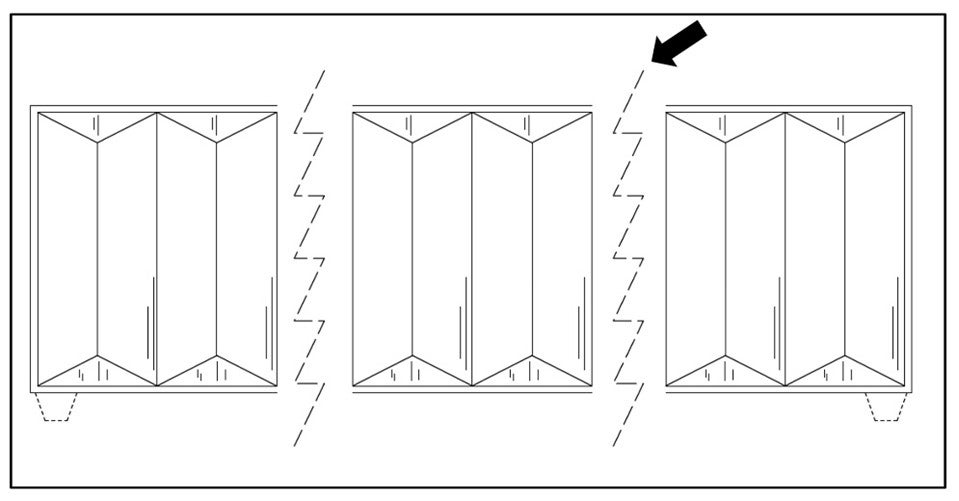
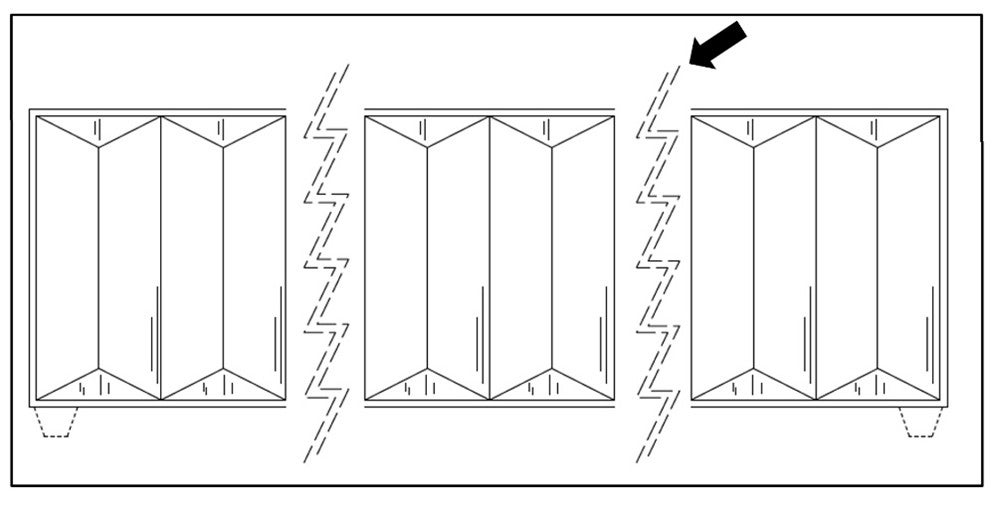
See July 21, 2025 Ex Parte Quayle Action in U.S. Application No. 29/900,572
- Second, with respect to differentiating between dashed lines versus break lines, consider differentiating between the two types by including language in the specification, such as:
- The small, evenly spaced dashed lines form no part of the claimed design. The drawings contain a symbolic break indicated by longer double break lines. The portion between each set of longer doublebreak lines forms no part of the claimed design.
Conclusion
As the current increase in design patent litigation may continue to rise, practitioners must adapt their strategies to ensure robust protection and successful prosecution. By focusing on comprehensive drawings and clear specifications, they can navigate the complexities of design patents and safeguard their clients’ innovations in an increasingly competitive landscape.
In Focus Products Group International, LLC v. Kartri Sales Co., Inc., No. 2023-1446 (Fed. Cir. Sept. 30, 2025), the Federal Circuit reversed patent infringement findings, holding that a patentee’s failure to contest an examiner’s restriction requirement can create an affirmative disclaimer of unelected subject matter, even for a claim that otherwise broadly covers the unelected subject matter. This decision demonstrates how restriction practice can be used to limit a broadly drafted claim and highlights the importance of challenging examiner-imposed claim restrictions.
Background
This case involved three related utility patents: U.S. Patent Nos. 6,494,248 (‘248 patent), 7,296,609 (‘609 patent) and 8,235,088 (‘088 patent), which are owned by Focus Products Group International, LLC (Focus) and its predecessors.[1] The patents cover “hookless” shower curtains, which do not require a hook to attach to a shower rod, but instead attach to the rod though a series of reinforced ring openings that are embedded within the curtain’s top end.
During prosecution of the ‘248 patent, the patent examiner issued a restriction requirement identifying multiple patentably distinct species of shower ring openings and required election of one species for prosecution on the merits. Although the examiner did not describe what was distinct about each species, the examiner characterized the different groups by reference to the application figures, with different claimed species being drawn to different sets of figures. One species of rings was characterized by reference to figures 18-20, which depict rings as having a “finger configuration” and/or an “offset slit.” Another species was characterized by reference to figure 21, depicting rings having a “flat upper edge.”
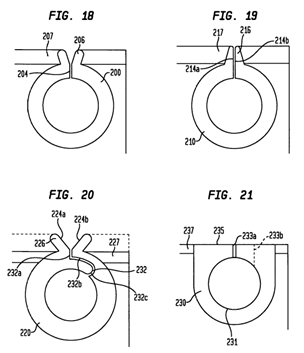
‘248 patent, Figures 18-21
Patentee responded to the restriction requirement by electing the species of rings based on figures 18-20, having the finger configurations and/or offset slit. The election was made “without traverse,” and no statements objecting to the examiner’s characterization of the claims were included in patentee’s response. Instead, patentee canceled the claims that were pending and added new claims that patentee affirmed were all “directed to the elected inventions only.” However, among the newly added claims was dependent claim 73 that recited a ring having “a flat upper edge.”
The examiner reviewed the newly added claims and issued a non-final office action in which claim 73, among other claims, was identified as being improperly “drawn to a nonelected species” and was withdrawn. Notably, however, the examiner did not find independent claim 61, which claim 73 depended on, to be drawn to unelected subject matter, even though claim 73 was broadly encompassed by claim 61 and only differed from claim 61 by expressly reciting “a flat upper edge along at least a portion of said ring.” In its response to the non-final office action, the patentee did not clarify the scope of claim 61, e.g., by identifying it as a generic claim that reads upon multiple embodiments illustrated in the application figures, including embodiments having a flat upper edge, nor did it otherwise contest the examiner’s characterization and withdrawal of claims.
Finally, in the notice of allowance, the examiner canceled claim 73 as being “drawn to a non-elected species without traverse.” The examiner invited the patentee to contest the cancellation should patentee find it “unacceptable.” Patentee did not object. The ‘248 patent issued with no claims reciting a flat upper edge.
During prosecution of the ’609 patent, patentee also elected the species based on figures 18-20 without objecting to how the examiner characterized the species. Like the ’248 patent, the ’609 patent issued with no claims reciting a flat upper edge.
The ’088 patent relates to shower curtain rings having a “projection edge” that projects from the ring’s outer circumference. Figure 31B illustrates an embodiment of the ‘088 patent:
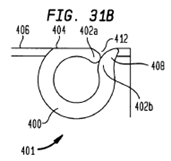
‘088 patent, Figure 31B
During prosecution, the examiner rejected all the ‘088 claims “on the ground of nonstatutory obvious-type double patenting” in view of the claims of the ‘248 and ‘609 patents. In response, patentee amended the ‘088 claims to distinguish them from the other patents by reciting that the ring includes, among other things, “a flat upper edge.” The examiner then withdrew the double patenting rejection, stating: “as the claims have been amended to incorporate the limitation of the flat upper edge which is drawn to a species which is not encompassed with the species as set forth in the applicant’s prior patents[,] the double patenting rejection is no longer applicable.” Patentee did not object to the examiner’s characterization and the ’088 patent issued with claims requiring a flat upper edge.
Focus sued Kartri Sales Co., Inc. and Marquis Mills, International, Inc. (collectively, Kartri), in district court for patent infringement of the ‘248, ‘609, and ‘088 patents based on Kartri’s “Ezy-Hang” shower curtains that contain rings having a flat upper edge.

Kartri’s Ezy-Hang Product[2]
The district court granted summary judgement in favor of Focus on the patent infringement claims based on the court’s claim constructions.[3],[4]
The Federal Circuit’s Decision
In reversing the district court’s patent infringement findings with respect to the ‘248 and ‘609 patents, the Federal Circuit determined that although the relevant claims were drafted broadly, without placing any restrictions on whether the rings have a flat upper edge or not, that patentee had “clearly disavowed” such feature during prosecution of its patents. Specifically, “by cooperating with the examiner’s repeated demand to exclude rings with a flat upper edge from the ‘248 and ‘609 patents, in keeping with the initial restriction requirement, the patent owner made it clear that it accepted the narrowed claim scope for these patents.” The court further interpreted the prosecution history of the ‘088 patent where patentee adopted the examiner’s characterization to overcome a double patenting rejection, as confirming patentee’s acceptance of the narrowed claim scope of the ‘248 and ‘609 patents, by showing that patentee understood the prior patents did not encompass a ring having a flat upper edge. Collectively, patentee’s actions were determined to be a “clear and unmistakable” disavowal of rings having a flat upper edge.
The Federal Circuit distinguished the outcome in this case from its decision in Plantronics, Inc. v. Aliph, Inc., 724 F.3d 1343 (Fed. Cir. 2013), where a patentee’s election without traverse in response to an examiner’s restriction requirement did not create a disclaimer of unelected subject matter. In Plantronics, the court found the examiner’s restriction to be “ambiguous” because neither the examiner nor patentee made “any particular remarks regarding the differences (e.g., in structure) of what the [examiner] found to be different inventions,” and although the patentee did not traverse the examiner’s restriction requirement, it did challenge the examiner’s comments on a broad claim by identifying the claim as a generic claim that read on “all the embodiments illustrated in the application.” This is in contrast to the findings in Focus, where the Federal Circuit determined there were “multiple instances” of the examiner expressly identifying the flat upper edge as a structural feature that is excluded from the claims and the patentee accepting the examiner’s characterization.
Key Takeaways
- Patent prosecutors should be strategic in how they respond to restriction requirements to avoid disclaiming claim scope that is otherwise encompassed by broadly drafted claims. Although silence in the face of an examiner’s claim interpretation is usually not enough to result in a disclaimer, Focus illustrates that challenging an examiner’s claim restrictions can be important. Had the patentee in Focus made it clear during prosecution that its species election and amendments were solely to expedite prosecution, and that they disagreed with the examiner’s claim interpretations, and/or if the patentee in Focus had identified independent claim 61 of the ‘248 patent as a generic claim that covers more than one species of invention, the outcome of this case may have been different.
- Because it is the exchange between the examiner and the patent prosecutor that can be determinative of whether claim scope has been disclaimed, applicants should not assume that disclaimer will not apply simply because the restriction requirement itself is “ambiguous” or fails to define different inventions based on their structure.
- Focus provides increased opportunities for defendants to credibly raise prosecution history disclaimer based on an examiner’s restriction requirement as a defense to claims of patent infringement. To do so effectively requires a detailed analysis of the prosecution history of the asserted patents and their family members and identification of potentially relevant statements made by the examiner and patentee and/or claim amendments that are suggestive of patentee’s acceptance of examiner-imposed restrictions to the claims.
[1] The ‘609 and ‘088 patents are continuations of the ‘248 patent and all three patents have the same written description and drawings.
[2] Image sourced from: Focus Prods. Grp. Int’l, LLC v. Kartri Sales Co., Inc., 454 F. Supp. 3d 229, 242 (S.D.N.Y. 2020), aff’d in part, vacated in part, remanded, No. 2023-1446, 2025 WL 2774853 (Fed. Cir. Sept. 30, 2025).
[3] The district court’s infringement finding with respect to the ‘248 patent was based its determination that the accused shower curtain ring comprises an “approximately horizontal component when [the shower curtain] is hanging from the [curtain] rod.”
[4] The district court’s infringement finding with respect to the ‘609 and ‘088 patents was primarily based on its determination that the accused shower curtain ring comprises a “projecting edge.”
Among the cases the U.S. Supreme Court is set to will review in its Fall term are several appeals concerning copyright and trademark law. One notable case seeks to address procedural inconsistencies and claims of unconstitutional vagueness attributed to the U.S. Court of Appeals for the Federal Circuit.
Click here to read the full article in Law.com and The Intellectual Property Strategist.
This article was originally published on Law360 and is republished here with permission as it originally appeared on October 23, 2025.
On Sept. 30, the California Privacy Protection Agency announced its latest enforcement for alleged violations of the California Consumer Privacy Act — In the Matter of Tractor Supply Company.
This action targeted the nationwide retailer, Tractor Supply, resulting in a $1.35 million fine and a mandate to further cultivate certain parts of its privacy compliance program.
Regulatory decisions like this can offer valuable lessons, especially in the field of privacy. This case provides businesses with critical insights into what they can anticipate from an enforcement perspective in the coming months, including factors that might render a company a prime target.
It also emphasizes the compliance areas that remain a priority for the California regulator, offering businesses key issues to monitor when evaluating their own programs and suggesting avenues for improvement.
Such decisions, often an underutilized source of guidance, help navigate a legal landscape that frequently appears to be in flux. So, what does the Tractor Supplier action imply?
1. Retailers and businesses with significant consumer interactions remain in the spotlight.
Since the CCPA took effect in 2018, the California attorney general and the CPPA have initiated nearly a dozen enforcement actions.
They have predominantly targeted retailers, data brokers, and other businesses characterized by high consumer interaction and data processing, such as hospitality, travel, food delivery platforms and vehicle manufacturers.
As businesses develop their compliance programs, they should assess how they interact with consumers, including the volume and sensitivity of the consumer data they process. Companies with significant consumer engagement, like retailers, are likely to remain under scrutiny. If the business operates in other high-touch consumer sectors, such as hospitality or travel, the risk profile is similarly elevated.
With this in mind, remember that when crafting disclosures and implementing your compliance program, your audience isn’t just consumers — it is likely inquisitive regulators as well.
Businesses should consider how their privacy practices will look to regulators from the outside, what they want regulators to understand about their compliance efforts, and whether these issues can be effectively addressed through their disclosures. For instance, does the business primarily handle publicly available data? Do its opt-out mechanisms cover all types of selling or sharing, or do consumers need to take additional steps?
Recognizing that regulators are likely to scrutinize these disclosures and related workflows, businesses should anticipate the questions regulators might have and take proactive steps to address them.
2. The role of the 30-day cure period continues to diminish.
The financial penalty in this case underscores the fact that the 30-day cure period, initially available when the law was first enacted, is no longer a guaranteed right for businesses.
The CPPA acknowledged and credited Tractor Supply for its remediation efforts, noting that since becoming aware of the investigation in 2024, the company had significantly revised its practices, addressed numerous issues, and allocated substantial financial resources to rectify the shortcomings identified in the final order.
Despite these efforts, Tractor Supply was fined $1.35 million.
Previously, when the cure provision was in effect, Tractor Supply might have avoided a fine altogether. Five years later, however, businesses should not expect the cure period to be their saving grace. Instead, they should proactively consider their compliance strategies and be ready to present a convincing narrative that demonstrates their good faith efforts to comply with the law.
3. Consumer complaints help regulators identify potential targets.
Businesses should be aware that both the California attorney general and the CPPA have mechanisms in place for consumers to file complaints if they believe their privacy rights have been violated.
These complaints can be submitted through dedicated portals provided by the CPPA and the attorney general, which request detailed information about the complaint, the rights allegedly violated, supporting materials (such as screenshots of emails or interactions), and whether the consumer has already contacted the business.
Often, consumers will first reach out directly to businesses to resolve their concerns. This initial contact is a critical opportunity for businesses to de-escalate the situation before it potentially escalates. Tractor Supply, for example, became the focus of regulatory attention due to a consumer complaint submitted through these channels.
When responding to consumer complaints, it is important to implement strategies that attempt to effectively calm and resolve issues internally. This involves clear communication, understanding the consumer’s perspective, and offering sometimes creative solutions.
Remember that when interacting with consumers, your audience includes regulators, as your communications may be forwarded to them. Consider what language you would want included if a regulator were to review it later and draft it to clearly convey a narrative of robust compliance and a commitment to prioritizing consumer interests.
4. Tracking technologies remain a priority item for enforcement.
Many enforcement actions under the CCPA have centered around online tracking technologies, and the Tractor Supply case is no exception.
In the stipulated final order, the CPPA identified five violations, two of which involved the use of tracking technologies. The first of these related to effectuating opt-out requests. More specifically, the stipulated order indicated that the retailer’s website employed cookies and tracking technologies that were deemed sales and shares of personal information under the CCPA.
Although the website featured a “Do Not Sell My Personal Information” link directing users to a webform to opt out, the process was allegedly flawed. Consumers who completed the webform were not successfully opted out. The webform also allegedly failed to inform consumers where or how they could opt out of Tractor Supply’s selling or sharing of personal information through tracking technologies.
The second issue identified related to opt-out preference signals. The order noted that the retailer did not configure its website to honor consumers’ requests to opt out of sharing or sale using an opt-out preference signal until July 2024. The retailer’s privacy policy also allegedly lacked clarity on how such opt-out signals would be handled.
Businesses should view the Tractor Supply decision as an opportunity to assess their compliance with the CCPA’s right-to-opt-out provision.
Businesses that sell or share personal information and are regulated by the CCPA generally must implement at least two opt-out mechanisms. These mechanisms should effectively address the specific type of selling the business engages in. For example, if personal information is shared through cookies, businesses should evaluate whether a webform allowing consumers to opt out of sharing will genuinely affect the disclosure made through their tracking technologies.
Businesses collecting personal information online that sell or share such information are also generally required to configure their websites to honor consumers’ requests to opt out of sharing or selling using an opt-out preference signal. While this requirement does not apply to all businesses — depending on specific selling or sharing practices — it is prudent to reassess whether this should be part of a business’s compliance program.
5. Regulators are expanding focus beyond service provider contracts.
Initially, when the CCPA was enacted, businesses concentrated on updating vendor contracts to implement service provider terms.
However, the Tractor Supply settlement underscores the importance of extending this focus to include third parties, such as advertising technology partners, with whom personal information may be sold or shared.
The CPPA made a point to highlight that contracts with both service providers and third parties must:
- Specify the limited and defined purposes for processing or disclosing consumers’ personal information;
- Ensure that consumers’ personal information is used solely for those specified purposes; and
- Require the contracting party to comply with the CCPA, thereby providing the same level of privacy protection required of regulated businesses under the CCPA.
In practice, many terms governing advertising technology partners may seem nonnegotiable, as businesses often lack negotiating power. Nevertheless, it is important to inventory the applicable terms and assess their alignment with CCPA requirements.
Some advertising partners may offer specific terms only upon request. Consider conducting an inventory of your tracking technologies, identifying the governing terms, and reviewing them to pinpoint potential gaps.
6. California continues to plow forward with regulating employee data.
California distinguishes itself as the sole state to incorporate employee-related data within the scope of its privacy law. Despite this unique position, the settlement with Tractor Supply highlights California’s commitment to uphold this aspect of the CCPA, even as other states have yet to follow suit.
For businesses with a substantial presence in California and a large workforce in the state, this could result in heightened scrutiny.
It is worth noting that California also regulates certain personal information collected in the business-to-business context, a domain other states have not ventured into. While B2B data typically consists of less sensitive information, such as basic contact details, the recent focus on employee data suggests that B2B data may soon receive similar attention.
7. Businesses need to recognize and remediate the low-hanging fruit.
The CCPA has been in effect for five years. Businesses that are perceived as meeting the CCPA’s applicability thresholds but have not taken steps to comply should anticipate attracting regulatory attention.
While compliance can be complex and sometimes seem like a moving target, demonstrating a good faith effort to adhere to the law is essential. If a business has not updated its privacy compliance program since before the CCPA’s implementation, it will face difficulties justifying its compliance strategy when regulators inquire.
As California continues to lead in enforcing its state privacy law, other states like Oregon are ramping up their efforts, conducting sweeps and inquiries to assess compliance and identify areas where businesses may fall short. In this collaborative regulatory environment, it is important to remember that state privacy regulators communicate regularly.
Thus, even if you are dealing with one state regulator, it is quite possible that others may be quietly observing. Leveraging any inquiry you receive to demonstrate your commitment to adhering to all applicable privacy laws can not only address the specific state’s concerns but also enhance the business’s reputation among regulators in other jurisdictions.
On October 20, 2025, the Treasury Department issued proposed regulations (the “2025 Proposed Regulations”) that would remove a controversial rule for determining whether a REIT is “domestically controlled.” The 2025 Proposed Regulations are a welcome change and generally would allow taxpayers greater flexibility in planning for domestically controlled REITs.
By way of background, under the Foreign Investment in Real Property Tax Act of 1980 (FIRPTA), gain on the disposition of a U.S. real property interest (USRPI) by a foreign person is subject to U.S. tax. USRPIs include shares in a U.S. real property holding corporation (USRPHC) – generally stock of a corporation holding significant USRPIs.[1] However, a key exception exists for equity interests in a “domestically controlled REIT” under Section 897(h)(2) of the U.S. Internal Revenue Code of 1986, as amended (the “Code”). Such interests are not USRPIs and therefore the sale of such interests by a foreign person is not subject to U.S. income or withholding tax under FIRPTA. A REIT is considered domestically controlled if less than 50% of its stock is held “directly or indirectly” by foreign persons at all times during a certain testing period. This FIRPTA exclusion for domestically controlled REITs is one of the primary benefits of using REITs in real estate fund structures and joint ventures where there are foreign investors.
The historical context leading up to the 2025 Proposed Regulations involves the issuance of proposed regulations in 2022 (“2022 Proposed Regulations”), which were finalized in 2024.
- Prior to the issuance of the 2022 Proposed Regulations, tax regulations did not address whether to look through certain owners in determining whether a REIT was “directly or indirectly” held by foreign persons. Based on a private letter ruling and legislative history, it was not uncommon for taxpayers to plan based on the assumption that a U.S. C corporation shareholder of a REIT would not be looked-through to determine whether the REIT was domestically controlled.
- The 2022 Proposed Regulations would have required a REIT to look through any nonpublic domestic corporate shareholder to determine whether it is domestically controlled. Specifically, under the 2022 Proposed Regulations, a domestic C corporation shareholder would be looked-through if more than 25% of that shareholder’s stock (by value) was owned by foreign persons – the so-called “look-through rule.” Given that many real estate funds and JVs with private REITs, in reliance on the IRS’s prior long-standing position, used domestic corporate blockers for tax planning purposes, this change was surprising and concerning. Commentators heavily criticized these regulations as being unmanageable and inconsistent with the statute and legislative intent and urged the IRS to withdraw the rules. The IRS declined to do so at that time.
- The IRS issued final regulations in 2024 (“2024 Final Regulations”) that generally retain the rules of the 2022 Proposed Regulations, but increase the foreign ownership threshold from 25% to 50%. Thus, under the 2024 Final Regulations, a U.S. C corporation owner of a REIT would be looked-through for purposes of determining the domestically controlled status of the REIT if more than 50% of the value of the domestic C corporation is owned by foreign persons. As a practical matter, most taxpayers did not view the threshold increase from 25% to 50% as helpful, because many domestic corporations that met the 25% threshold under the 2022 Proposed Regulations also would meet the 50% threshold under the 2024 Final Regulations. Commentators also criticized the 2024 Final Regulations based on the practical difficulty of tracing ownership, the related administrative burdens and a possible chilling effect on investment in U.S. real estate.
The 2025 Proposed Regulations would remove the look-through rule for domestic C corporation shareholders of a REIT. Thus, under the 2025 Proposed Regulations, it will no longer be necessary to look through a domestic corporation to determine whether its owners are foreign for purposes of determining whether a REIT is domestically controlled. The 2025 Proposed Regulations would remove the look-through rule only for domestic C corporation shareholders of a REIT. Equity holders of REITs that are taxed as partnerships, REITs, or RICs would remain subject to the look-through rule.
The 2025 Proposed Regulations will be effective after being published in final form. Taxpayers may, however, rely on the 2025 Proposed Regulations before they are finalized. Once published in final form, taxpayers may choose to apply them to transactions occurring on or after April 25, 2024 (the date of the publication of the 2024 Final Regulations).
The 2025 Proposed Regulations are a welcome development. If finalized in their current form, they will provide taxpayers greater flexibility to plan for investment in domestically-controlled REITs.
[1] A corporation is a USRPHC if the fair market value of its USRPIs is at least 50% of the sum of the fair market values of (1) its total USRPIs, (2) its total interests in real property outside the U.S., and any other assets used in a trade or business.
As we inch closer to All Hallows’ Eve, we wanted to remind those navigating the digital landscape to remain vigilant against the undead threat of “zombie content.” No, this isn’t a horror movie plot — it’s the phenomenon where outdated, irrelevant, or low market value information rises from the depths of the internet to haunt your business.
What Is Zombie Content?
In the world of intellectual property, zombie content can refer to copyrighted material that was previously in the public domain but has had its copyright protections restored. It can also include a once-abandoned trademark that has been revived through new and updated use.
But zombie content can also refer to outdated articles, advertising, blog posts, or social media updates that refuse to rest in peace. These digital frights might include advertising copy or images that were once relevant to your business or a promotional campaign. As the market and your marketing efforts move forward, the value of this content fades. Yet, it still lingers in search engine results, waiting to confuse visitors with outdated data or obsolete insights. Worse yet, it can damage your company’s credibility or even lead to compliance issues.
Zombie Content Survival Tips:
- Conduct Regular Content Audits: Just like checking under the bed for monsters, regularly review your content to ensure it’s fresh, accurate, and relevant. Make sure your licenses for stock photos, GIFs, and video/audio clips are up to date and grant your company the appropriate permissions to use this content. Ensure your key trademarks are properly registered and maintained and decide whether your own copyrighted materials are worth registering.
- Update or Banish: If you find zombie content, decide whether it can be revived with updates or if it needs to be laid to rest permanently. Online content may inadvertently include unlicensed or improperly licensed photos or music clips that may lead to an unforeseen infringement claim. Outdated content or cultural references may no longer sit well with your customers or even be considered a statement against interest.
- Monitor SEO: Keep an eye on search engine rankings to ensure your content isn’t being overshadowed by its undead counterparts.
- Engage with Your Audience: Encourage feedback and questions to identify any lurking zombie content that might be causing confusion.
- Stay Informed: Keep abreast of industry changes and cultural shifts to ensure your content remains alive and kicking.
Remember, while zombies might make for great Halloween costumes, they have no place in your content strategy. If you need assistance in identifying and fighting the undead, reach out to Troutman Pepper Locke.
Stay safe this spooky season!
State attorneys general increasingly impact businesses in all industries. Our nationally recognized state AG team has been trusted by clients for more than 20 years to navigate their most complicated state AG investigations and enforcement actions.
State Attorneys General Monitor analyzes regulatory actions by state AGs and other state administrative agencies throughout the nation. Contributors to this newsletter and related blog include attorneys experienced in regulatory enforcement, litigation, and compliance. Also visit our State Attorneys General Monitor microsite.
Contact our State AG Team at StateAG@troutman.com.
Troutman Pepper Locke Spotlight
Compliance and Enforcement in Consumer Financial Services: Navigating the Changing Landscape of Federal and State Oversight
By Troutman Pepper Locke State Attorneys General Team
Wednesday, October 29 | 1:00 – 3:10 p.m. ET
Mike Yaghi and Lane Page, members of Troutman Pepper Locke’s State Attorneys General practice, along with Stefanie Jackman and Caleb Rosenberg from the Consumer Financial Services practice, will participate in an upcoming CLE webinar with myLawCLE. They will analyze the evolving roles and enforcement priorities of federal and state regulatory agencies, focusing on their impact on consumer financial services.
Multistate AG News
28 State AGs Defend State ENDS Directory Laws in Amicus Brief to Fourth Circuit
By Troutman Pepper Locke State Attorneys General Team, Bryan Haynes, and Michael Jordan
On September 22, a group of 28 state AGs led by Iowa filed an amicus brief in Vapor Technology Association v. Wooten in support of North Carolina’s state directory law that prohibits the sale of electronic nicotine delivery system (ENDS) products or e-cigarettes that lack Food and Drug Administration (FDA) marketing authorization. According to the brief, 15 states have already enacted laws similar to North Carolina’s ENDS directory law, and another 25 states are considering such legislation.
Single State AG News
Illinois Department of Insurance Initiates Litigation Against State’s Largest Insurer Over Failure to Produce Document
By Troutman Pepper Locke State Attorneys General Team and Mary Grace Metcalfe
On October 10, 2025, Illinois Attorney General (AG) Kwame Raoul filed a lawsuit on behalf of Ann Gillespie, director of the Illinois Department of Insurance (the Department), against four different entities, all within the State Farm corporate umbrella. This lawsuit arises from State Farm’s alleged refusal to comply with financial examination warrants issued by Director Gillespie, which aim to force State Farm to disclose information about the policies it writes and the premiums it charges. As insurance regulation is a creature of state law, the Department’s director oversees the enforcement and execution of all insurance laws in Illinois. Further, AG Raoul has authority to bring lawsuits on behalf of other Illinois state agencies.
Minnesota AG Ellison Reaches $800,000 Settlement With Shipt on Worker Classification
By Troutman Pepper Locke State Attorneys General Team
On September 26, 2025, Minnesota Attorney General (AG) Keith Ellison announced a $800,000 settlement with Shipt, Inc. (Shipt). The settlement resolves allegations that the company was misclassifying its workers (referred to as “Shoppers”) as independent contractors instead of employees.
California Charts the Frontier With First Law Setting Reporting And Compliance Requirements For Powerful “Frontier AI Models”
By Troutman Pepper Locke State Attorneys General Team
On September 29, 2025, California Governor Gavin Newsom signed Senate Bill 53, the Transparency in Frontier Artificial Intelligence Act, into law. The bill will go into effect on January 1, 2026. The act builds upon the recommendations found in the “California Report on Frontier AI Policy,” which was released to the public on June 17, 2025. This report detailed key principles to guide the legislation drafting process, including grounding AI policy in empirical research and providing greater transparency into AI systems. Given that California is home to 32 of the top 50 AI companies worldwide, the state dominates the AI industry. It is no surprise that California is the first state to create rules promoting safety, transparency, and incident reporting for frontier models. This new act is expected to set the stage for similar AI legislation across the U.S.
AG of the Week
J.B. McCuskey, West Virginia
J.B. McCuskey was elected as West Virginia’s attorney general (AG) in November 2024 and took office in January 2025. He earned his undergraduate degree in political communication from The George Washington University and a law degree from West Virginia University College of Law. Early in his career, McCuskey worked as a civilian in the general counsel offices of the Army and Department of Defense at the Pentagon.
McCuskey began his public service in the West Virginia House of Delegates, serving from 2013 to 2017, where he supported policies related to fiscal responsibility, job creation, and energy. He was elected West Virginia state auditor in 2016 and served two terms. As auditor, McCuskey implemented systems for public access to real-time government spending data and developed a platform to track government expenditures, fraud, and abuse. He also streamlined the property tax process and advocated for updates to longstanding tax laws.
Upcoming AG Events
-
November: DAGA | Scottsdale Policy Conference | Scottsdale, AZ
-
November: AGA | International Delegation
-
December: DAGA | Holiday Party | Washington, D.C.
For more on upcoming AG Events, click here.
Troutman Pepper Locke’s State Attorneys General team combines legal acumen and government experience to develop comprehensive, thoughtful strategies for clients. Our attorneys handle individual and multistate AG investigations, proactive counseling and litigation, and manage ancillary regulatory issues. Our successful approach has been recognized by Chambers USA, which ranked our practice as a leader in the industry.
The U.S. government’s Intellectual Property Rights Center (IPRC) continues to strengthen its operations in the global fight against counterfeiting and digital piracy through two cornerstone initiatives: Operation Apothecary and Operation In Our Sites (OIOS).
Click here to read the full article in International Trademark Association.