


Confirming the bedrock principle that the antitrust laws are designed to protect competition and not individual competitors, a federal court put an end to a legal turf war over the cardiology market in Laredo, TX on January 28.[1] The summary judgment decision made clear that even where there is evidence of coordinated behavior that caused economic injury, plaintiffs cannot get to trial without sufficient evidence that the behavior also caused antitrust injury.
The plaintiffs in the suit, Doctors Hospital of Laredo (DHL) and its physicians’ group, alleged that Dr. Ricardo Cigarroa and his cardiovascular clinic (Cigarroa defendants), along with the Laredo Medical Center (LMC), engaged in coordinated behavior to corner the plaintiffs out of market for cardiology services. According to the complaint, the plaintiffs and defendants were the sole players in Laredo’s cardiology game. A city Laredo’s size, the plaintiffs claimed, should have at least 20 cardiologists in a competitive market, but there were only eight practicing cardiologists at the time the litigation commenced. The plaintiffs alleged that DHL began recruiting new cardiologists in August 2020, which Cigarroa viewed as “a threat to his dominant market position.”[2]
Asserting claims under Sections 1 and 2 of the Sherman Act and Texas state law, the plaintiffs alleged that the Cigarroa defendants and LMC proceeded to engage in a wide variety of anticompetitive conduct designed to thwart DHL’s ability to expand cardiology services in Laredo. Specifically, the plaintiffs claimed that Cigarroa and his colleagues threatened prospective cardiologists recruited by DHL; collectively stopped responding to emergency calls at DHL or referring patients there; induced Laredo’s only cardiovascular surgeon to leave DHL for LMC in violation of a noncompete contractual provision; and recruited DHL cardiothoracic surgery technicians to quit their jobs in favor of positions at LMC.
The court agreed that the defendants’ actions demonstrated a concerted effort to draw business away from DHL. However, it declined to find those efforts violated any law. The court explained that “[w]hile the evidence shows that defendants sought to increase their market share at the expense of DHL — indeed run them out of business — this is mere competitive intent, which does not turn a refusal to deal into an anticompetitive act.” Notably, the court found that the plaintiffs did suffer an economic injury-in-fact due to the defendants’ actions, but noted that the crux of the dispute was whether plaintiffs suffered an antitrust injury. The court explained that there may have been economic harm to a competitor, but there was no harm to competition itself.
As in several similar cases, the plaintiffs here failed to convince the court that any alleged economic damage their competitor did to their business rose to the level of having an anticompetitive effect in the market. The plaintiffs were unable to show that defendants cut off their access to any supplies or facilities necessary to compete in the Laredo cardiology services market. To the contrary, DHL hired two additional cardiologists and found temporary physicians to cover shifts after the plaintiffs’ alleged campaign against it began. There was also no evidence that patients in Laredo, the consumers in the market for cardiology services, suffered harm or saw increased costs for medical care as a result of defendants’ conduct. Consequently, the court found that that no reasonable jury could decide that defendants’ behavior was unlawfully anticompetitive: “On this record, this theory is consistent with harm to a competitor, not to competition or to any consumers in the relevant market.”
This is the latest decision to demonstrate that the line between procompetitive and anticompetitive behavior can be quite thin in health care markets. Hospital systems and physician practices must keep in mind the competitive impact of their business practices, including how they may affect competitors’ market access as well as consumer prices and choice.
[1] Drs. Hosp. of Laredo v. Cigarroa, No. SA-21-CV-01068-XR, 2025 U.S. Dist. LEXIS 14899, at *1 (W.D. Tex. Jan. 28, 2025).
[2] Plaintiffs’ First Amended Compl. at 1-2, Drs. Hosp of Laredo v. Cigarroa, No. SA-21-CV-01068-XR, 2025 U.S. Dist. LEXIS 14899 (W.D. Tex. Jan. 28, 2025).
The 2025 SCOPE Conference (Summit for Clinical Ops Executives), held last week in Orlando, FL, brought together more than 4,500 industry leaders, innovators, and experts in the clinical operations field. With an agenda covering a wide array of topics, including clinical trial planning and management, patient recruitment and retention, data management, and regulatory compliance, the conference highlighted the industry’s collective focus on improving patient outcomes by leveraging cutting-edge technology. While these new technologies will undoubtably shape the sector, they will also have ever-evolving legal ramifications — meaning industry participants must also prioritize legal compliance and risk mitigation strategies.
AI Integration Into Clinical Trials. Predictably, the dominant theme from the conference was the integration of artificial intelligence (AI) into various aspects of the clinical trial life cycle. While most attendees and presenters could agree on the immediate use of AI as an efficiency tool for formerly tedious jobs such as data analysis and aggregation, there were a few mold-breaking use cases on display. Among these breakthrough generative AI use cases were companies developing tools targeted at materials generation, trial design and optimization, patient selection and site engagement, and pre-clinical trial analyses.
EHR to EDC Integration. Another focus of the conference was the unification of the industry through improved integration of electronic health records (EHR) and electronic data capture (EDC) systems. Integration efforts aim to streamline data flow, reduce redundancies, and enhance the accuracy and efficiency of clinical trials. The integration of EHR to EDC was emphasized as a critical step toward creating a more cohesive and efficient clinical trial ecosystem.
Wearable Technology and Patient Platforms. Lastly, there was a strong emphasis on wearable technology and providing patients with easier clinical trial engagement, in order to obtain more detailed patient data (to subsequently feed into AI analysis tools) and achieving better retention outcomes. The post-COVID “work-from-home mindset” was identified as a critical factor in providing patients with more flexible tools to engage in clinical trials.
Our Legal Takeaways. As organizations continue to integrate AI and other new technologies into their daily operations, there will continue to be new legal developments to consider. Here’s what we recommend:
- Stay Informed on Regulatory Changes. As AI use cases and capabilities continue to evolve, legislation is continually shifting in response. State laws can vary across jurisdictions and governmental agencies are regularly issuing new guidance and policies with respect to AI use. Organizations should be prepared to and expect to regularly pivot their operations and procedures as new laws and guidance are enforced.
- Implement and Monitor Data Privacy and Security Measures. With the rise of new technologies, data privacy and security are more important than ever. In addition to conducting regular audits, policies and procedures should be regularly updated for compliance with current laws and regulations, such as the significant proposed amendments to the Security Rule under HIPAA that were recently published by the Department of Health and Human Services (HHS) Office for Civil Rights (OCR).
- Develop and Follow Responsible AI Guidelines. Responsible AI use should become a central focus of an organization’s operations, and operational guidelines should be regularly updated to align with emerging best practices and ethical standards. This includes measures that account for AI’s accuracy limitations and potential bias that can create significant risk exposure for an organization.
The increased automation that will come from new technologies will allow the industry to break down old processes and move more efficiently through the clinical trial process and identify positive outcomes that previously could have flown under the radar. This inevitably means more therapies, devices, and tools to help ease patient suffering. However, this rapid advancement also necessitates organizations to take a vigilant approach to their legal compliance and risk mitigation strategies.
Despite the many technological advances in the collection, processing, and review of electronically stored information, it remains vital to conduct custodial interviews focused on data identification to confer a litigation advantage, reduce downstream costs, minimize disputes, and mitigate discovery risk. Undue reliance on back-end keyword searching or custodial self-collections can yield results that are both over- and under-inclusive, increasing the volume of irrelevant data swept into review workflows while missing key information. Otherwise avoidable discovery disputes may then ensue. By contrast, a purposeful collection approach — combining custodian interviews with supervised collections — yields superior results. eMerge offers custom collection solutions incorporating custodial interviews into remote, supervised collections for this very reason.
What Is Self-Collection?
“Self-collection” in eDiscovery generally refers to a custodian self-identifying and collecting relevant documents at the request of counsel. Although the defensibility of this practice varies based on the nature of the matter, the role of the custodian, and the level of supervision and guidance provided by counsel, it is generally disfavored. See In re Soc. Media Adolescent Addiction/Pers. Inj. Prods. Liab. Litig., No. 22-MD-03047-YGR (PHK), 2024 WL 4125618, at *14 (N.D. Cal. Sept. 6, 2024) (an attorney cannot abandon his professional and ethical duties imposed by the applicable rules and case law and permit an interested party or person to ‘self-collect’ discovery without any attorney advice, supervision, or knowledge of the process utilized.); see also DR Distributors, LLC v. 21 Century Smoking, Inc., 513 F. Supp. 3d 839, 935 (N.D. Ill. 2021) (observing that “without proper guidance and oversight from counsel, custodian self-collection can be a risky move” after tens of thousands of documents were not timely produced). Self-collections introduce heightened risk that relevant information is omitted and make it challenging for counsel to confirm the completeness of the collection or accurately represent the criteria used to identify relevant information.
In a worst-case scenario, self-collections enable unscrupulous custodians to intentionally withhold relevant information without counsel’s knowledge and can lead to mandatory sanctions on counsel for violations of Fed. R. Civ. P. 26(g). See Rojas v. Town of Cicero, 775 F.3d 906, 909 (7th Cir. 2015) (If an attorney or party violates Rule 26(g), sanctions are mandatory… Rule 26(g)(3) gives the judge discretion over the nature of the sanction but not whether to impose one); HM Elecs., Inc. v. R.F. Techs., Inc., No. 12CV2884-BAS-MDD, 2015 WL 4714908, at *13, 15 (S.D. Cal. Aug. 7, 2015), vacated in part as moot, 171 F. Supp. 3d 1020 (S.D. Cal. 2016) (deeming unreasonable outside counsel’s acceptance of defendant’s erroneous representations that no responsive documents existed “without asking other employees or collecting or sampling documents); see also Collins-Williams v. Contour Eastwyck LLC, No. 1:20-CV-3129-CAP, 2022 WL 17828934, at *92 (N.D. Ga. Dec. 15, 2022) (finding that acceptance at face value of what client provided in response to discovery insufficient under Rule 26(g)). For all of these reasons, some jurisdictions, such as Delaware Chancery Court, categorically forbid the practice. See Goldstein v. Denner, C.A. No. 2020-1061-JTL, 2024 WL 303638 (Del. Ch. Jan. 26, 2024) ([a]n attorney may not simply rely on custodian self-collection of ESI” and instead “must test the accuracy of the client’s response to document requests to ensure that all appropriate sources of data have been searched and that responsive ESI has been collected — and eventually reviewed and produced).
Because of these risks and the improved availability and capabilities of tools like Microsoft Purview and Google Vault, some companies may rely on search-term-based queries to identify potentially relevant information. While this method provides more objective collection criteria, it may also miss the mark unless paired with a custodian interview.
What Is a Custodial Interview?
A custodial interview is a structured conversation with individuals (custodians) in possession, custody, or control of potentially relevant data to a litigation or investigation. These interviews are often combined with a more substantive conversation led by the merits attorney regarding the custodian’s role in the underlying facts and issues. The primary objectives are to reaffirm the custodian’s ongoing preservation obligations while identifying both custodial and noncustodial data that may be pertinent to the legal matter.
To make these interviews more efficient, eMerge typically combines a remote interview with a screen-share and simultaneous forensically sound collection of identified relevant electronically stored information. We developed this workflow to enable a more detailed, real-time inquiry into the data sources readily accessible to each custodian. This process allows our attorneys to make substantive decisions and rule out irrelevant sources from the collection on the fly, thereby reducing costs and improving the precision of the collection. The interview also helps to:
- Identify sources that need to be prioritized for review without filtering;
- Target sources that would benefit from search term filtering;
- Refine our search terms to be more effective; and
- Gain knowledge about the data that improves the accuracy of our review.
Which Custodians Should Be Interviewed for ESI Issues?
Any custodian warranting an interview for substantive reasons and fact-gathering ordinarily should also be interviewed regarding relevant ESI sources. Additional questions about their use of technology, communication methods, and document storage habits should take minimal time and provide valuable insights that will help make analysis of any data collected more efficient and accurate. Ideally, this interview should be conducted in tandem with a screen-sharing session to see where and how they work. During such interviews, we have successfully:
- Identified key additional custodians, systems, and shared drives used by a team that were not previously known by the IT department or legal team;
- Meaningfully narrowed the pertinent folders from a voluminous shared repository; and
- Prioritized the documents needed for review by lead merits counsel to assist with drafting responsive pleadings.
Custodians identified as deposition witnesses should also be interviewed regarding ESI-related issues as part of deposition preparation, even if they were previously interviewed during earlier stages of discovery. By engaging in a dialogue regarding ESI just prior to the deposition, the deponent will be better positioned to field any eDiscovery-related questions posed during the deposition itself. This follow-up interview also helps identify potential gaps in prior collections and productions while supplementation is still timely. Sanctions cases involving the discovery of previously unproduced ESI first identified during depositions abound. Even where the oversight was inadvertent, the optics and delays caused by dilatory productions can lead to protracted and expensive motions practice if not sanctions against clients and their counsel for failing to make a “reasonable inquiry” earlier in discovery. See, e.g., DR Distributors at 927 ([A] reasonable custodian interview consists of locating the relevant people and the locations and types of ESI. … Counsel have a duty to know and understand their clients’ ESI systems and storage) (internal citations omitted); Brown v. Tellermate Holdings Ltd., No. 2:11-cv-1122, 2014 WL 2987051, at *20 (S.D. Ohio July 1, 2014) (noting when applying sanctions that counsel has “an affirmative obligation to speak to the key players … [to] identify, preserve and search the sources of discoverable information); Bernal v. All Am. Inv. Realty, Inc., 479 F. Supp. 2d 1291, 1327 (S.D. Fla. 2007) (Blind reliance on a client’s representation is rarely a reasonable inquiry).
Any custodian who identified sources in a legal hold questionnaire that require additional information to ensure appropriate preservation or collection may also merit an interview. For example, if a custodian disclosed the use of shared repositories (e.g., SharePoint sites, shared drives, or Teams channels), an interview will help focus preservation and collection efforts on the specific portions of those repositories most likely to contain potentially relevant information.
Although the benefits of an interview far outweigh the risks and costs, some custodians with more tangential involvement or whose roles overlap with those interviewed may not require an independent interview. Depending on the nature of the case and the amount in controversy, these interviews may be deprioritized. Similarly, repeat custodians on largely duplicative matters may not require repetitive interviews to verify known and common document sources. But given the rapid evolution of technology and communications platforms, overreliance on past practices may be misplaced.
Why Custodial Interviews Are Crucial
In addition to their role enabling defensible preservation and collection efforts, conducting ESI interviews helps to reduce discovery disputes and accelerate the identification of key information supporting claims and defenses. By helping to pinpoint the exact sources of relevant data and providing context to the data, collection interviews improve the accuracy of responsiveness and privilege assessments. For example, we may learn that a custodian collected and prepared damages-related documents at the direction of counsel and stored them in a specific folder. The compilation of files that may otherwise seem like routine business records would warrant work product production. Had those same files been collected via keyword-based searches or dragnet-style device imaging, this critical context could have been lost.
Custodian interviews markedly reduce the risk of spoliation or incomplete data collection associated with self-collections or search-term-only collection strategies. See ZAGG Inc. v. Ichilevici, No. 1:23-CV-20304, 2024 WL 557899, at *3 (S.D. Fla. Jan. 30, 2024) (describing self-collection as “highly problematic” and “rais[ing] a real risk that data could be destroyed or corrupted); Deal Genius, LLC v. O2COOL, LLC, No. 21 C 2046, 2022 WL 17418933, at *2 (N.D. Ill. Oct. 24, 2022) (remarking Microsoft 365 does not fully index the data encompassed within the organization’s systems, nor can it accommodate complex Boolean searches, wildcard operators, proximity operators, connector terms, or “fuzzy logic” searches); Deal Genius, LLC v. O2COOL, LLC, 682 F. Supp. 3d 727, 734 (N.D. Ill. 2023) (One of the most problematic limitations of search terms is that they tend to be under-inclusive.).
Courts have cited approvingly to custodian interviews as a way for counsel to discharge their obligations. See DR Distributors at 963 (With regard to ESI, reasonable inquiry necessitates a proper custodian interview. A proper custodian interview has been required for years before this case was even filed.). These interviews are invariably more effective when they are carefully tracked and documented. Our dedicated eDiscovery attorneys and collections professionals routinely do just that, preparing collections memoranda replete with screenshots and other details to memorialize the process.
Key Components of an Effective Custodial Interview
Once custodians have been identified for custodial interviews, it is important to prepare and involve the right people. Those conducting the interview must understand the scope of the legal matter, the custodian’s role, and technical issues associated with the client’s and custodian’s systems and devices.
eMerge leverages discovery attorneys and data collection experts who reference tailored questions to elicit comprehensive information about data sources and usage. We document these interviews through screenshots and completion of standard interview forms to ensure we cover all common (and many less common) locations and resolve issues known from other matters. Clients may have their own teams and resources, but outside counsel should still confirm the workflow and oversee the process. Hedgeye Risk Mgmt., LLC v. Dale, No. 21CV3687ALCRWL, 2023 WL 4760581, at *3 (S.D.N.Y. July 26, 2023) (It is not appropriate to take a client’s self-collection of documents, assume it is complete, and not take steps to determine whether significant gaps exist.). As the case evolves, follow-up interviews may be worthwhile.
Custodian interviews are most efficient when a detailed interview with the client’s IT or discovery team is first conducted to understand the systems available to custodians and confirm the client’s own internal capabilities and workflows for collection. For longstanding clients with known systems and workflows, a brief call or communication to identify any material changes since the last collection is recommended.
Finally, custodian interviews are more effective if counsel has prepared the custodians for what to expect to alleviate any anxiety and ensure sufficient time for the interview. Common concerns include worries about the collection of irrelevant or personal information. The interview process is one tool we use to reduce those concerns by minimizing the collection of irrelevant personal or sensitive data and reassuring custodians about confidentiality and data security. If such data is commingled with relevant data, the interview process helps us better understand the data and refine our workflows to separate and remove irrelevant information in a defensible manner.
Common Concerns and How to Overcome Them
Some of the most common, albeit misguided, justifications we encounter for not conducting custodian interviews and their associated risks are summarized below.
Concern: Interviewing custodians bothers them and wastes time.
Response: An efficient interview should take less than an hour in most cases and will lessen the likelihood of additional burdens on the custodian’s time if the collection is subsequently found to be incomplete or deficient.
Concern: A discovery attorney-led interview will increase the costs of litigation.
Response: Our remote interview and collection process is less expensive than the back and forth of a custodian-driven collection and includes both an interview led by a discovery attorney and a real-time collection conducted by a specialized collection technician. The downstream costs of over- and under-collecting data far outweigh the cost of an effective custodian interview.
Concern: A custodian-led self-collection is more accurate and efficient than an interview.
Response: Relying on the custodian to identify relevant information and send it to the attorney does not allow for mandated oversight, may result in alteration of metadata (i.e., spoliation), and foregoes critical documentation of what criteria were used and what sources were searched.
Concern: An interview is unnecessary when a client has an existing workflow for collection and preservation of ESI for litigation (e,g., searching emails and home drives using key terms; exporting the “custodial file” from the systems of record, etc.).
Response: Outside counsel is still responsible for ensuring a reasonable inquiry was made and that appropriate sources are identified, collected, and documented. Where formal interviews are not conducted, the associated risks should be disclosed in writing to the client.
Conclusion
Custodial interviews and supervised collections facilitate a more defensible and cost-effective eDiscovery process by focusing the collections, helping our attorneys identify key documents sooner, and reducing the risk of incomplete preservation, collection, and production. Please contact eMerge at the onset of your matter to ensure that custodial interviews are a central element of your preservation plan.
In Insurance Marketing Coalition Ltd. v. FCC, — F.4th —-, 2025 WL 289152 (11th Cir. Jan. 24, 2025), the U.S. Court of Appeals for the Eleventh Circuit came to the rescue of the lead generation industry, striking down new regulations that were set to go into effect on January 27. Under the Telephone Consumer Protection Act (TCPA), 47 U.S.C. § 227, sellers and telemarketers are prohibited from making certain telemarketing calls using an automatic telephone dialing system (ATDS) or artificial or prerecorded voice messages without “prior express consent.” On December 18, 2023, the Federal Communications Commission (FCC) issued an order adopting rules aimed at closing what it termed the “lead generator loophole” (2023 order). The FCC objected to lead generators using a single webform to obtain prior express written consent for a list of marketing partners. The FCC also objected to webforms that obtained broad consent for marketing calls about a wide-range of products and services. The 2023 order adopted a new definition of “prior express written consent” that would have prohibited consumers from giving consent to receive marketing calls from more than one company at a time or about products and services that were not “logically and topically associated with” those promoted on the website. The Eleventh Circuit held that the FCC exceeded its authority under the TCPA because the consent restrictions conflicted with the ordinary meaning of “prior express consent.” This decision is consistent with the recent shift in the willingness of federal courts to review administrative decisions after the Supreme Court overruled Chevron deference in Loper Bright Enterprises v. Raimondo, 144 S. Ct. 2244 (2024).
Background
The TCPA prohibits calls, including telemarketing calls, to wireless telephone numbers using an ATDS or prerecorded or artificial voice messages without the “prior express consent” of the consumer. The TCPA also prohibits telemarketing calls to residential telephone numbers using a prerecorded or artificial voice message without “prior express consent.” The FCC has interpreted “calls” to include text messages.
The TCPA does not define “prior express consent.” Congress gave the FCC the authority to “prescribe regulations to implement” the TCPA. In 2012, the FCC declared by regulation that robocalls that “include[ ] or introduce[ ] an advertisement or constitute[ ] telemarketing” require “prior express written consent.” The regulations define “prior express written consent” as:
an agreement, in writing, bearing the signature of the person called that clearly authorizes the seller to deliver or cause to be delivered to the person called advertisements or telemarketing messages using an automatic telephone dialing system or an artificial or prerecorded voice, and the telephone number to which the signatory authorizes such advertisements or telemarketing messages to be delivered. 47 C.F.R. § 64.1200(f)(9).
Some comparison shopping websites obtain prior express written consent by having consumers agree to receive telemarketing calls from a list of marketing partners. These websites generally clearly disclose the companies through a hyperlink. Courts around the U.S. consistently applied well-settled law interpreting internet click-wrap agreements to uphold the enforceability of consumers’ consent when the consumers clicked on a button agreeing to be contacted by the marketing partners using an ATDS or artificial/prerecorded messages.
The FCC’s new requirements in the 2023 order were an attempt to rewrite internet contract law for leads. Under the proposed new rules, companies and lead generators that use comparison shopping websites were prohibited from obtaining prior express written consent for multiple companies with a single click. Instead, websites would be required to obtain consent “a single seller at a time.” The 2023 order also limited prior express written consent to products and services “logically and topically associated” with the website. The FCC declined to adopt a definition of “logically and topically associated”, leaving it to the courts and juries to decide. The FCC suggested that when in doubt, companies should err on the side of limiting the scope of the subject matter on websites “to what consumers would clearly expect.” Order, ¶ 36. The FCC did offer one example of what would not meet the new “logically and topically associated” standard: “a consumer giving consent on a car loan comparison shopping website does not consent to get robotexts or robocalls about loan consolidation.” Id.
Prior to the Eleventh Circuit’s decision, the FCC had issued an order postponing implementation of its 2023 order for 12 months, until January 26, 2026. The Eleventh Circuit’s opinion rendered that date and order moot.
Eleventh Circuit’s Decision
The court evaluated the new rules applying ordinary principles of statutory interpretation. When a statute leaves a phrase undefined, courts ordinarily give that phrase its “plain and ordinary meaning.” However, where Congress uses terms that have accumulated settled meaning under the common law, a court will presume, absent clear direction, that Congress meant to incorporate the established meaning of the terms. Because the TCPA did not define “prior express consent,” courts have consistently held that Congress intended to incorporate the common law concept of consent. Under the common law, express consent must be given voluntarily and be clearly and unmistakably stated.
Applying these principles, the court held that the 2023 order’s one-to-one consent and logically and topically associated restrictions conflicted with the common law meaning of “prior express consent” and improperly converted consent to “prior express consent plus.” The one-to-one consent restriction would have barred calls to consumers even where they had clearly and unmistakably stated that they were willing to receive marketing calls from multiple companies because consent had to be given independently and separately to each caller.
The court further assailed the FCC’s attempt to justify its expansions of the consent requirements because the restrictions were good policy. Adhering to the idea that “atextual good policy cannot overcome clear text,” the Eleventh Circuit admonished the FCC for decreeing “a duty [on lead generators] that the statute does not require and that the statute does not empower the FCC to impose.” The court concluded that vacatur of the FCC regulation was appropriate. Because the case was brought to the Eleventh Circuit on a direct petition for review of the FCC ruling under the Hobbs Act, the Eleventh Circuit’s decision applies to all courts unless overturned by the U.S. Supreme Court.
Do Not Call Restrictions Still Apply
Although the Eleventh Circuit struck down the one-to-one consent and “logically and topically related” rules for marketing calls using an ATDS or artificial or prerecorded voice messages, the opinion did not address the rules governing telephone solicitations to numbers on the federal and state Do Not Call Registries. The TCPA prohibits telephone solicitations to numbers on the DNC Registry without the consumer’s “prior express invitation or permission” or unless the caller has an established business relationship with the consumer. 47 U.S.C. § 227(b)(1)(B). The FCC adopted a definition of “permission” requiring that “[s]uch permission must be evidenced by a signed, written agreement between the consumer and seller which states that the consumer agrees to be contacted by this seller and includes the telephone number to which the calls may be placed.” 47 C.F.R. § 64.1200(c)(2)((ii).
Although the FCC has not issued any rules requiring one-to-one consent for prior express permission for calls to numbers on the DNC Registry, the 2023 order strongly implies that the DNC rules require one-to-one consent. The Telemarketing Sales Rule (TSR) adopted by the Federal Trade Commission (FTC) prohibits marketing calls to numbers on the DNC Registry unless the “seller has obtained the express agreement, in writing” for the calls. The written agreement must “clearly evidence such person’s authorization that calls made by or on behalf of a specific party may be placed to that person.” 16 C.F.R. § 210.4(b)(iii)(B)(1). The FTC has already interpreted the TSR to require one-to-one consent for calls to numbers on the Do Not Call registry. In a publication titled “Complying with the Telemarketing Sales Rule,” the FTC explained that the “TSR requires that the written agreement identify the single ‘specific seller’ authorized to deliver prerecorded messages. The authorization does not extend to other sellers, such as affiliates, marketing partners, or others.” See https://www.ftc.gov/business-guidance/resources/complying-telemarketing-sales-rule.
Sellers and callers should assume that the FCC, FTC, and plaintiff’s attorneys will continue to argue that one-to-one consent is still required for calls to DNC numbers even after Insurance Marketing Coalition. They will point to the slight differences in language governing calls to numbers on the DNC Registry, the TSR language requiring the written agreement authorize calls “by or on behalf of a specific party,” and the TCPA regulations requiring permission be evidence by an “agreement between the consumer and seller” as support for requiring on-to-one consent.
The same principles of statutory construction used by the Eleventh Circuit support rejecting one-to-one restrictions for DNC numbers. The ordinary meaning of “permission” and “agreement” and the common law developed by the courts should allow for callers to obtain consent/permission/agreement for marketing calls through intermediaries. The Eleventh Circuit’s ruling does not address the DNC restrictions. As a result, companies should expect that the reasoning of the Eleventh Circuit will be tested in district courts outside that circuit on claimed DNC violations, as well as other interpretations of related regulatory text such as what it means to “make a call” under the statute, which the FCC has interpreted to include not only physically placing the call, but also either of a “high degree of involvement” or “actual notice of an illegal use and failure to take steps to prevent such transmissions.” In the Matter of Rules & Reguls. Implementing the Tel. Consumer Prot. Act of 1991, 7 F.C.C. Rcd. 8752, ¶ 54 (1992). Until the Supreme Court issues its decision in McLaughlin Chiro. Assocs, Inc. v. McKesson Corp., No. 23-1226, addressing the limits of the FCC’s “gap-filling” ability under the TCPA, sellers, telemarketers, and lead generators should remain wary of the litigation risks.
The Eleventh Circuit’s decision should bring increased peace of mind to health insurance companies and companies operating through multiple subsidiaries. While the FCC focused solely on lead generators, the one-to-one consent rule was not limited to lead generators, leaving companies uncertain about the best way to comply with the FCC’s new expectations. The uncertainty was compounded by a 2024 FTC rule requiring companies to disclose the “specific seller” by its legal name to obtain valid prior express written consent for telemarketing calls. See 89 FR 26760-01, 2024 WL 1620594 (Apr. 16, 2024). Requiring companies to list out every potentially marketing subsidiary with a separate checkbox and then managing the individualized consents obtained would have imposed a substantial burden on companies and, in the case of health insurance companies, made it significantly more difficult to inform members about other, better options to meet their needs, particularly when those options were offered by different subsidiaries.
Compliance Going Forward
Companies that place telemarketing calls and lead generators should take the following actions to try to minimize exposure to TCPA litigation:
-
Review webforms used by lead vendors to ensure consent disclosures are clear and conspicuous — font size, close to the submit button, use action words (“I agree,” “I consent”), demonstrate an intent to provide an electronic signature, highlighted hyperlinks, etc.).
-
Review the webforms used by your lead sources to confirm the company that will be calling consumers is getting one-to-one consent or is included on the list of marketing partners.
-
Revise your contracts with lead vendors to require one-to-one permission and consent.
-
Revise your contracts to include indemnification language for breaches of the representations and warranties about permission and consent.
-
Revise contracts with lead vendors to obtain copies of the consent language for each lead.
-
Revise telemarketing contracts to ensure compliance with the record-keeping requirements, including specifying which party is responsible for keeping the records.
-
Implement a review or audit process to ensure lead sellers continue to police their lead sources for one-to-one compliance.
This past Monday, the U.S. District Court for the District of North Dakota issued its ruling in the closely watched case of Iowa v. Council on Envtl. Quality, 1:24-cv-089 (D.N.D. Feb. 3, 2025), vacating the Biden administration’s Phase 2 National Environmental Policy Act (NEPA) rule on the grounds that the Council on Environmental Quality (CEQ) overstepped its authority when it first promulgated NEPA regulations in 1978. This decision was just the latest in a series of falling dominos over the past three months that have completely upended NEPA practice both inside and outside of the federal government.
A Series of Jolts to the NEPA System
Until very recently, it was almost universally accepted that CEQ, a division of the Executive Office of the President, had the authority to issue NEPA regulations as a result of an executive order (EO) issued by President Jimmy Carter in 1977. CEQ’s regulations remained relatively static from 1978 until the first Trump administration overhauled them in 2020.[1] Under the Biden administration, CEQ first undid most of these 2020 changes in its 2022 “Phase 1” rulemaking,[2] and then issued a “Phase 2” NEPA regulation in May 2024 that (as we discussed last year) implemented new statutory amendments to NEPA adopted in the 2023 Fiscal Responsibility Act and added new requirements for agencies to conduct environmental justice and climate analyses.[3] A consortium of Republican states quickly sued to challenge the Phase 2 rules.[4]
While that challenge was being briefed, the D.C. Circuit shocked observers last November when a divided panel held in Marin Audubon v. Federal Aviation Administration, No. 23-1067 (D.C. Cir. 2024) that Congress had never actually granted CEQ rulemaking authority. Notably, the majority raised the issue sua sponte; the parties in the case had not even briefed it. The lame-duck Biden administration and various environmental groups sought en banc review of Marin Audubon, which the D.C. Circuit declined on January 31 while suggesting that the Circuit panel’s opinion regarding the CEQ’s lack of regulatory authority constituted nonbinding dicta.
This guidance from the D.C. Circuit clarified little, given that one of President Donald J. Trump’s “day one” executive orders the previous week rescinded the aforementioned Carter EO that had long been viewed as the basis for CEQ’s regulatory authority and gave CEQ just 30 days to propose recission of its NEPA regulations and coordinate with agencies to develop a new set of implementing regulations.[5] Given Trump’s longstanding criticism of federal environmental reviews, it was perhaps unsurprising that he embraced the disruption of Marin Audubon right out of the gates.
Iowa v. CEQ: NEPA Entropy Continues
In Iowa v. CEQ, the North Dakota District Court fully embraced the D.C. Circuit’s holding in Marin Audubon. Relying on strict statutory interpretation and NEPA case law predating the 1977 EO, the court found that NEPA only authorizes the CEQ to make recommendations to the president, not promulgate binding regulations.[6] Although Carter granted authority to CEQ, the Iowa court saw this as implicating separation of power issues and emphasized that agency power comes from statutes issued specifically by Congress. Although the court acknowledged that numerous cases have interpreted and applied CEQ regulations, it noted that until Marin Audubon, none of them directly addressed CEQ’s authority to issue those regulations in the first place.[7]
The court then went a step further, striking down certain aspects of the rule on other grounds “in the event another court decides CEQ has valid rule-making authority.”[8] First, the court made clear that CEQ was not owed deference under Loper Bright Enters. v. Raimondo, 603 U.S. 369 (2024), and that the court would be the judge of whether CEQ engaged in “reasoned decisionmaking” within the limits of its authority.[9] Under this rubric, the court made several findings, including:
- It was inappropriate for the Phase 2 rule to adopt the term “action forcing” to interpret a purely procedural statute.[10]
- Mandating policy priorities such as “consideration of environmental justice, climate change, indigenous knowledge, and worldwide effects” overstepped Congressional direction.[11]
While the court found that some challenged provisions of the Phase 2 rule would have been reasonable if CEQ had the authority to make binding rules, the decision overall appears to curtail CEQ’s latitude to set interpretive policies.
Finally, the court made clear that it was vacating the CEQ Phase 2 NEPA regulations in their entirety — and that its ruling applies to “everyone.”[12]
Do Agencies Still Have Agency?
The implications of Iowa v. Council on Envtl. Quality, in tandem with the D.C. Circuit’s Marin Audubon decision and Trump’s EOs, are significant for federal agencies and project proponents alike:
- With no CEQ regulations to anchor their environmental reviews, federal agencies processing major permit applications are left with little to no guidance regarding what level of analysis is sufficient under the statute. Given that no CEQ director has yet been announced, this state of uncertainty could last for some time.
- Until new guidance is issued, we could see wide variations in the quality and quantity of NEPA analysis from agency to agency and bureau to bureau — to the extent agencies are even allowed to review projects while the Trump administration develops new guidance.
- It remains to be seen how courts will evaluate pending challenges to NEPA analyses that agencies have conducted in reliance on regulations that multiple courts have now found to be void ab initio. Most NEPA case law has developed in the context of CEQ’s regulatory framework. It is unclear whether that case law will continue to serve as precedent in light of the Trump administration’s order that future guidance be consistent with the statutory language (which itself was recently amended in 2023).
- This uncertainty could create new opportunities for project proponents to defeat NEPA citizen suits. For instance, because an agency’s cumulative impacts analysis is a creature of CEQ regulations and not NEPA itself, one may argue that the analysis was altogether optional and therefore not subject to legal challenge.
Troutman Pepper Locke will continue to monitor the rapidly changing NEPA landscape as further regulations, guidance, and court decisions are issued. For questions or to discuss how these developments may impact your projects, please contact the authors.
[1] 85 Fed. Reg. 1684 (Jan. 10, 2020).
[2] NEPA Implementing Regulations Revisions, 87 Fed. Reg. 23453, 23453 (Apr. 20, 2022) (the “Phase 1 Rule”).
[3] National Environmental Policy Act Implementing Regulations Revisions Phase 2, 89 FR 35,442, 35,490 (May 1, 2024) (“NEPA Phase 2 Rule”).
[4] Iowa v. Council on Envtl. Quality, 1:24-cv-089 (D.N.D. May 21, 2024); 89 FR 35442.
[5] EO 14154, Unleashing American Energy, at Sec. 5.
[12] Id. at 43-44. There is a split in authority regarding whether and in what circumstances trial courts are allowed to impose nationwide injunctions, although they appear to generally be allowed in the 8th Circuit. See, e.g.,Nebraska v. Biden, 52 F.4th 1044, 1048 (8th Cir. 2022). We anticipate that environmental groups could seek to limit the geographic scope of this ruling on appeal.
Chapter 11 plans contain various releases – some in favor of the debtor and some in favor of certain nondebtor third parties. While creditors are bound by a Chapter 11 discharge, they have options for dealing with a plan’s third-party release.
This article will discuss the third-party release options during a Chapter 11 case. To access this article and read other insights from our Creditor’s Rights Toolkit, please click here.
This article was republished in INSIGHTS: The Corporate & Securities Law Advisor (Volume 39, Number 4, April 2025).
The primary development in executive compensation disclosure for the 2025 proxy season is new Item 402(x) under Regulation S-K, relating to the disclosure of stock option grant timing policies and practices. Companies with fiscal years ending December 31 are now drafting these disclosures for the first time and are eager to see how other companies have complied with the new rule. This client alert reviews the rule itself, makes a few observations about the early filings, and attaches examples of early Item 402(x)(1) disclosures made by well-known issuers.
A Quick Review of The Rule
To review, Item 402(x) includes both narrative and tabular components.
Narrative Disclosure
First, Item 402(x)(1) requires issuers to provide a narrative disclosure describing their policies and practices regarding the timing of awards of options in relation to their release of material non-public information (MNPI), including:
- How the board or compensation committee determines when to grant such awards (for example, whether the awards are granted on a predetermined schedule);
- Whether (and if so, how) MNPI is taken into account when determining the timing and terms of an award; and
- Whether the company has timed the disclosure of MNPI for the purpose of affecting the value of executive compensation.
For this purpose, the term “option” includes stock options, stock appreciation rights (SARs) and other instruments with option-like features.
Tabular Disclosure
Second, Item 402(x)(2) requires an issuer to make the following tabular disclosure if, during the preceding fiscal year, it has granted an option to a named executive officer (NEO) within four business days before or one business day after the filing of a Form 10-Q, Form 10-K, or a Form 8-K that discloses MNPI (an “MNPI window”):
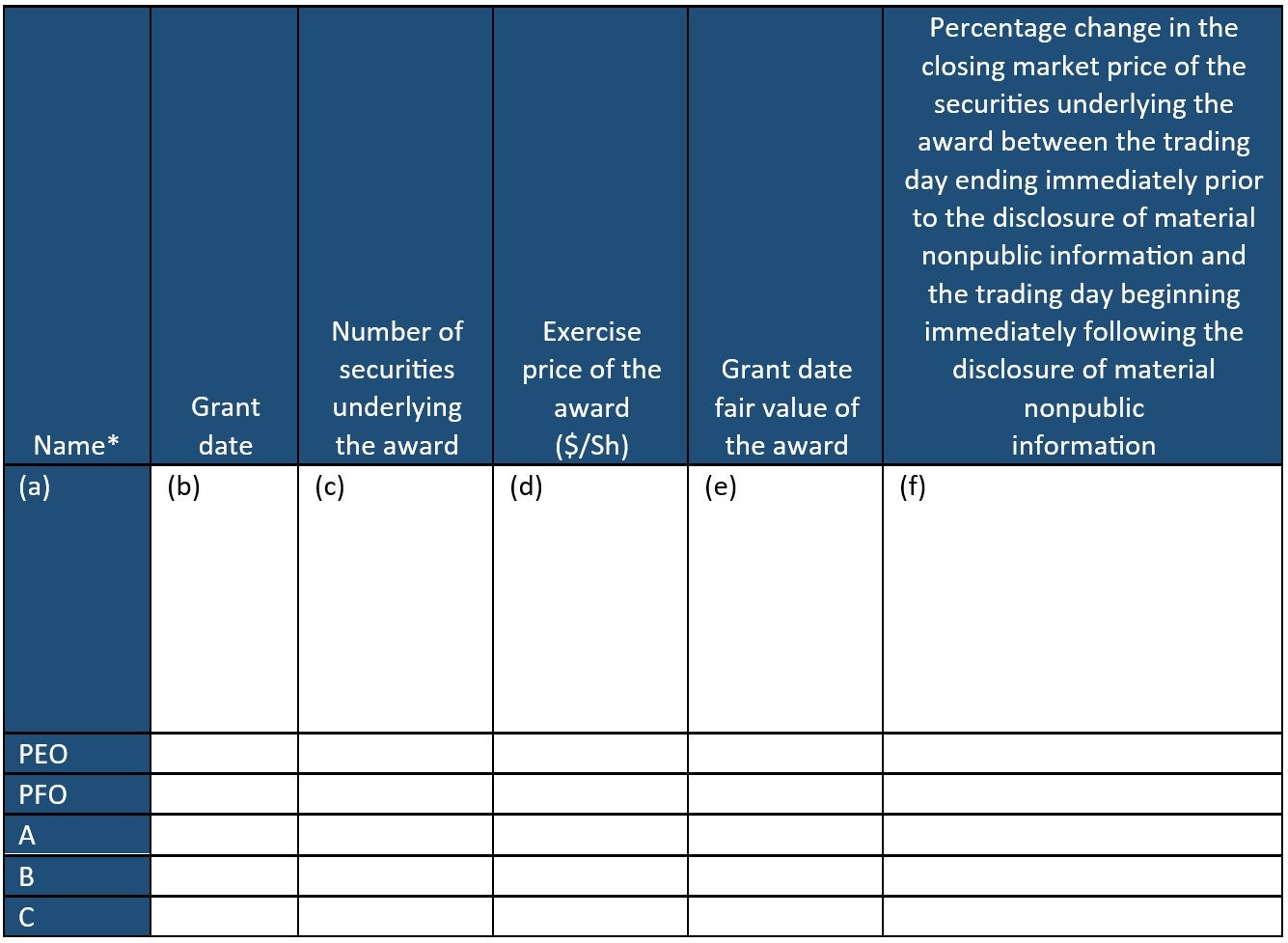
* This list should be adjusted for each reporting company to reflect the company’s roster of NEOs for a particular year (including a shorter list for smaller reporting companies and emerging growth companies).
For this purpose, an option is deemed granted on its effective date, even if it approved on an earlier date. If no options were granted within an MNPI window, then the table may be omitted.
Item 402(x) disclosures were first required to be included in Form 10-Ks filed for fiscal years ending on or after March 31, 2024 (or for smaller reporting companies, September 30, 2024). However, as permitted by Securities and Exchange Commission (SEC) rules, most companies incorporate Item 402 disclosures by reference to proxy statements filed shortly after their Form 10-K. Therefore, early Item 402(x) disclosures started trickling out last summer.
Early Filings, and a Few Observations
Attached for your reference are early Item 402(x)(1) narrative disclosures from several well-known issuers, which illustrate a range of approaches. We have the following observations and practice pointers based on the rules and early disclosures:
- Who Is Covered? Unlike the Item 402(x)(2) tabular disclosure, the scope of Item 402(x)(1) covers all option grantees, not just NEOs. Most early disclosures appear to be correctly addressing this point.
- What Period Is Covered? Item 402(x)(1) requires that the disclosure address whether the issuer has timed the disclosure of MNPI for the purpose of affecting the value of executive compensation. However, the rule does not indicate the time period covered by this disclosure. On this point, some early disclosures have been limited to the most recently completed fiscal year (see e.g., Visa), which we believe is a reasonable approach. Other issuers avoid the question by using artful language and, rather than stating that the issuer has never timed the disclosure of MNPI for the purpose of affecting the value of executive compensation, state that it is not the issuer’s practice to do so (see e.g., Estee Lauder).
- Silence Is Not an Option, Even if You Don’t Grant Options. Even issuers that do not grant options should not omit the 402(x)(1) disclosure altogether. Such an issuer must still indicate whether it has a policy or practice regarding option grant timing. If true, it would be appropriate to disclose that the issuer has no such policy or practice, because it does not grant (or has not in recent years granted) options.
- What Grants Are Covered? Item 402(x) only covers stock options (and similar instruments, like SARs) and some issuers have limited their disclosures accordingly (see e.g., Estee Lauder). However, many issuers (see e.g., Apple, Deere, Intuit, Visa) use the disclosure to explain their grant policies or practices with respect to all equity award types. We expect the latter approach to become very common, because for the many issuers granting exclusively restricted stock units and performance-based restricted stock units, saying that you have no policy or practice regarding the timing of option grants (see #3 above) begs the question of what your policy or practice is for other award types.
- Where Does the Disclosure Appear? Some early filers have placed their Item 402(x)(1) narrative disclosures outside the Compensation Discussion and Analysis (CD&A). Others have included the 402(x)(1) disclosure within their CD&As (see e.g., Apple, Visa). While either approach is acceptable, we prefer the CD&A placement given long-standing SEC rules that include equity award timing among the illustrative list of items that could warrant discussion in the CD&A (see Item 402(b)(2)(iv)).
- Will Most Option Issuers Disclose That They Have Policies or Practices Governing the Timing of Option Grants? Although Visa is the only issuer in the examples below that discloses a formal policy regarding equity award timing, all the issuers indicate that they have consistent practices governing option or equity award timing, and all work hard to describe their practices as consistent with good governance standards. In this regard, Item 402(x) is having its intended effect. The SEC was not in a position to prohibit option grants during MNPI windows. Indeed, such grants are generally lawful (although do have accounting consequences and raise fiduciary considerations). Nonetheless, the SEC was troubled by the practice and promulgated Item 402(x) to name and shame issuers into avoiding it. Early indications suggest that most issuers are quickly falling into line.
- Will Item 402(x)(2) Tabular Disclosures be Common? As a corollary to #6 above, issuers have become increasingly conscious about scheduling their compensation committee meetings (or the effective dates of their option grants) to avoid making option grants during an MNPI window. While such grants will still occur on occasion, the Item 402(x)(2) tabular disclosure obligation is enough to discourage them in most cases.
- Caution Is Required. If, like most other issuers, you intend to write your Item 402(x)(1) narrative disclosure to describe your equity grant practices as following good governance standards, don’t oversell it. Issuers can often say (for example) that their compensation committee meetings are scheduled far in advance and generally occur after earnings are announced, and that they do not time the disclosure of MNPI for the purpose of affecting the value of executive compensation. But despite standard practices that reduce the likelihood that grants will be made when MNPI exists, such grants may nonetheless occur for a variety of reasons. For example, an issuer may consider it necessary or appropriate to grant equity to a newly hired senior executive immediately upon his or her start date. In such cases, issuers need to be able to show that the grants did not violate the practices they articulated. Moreover, to demonstrate responsible exercise of fiduciary duties in such cases, issuers may need to say that their compensation committees DID take the anticipated effects of the MNPI into account when sizing the grants.
***
To discuss your equity grant timing practices or related proxy disclosures, please contact any of the authors of this client alert or your regular Troutman Pepper Locke contact.
Early Filers
Apple 2025 Proxy Statement, Page 54:
Equity awards are discretionary and are generally granted to our named executive officers on the first day of the applicable fiscal year. In certain circumstances, including the hiring or promotion of an officer, the People and Compensation Committee may approve grants to be effective at other times. Apple does not currently grant stock options to its employees. Eligible employees, including our named executive officers, may voluntarily enroll in the ESPP and receive an option to purchase shares at a discount using payroll deductions accumulated during the prior six-month period. Purchase dates under the ESPP are generally the last trading day in July and January. The People and Compensation Committee did not take material nonpublic information into account when determining the timing and terms of equity awards in 2024, and Apple does not time the disclosure of material nonpublic information for the purpose of affecting the value of executive compensation.
Deere & Co. 2025 Proxy Statement, Page 85:
We provide the following discussion of the timing of option awards in relation to the disclosure of material nonpublic information, as required by Item 402(x) of Regulation S-K. The Company’s long-standing practice has been to grant LTI equity awards on a predetermined schedule. At the first quarterly meeting of any new fiscal year, the Committee or, with respect to the CEO’s equity award, the Board, reviews and approves the value and amount of the equity compensation to be awarded (inclusive of RSUs, PSUs, and stock options) to executive officers. The grant of approved equity awards then occurs a week after the Board’s first quarterly meeting. The first quarterly meeting of the Board typically occurs after the Company’s release of the financial results for the prior fiscal year through the filing of a Current Report on Form 8-K and accompanying earnings release and earnings call, but before the filing of the Company’s Annual Report on Form 10-K for that fiscal year.
The Committee does not take material nonpublic information into account when determining the timing and terms of LTI equity awards. Instead, the timing of grants is in accordance with the yearly compensation cycle, with awards granted at the start of the new fiscal year to incentivize the executives to deliver on the Company’s strategic objectives for the new fiscal year.
The Company has not timed the disclosure of material nonpublic information to affect the value of executive compensation. Any coordination between a grant and the release of information that could be expected to affect such grant’s value is precluded by the predetermined schedule. Over the last three years, the average percentage change in the value of the Company’s common stock from the last trading day before the filing of the Company’s Annual Report on Form 10-K to the trading day immediately following such filing is 0.91%, demonstrating that the release of the Company’s Annual Report on Form 10-K, and any material nonpublic information contained therein, does not meaningfully influence the Company’s stock price, and by extension, the value of stock options or other LTI equity awards at the time of grant.
Estee Lauder 2024 Proxy Statement, Page 71:
Our Company has certain practices relating to the timing of grants of stock options. For option grants to our employees, including executive officers, grants of options are currently made by and at meetings of the Subcommittee on a predetermined schedule under our Share Incentive Plan. The Subcommittee does not currently take material non-public information into account when determining the timing and terms of stock option awards, except that if the Company determines that it is in possession of material non-public information on an anticipated grant date, the Subcommittee expects to defer the grant until a date on which the Company is not in possession of material non-public information. For option grants to our non-employee directors, as specified in the Director Share Plan such grants are automatically made on the date of each Annual Meeting to each non-employee director in office immediately following such meeting. See “Director Compensation” above. It is the Company’s practice not to time the disclosure of material non-public information for the purpose of affecting the value of executive compensation.
Intuit 2025 Proxy Statement, Page 60:
Equity grants made to the CEO, Executive Vice Presidents, or other Section 16 officers must be approved by the Compensation Committee.
Timing of grants. During fiscal 2024, equity awards to employees generally were granted on regularly scheduled predetermined dates. As part of Intuit’s annual performance and compensation review process, the Compensation Committee approves stock option, RSU and PSU awards to our NEOs within a few weeks before Intuit’s July 31 fiscal year-end. The Compensation Committee does not grant equity awards in anticipation of the release of material nonpublic information and we do not time the release of material nonpublic information based on equity award grant dates.
Option exercise price. The exercise price of a newly granted option (i.e., not an option assumed or substituted in connection with an acquisition) is the closing price of Intuit’s common stock on the Nasdaq stock market on the date of grant.
Visa 2025 Proxy Statement, Page 75:
The Compensation Committee maintains a Policy on Granting Equity Awards (Equity Grant Policy), which contains procedures to prevent stock option backdating and other grant timing issues. Under the Equity Grant Policy, the Compensation Committee approves annual grants to executive officers and other members of the Executive Committee at a meeting to occur during the quarter following each fiscal year end. The Board has delegated the authority to Mr. McInerney as the sole member of the Stock Committee to make annual awards to employees who are not members of the Executive Committee and who are not subject to Section 16(a) of the Exchange Act (Section 16 officers). The grant date for annual awards to all employees has been established as November 19 of each year.
In addition to the annual grants, stock awards may be granted at other times during the year to new hires, employees receiving promotions, and in other special circumstances. The Equity Grant Policy provides that only the Compensation Committee may make such “off-cycle” grants to NEOs, other members of Visa’s Executive Committee, and Section 16 officers. The Compensation Committee has delegated the authority to the Stock Committee to make off-cycle grants to other employees, subject to guidelines established by the Compensation Committee. Any off-cycle awards approved by the Stock Committee or the Compensation Committee are granted on the 15th day of the calendar month or on such other date determined by the Stock Committee, Compensation Committee, or the Board.
We do not grant equity awards in anticipation of the release of material, nonpublic information or time the release of material, nonpublic information based on equity award grant dates, vesting events, or sale events. For all stock option awards, the exercise price is the closing price of our Class A common stock on the NYSE on the date of the grant. If the grant date falls on a non-trading day, the exercise price is the closing price of our Class A common stock on the NYSE on the last trading day preceding the date of grant.
No off-cycle stock option awards were granted to NEOs in fiscal year 2024. During fiscal year 2024, we did not grant equity awards to our NEOs during the four business days prior to or the one business day following the filing of our periodic reports or the filing or furnishing of a Form 8-K that discloses material nonpublic information. We have not timed the disclosure of material nonpublic information for the purpose of affecting the value of executive compensation for NEO grants in fiscal year 2024.
Newly confirmed Interior Secretary Doug Burgum wasted little time implementing many of President Trump’s initial energy executive orders (EOs), unleashing a round of Secretary’s Orders (SOs) this past Monday that push fossil fuels and mining to the fore. Although renewable energy is not excluded from the SOs, they signal the potential for additional adverse actions beyond those announced in Trump’s wind energy presidential memorandum, which we covered in a previous client alert.
- National Energy Emergency (SO 3417). Implementing provisions of EO 14156, this SO directs all bureaus and offices within the Department of the Interior (DOI) to identify emergency authorities (and other legal authorities) within 15 days that will (a) “facilitate the identification, permitting, leasing, development, production, transportation, refining, distribution, exporting, and generation of domestic energy resources and critical minerals including, but not limited to, on Federal lands and the Outer Continental Shelf”; and (b) “expedite the completion of all authorized and appropriate infrastructure, energy, environmental, and natural resources projects within their jurisdiction to perform or to advance, including use of all authorities to facilitate the supplying, refining, transporting, and exporting of energy including, but not limited to, in and through the West Coast of the United States, the Northeast of the United States, and Alaska.” While SO 3417 is presumed to focus on oil and gas, it is worded in a manner that is not exclusive of renewable energy sources.
- Unleashing American Energy (SO 3418). This SO implements EO 14154 and directs DOI’s assistant secretaries to, among other things, present an action plan to “suspend, revise, or rescind” a list of Biden-era regulations, secretarial orders, Solicitor’s Office M-Opinions, and other regulatory documents. These include, most notably, the 2024-2029 Five-Year Plan for offshore oil and gas leasing, as well as M-Opinions interpreting offshore renewable energy provisions of the Outer Continental Shelf Lands Act (OCSLA) and confirming the Migratory Bird Treaty Act’s (MBTA) inclusion of incidental take. These are documents that the Biden administration issued to reverse documents from the first Trump administration, and we anticipate that they could revert back to something resembling the original versions. For example, the scope of the MBTA has been debated between the past several administrations, and this move signals that the Trump administration may only apply the MBTA take prohibition to intentional takes.
The SO also directed that the action plan include steps to increase oil and gas leasing on public lands (including the reinstatement of canceled leases), revise critical habitat designations, assess DOI’s implementation of the National Historic Preservation Act, reduce burdens on mining, identify the locations of deposits of critical minerals, and ensure that “rules, guidance, and policies relating to the development of energy resources on Federal land do not bias government or private-sector decision making in favor of renewable energy projects as compared to oil, gas, or other mineral resource projects.”
Finally, the SO directs the Assistant Secretary for Policy, Management and Budget to reassess “processes, policies, and programs for issuing grants, loans, contracts, or any other financial disbursements of all appropriated funds” from the Inflation Reduction Act (IRA) and the Infrastructure Investment and Jobs Act (IIJA), which included (among other things) several years of enhanced appropriations for permitting environmental reviews.
- Delivering Emergency Price Relief for American Families and Defeating the Cost-of-Living Crisis (SO 3419). Implementing the EO of the same name, this SO directs DOI to identify programs and regulations that “may result in higher costs for the American people.” This review is intended to focus on “coercive ‘climate’ policies that increase the cost of food or energy,” but at the same time “consider how to create employment opportunities for American workers, including drawing discouraged workers into the labor force.”
- Announcing Trump’s Revocation of Former Outer Continental Shelf Withdrawals (SO 3420). Implementing a portion of EO 14148, this SO purports to rescind President Biden’s withdrawal of large swaths of the Outer Continental Shelf from further offshore oil and gas leasing in the closing weeks of his administration pursuant to OCSLA Section 12(a). It remains to be seen whether this order is enforceable, given that the only court to interpret Section 12(a) found that such withdrawals could only be reversed through an act of Congress,[1] and we anticipate that this order will be challenged by environmental groups.
- Achieving Prosperity Through Deregulation (SO 3421). This SO implements Trump’s Deregulation EO and requires DOI to identify “at least 10 existing Department regulations to be eliminated” for “each new regulation that they propose to promulgate.” This represents a significant escalation of the first Trump administration’s policy of requiring the elimination of two regulations for every new one promulgated.
- Unleashing Alaska’s Extraordinary Resource Potential (SO 3422). Implementing provisions of EO 14153, this SO directs a more aggressive approach to oil and gas leasing in the Arctic National Wildlife Refuge (ANWR). The ANWR lease sales mandated by Congress in 2017 resulted in few to no bids and the area remains a focus of environmental group opposition; it remains to be seen whether commercial interest increases as a result of the second Trump administration’s more fossil fuel-friendly policies.
[1] League of Conservation Voters v. Trump, 363 F. Supp. 3d 1013 (D. Alaska 2019).
When the Inflation Reduction Act was signed into law two years ago, it laid out a target to achieve 100% clean electricity a decade from now. This ambition has since stimulated major investment in renewable technologies and infrastructure totalling close to US$500 billion.
Click here to read the full article on Energy Storage News.
Published in Law360 on February 4, 2025. © Copyright 2025, Portfolio Media, Inc., publisher of Law360. Reprinted here with permission.
This article is part of a monthly column that connects popular culture to hot-button labor and employment law issues. In this installment, we focus on various methods of feedback used by “Harry Potter” characters and how effective feedback can transform workplaces in magical ways.
The magical universe of “Harry Potter” needs little introduction. J.K. Rowling’s series follows Harry Potter and his young wizard friends through their years at Hogwarts School of Witchcraft and Wizardry, navigating both the academic and existential.
The franchise is full of life lessons, including relevant insights into the art — and pitfalls — of delivering feedback, which is a crucial skill in every industry.
Mishandled feedback can lead to serious workplace issues, from employee dissatisfaction to legal claims.
For example, vague or inconsistent feedback in performance reviews has been cited as evidence, in some instances, in disputes over wrongful termination or discrimination. Performance reviews themselves can also evidence a pattern of discrimination.
On the other hand, failing to accurately document feedback, recording overly or inaccurately positive feedback, or providing inconsistent feedback can create headaches for employers when it comes time to address or hold employees accountable for poor performance.
Thus, clarity and consistency in feedback are not just management best practices — they are vital for the health and longevity of a team and the organization itself.
Recent tabloid headlines have also shown how mishandled feedback can backfire, even in the public eye. Longtime Kiss frontman Gene Simmons, who was known for his bold stage persona in the band, recently stirred controversy during his appearance on “Dancing with the Stars.”
His harsh and, at times, inappropriate critiques drew backlash for their tone and content,[1] and stirred debate about the importance of delivering constructive and respectful feedback, even in high-pressure environments.
Simmons’ actions show how poorly delivered feedback — whether in the workplace or on a televised stage — can harm reputations, create discomfort and ultimately undermine the intended message.
To discuss employer best practices on giving and receiving feedback, taking lessons from “Harry Potter,” we chatted with Tara Weintritt, a partner of Wicker Park Group, which aims to help build client loyalty for law firms and other professional service firms through a variety of client feedback services.
The Snape Method
Professor Severus Snape, with his sharp and cutting remarks, exemplifies exactly how not to give feedback. While he often points out real issues, Snape’s approach to manage through fear keeps Harry and his classmates constantly on the defensive, which undermines the purpose of feedback.
Once someone feels attacked, they stop listening to constructive criticism. This dynamic makes meaningful growth nearly impossible, and highlights the importance of a more balanced and thoughtful approach to feedback.
To give constructive feedback, it is important to keep personality out of it. Effective feedback should focus on behaviors, not the person, and should offer clear steps for improvement.
Managers should avoid vague criticisms, like saying someone is “not a good fit.” Instead, they should provide concrete examples tied to measurable outcomes.
Specificity not only helps employees understand expectations, but also protects organizations from potential claims of unfair treatment by supporting evaluations with objective evidence.
Data-driven feedback offers another valuable tool for clarity and alignment. Organizations that leverage trend analysis, such as tracking changes in priorities or skills over time, can tailor feedback to better meet individual and organizational goals.
This approach allows leaders to clarify expectations and align efforts with broader objectives. Feedback should always aim to build trust, encourage a growth mindset and foster a culture of improvement.
Ultimately, feedback must balance critique with positivity. Starting with examples of what is working well sets a collaborative tone and builds receptiveness. Comparisons to others should be limited, but where necessary, they should highlight positive examples rather than diminish the recipient.
Encouraging a culture of feedback — where specific, actionable and constructive insights are regularly shared — helps employees grow and strengthens organizational relationships.
Whether in the context of a law firm, workplace or even a Hogwarts classroom, well-done feedback is a gift that benefits all parties involved.
The Dumbledore Method
Professor Albus Dumbledore, a truly beloved character of the “Harry Potter” franchise, is often regarded as the epitome of wisdom and guidance. How could we possibly find anything to critique about his method of providing feedback? Yet, on closer examination, Dumbledore’s feedback to Harry, while inspirational and morale boosting, often lacks the specificity needed for measurable improvement.
Dumbledore’s words motivate and reassure, but they fail to provide clear steps or tangible goals for Harry to work toward.
While aspirational feedback has its place, especially in fostering confidence and maintaining morale, it should be paired with actionable advice to ensure progress.
When is it appropriate to focus on aspirational feedback versus addressing smaller, day-to-day behaviors that could be improved? A culture of feedback involves striking this balance.
There is a time and place for formal feedback, such as annual reviews and strategic planning sessions, where broader goals and areas for improvement can be addressed. These moments allow for reflection on what is working, what has changed and what needs to improve.
However, ongoing informal feedback is equally critical. Regular check-ins — whether sharing advice from a real-world experience or reviewing a project — help ensure alignment and provide opportunities to course-correct on day-to-day performance in real time.
This cadence of feedback builds trust and opens the door for continuous improvement. Asking questions, like “Is this going the way you wanted?” or “Did we meet the client’s expectations?” allows for constructive dialogue and helps both parties feel heard. Ultimately, the key is to create an environment where feedback flows freely.
The Hermione Method
Hermione Granger’s feedback style is a classic example of good intentions being undermined by poor delivery.
In one memorable scene, she corrects Ron Weasley’s pronunciation of a spell, “wingardium leviosa.” Here, Hermione offers accurate and specific feedback, but delivers it in a tone that alienates rather than encourages, even though Ron is one of her best friends! Her critique — while technically correct — comes across as bossy and condescending, leaving Ron annoyed, defensive and unmotivated to improve.
Hermione also shows us that feedback does not have to come from the top. Peers can be great sources of feedback to each other, and managers can learn from those who report to them. Even interns may have valuable feedback to share with company leadership. Their unique perspective and experiences can help identify areas for improvement or highlight successes that may otherwise go unnoticed.
Conclusion
Effective feedback is not just a management tool; it is a cornerstone of workplace culture that embraces collaboration, diversity and constant improvement. Leaders who prioritize clear, actionable and empathetic feedback can improve overall team satisfaction and success.
As Dumbledore wisely said, “Words are, in my not so humble opinion, our most inexhaustible source of magic, capable of both inflicting injury and remedying it.”
Whether managing teams, mentoring colleagues or navigating client relationships, encouraging and constructive feedback has the potential to transform the workplace into a thriving and collaborative environment, when it is given with care and received with openness.
Just don’t forget: It’s leviOsa, not leviosA.
[1] https://www.forbes.com/sites/monicamercuri/2024/10/09/gene-simmons-slammed-by-dancing-with-the-stars-fans-for-creepy-comments-and-harsh-scores/.