Strategies helps businesses and individuals solve the complexities of dealing with the government at every level. Our team of specialists concentrate exclusively on government affairs, representing clients nationwide who need assistance with public policy, advocacy, and government relations strategies.
Troutman Pepper Locke’s program for Startup and Early-Stage Entrepreneurial Development
This unique program provides innovative and affordable opportunities to startups and early-stage emerging companies with a solid technology or scientific foundation. We help companies that have a quality management team in place and do not have other significant legal representation.
Market leading eDiscovery and data management services.
eMerge’s lawyers and technologists work together to deliver strategic end-to-end eDiscovery and data management solutions for litigation, investigations, due diligence, and compliance matters. We help clients discover the information necessary to resolve disputes, respond to investigations, conduct due diligence, and comply with legal requirements.
The rapid growth in electric vehicle (EV) sales in the United States has created an urgent demand for robust EV charging infrastructure. The demand for EV charging infrastructure is driven by the need to ensure the benefits of EVs are fully realized. The EV industry has reached a critical tipping point at which the widescale commercialization of EVs is showing signs of receding until confidence grows in the availability and maturity of the publicly available EV charging infrastructure. This was identified as a key challenge facing the sector in our April 2024 report “Driving Change: Scaling Up EVs in the U.S.“
As “range anxiety” is cited as one of the leading obstacles to widespread adoption of EVs, pressure has increased from all participants in the EV market, and among lawmakers, to make publicly available EV charging infrastructure more prevalent, accessible, and reliable. While most EV charging occurs at home, more than 20% of EV drivers are “garage orphans” who lack access to at-home charging, which increases the demand on public charging infrastructure. Further, 90% of public EV charging infrastructure is available in urban areas, leaving rural areas underserved, reminiscent of a cell phone wall map in the 1990s. This article discusses how the evolution, development, and operation of EV charging infrastructure presents complex legal, regulatory, and operational issues and challenges that must be carefully navigated to ensure the robust growth of the public EV charging infrastructure network necessary to support rising demand.
The Stakeholders
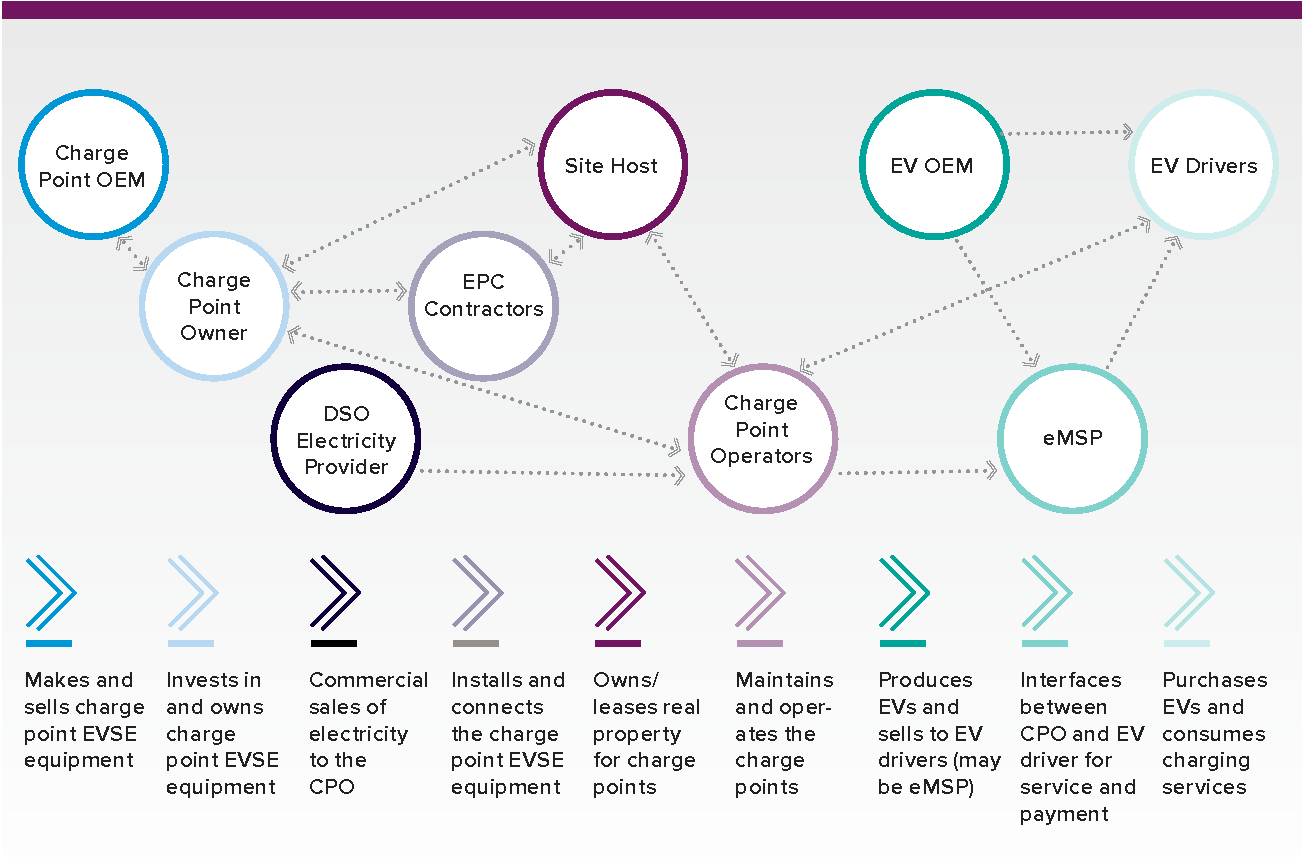
The EV charging ecosystem is a complicated landscape that involves a variety of overlapping stakeholders. These various stakeholders include the following:
Charge Point OEMs (CP OEMs): CP OEMs manufacture charge point hardware and firmware and related devices. They either sell devices to third party CP Owners or operate as CP Owners themselves.
Charge Point Owners (CP Owners): CP Owners finance and own the physical charging stations, plug connectors and related equipment, commonly referred to as Electric Vehicle Supply Equipment (EVSE). CP Owners can be private companies, retail establishments, public utilities, government entities, EV fleet owners, or OEMs. CP Owners often contract with construction services firms to design and build the necessary infrastructure to erect and power the charging stations. CP Owners can be self-funded or financed through third parties and many OEMs offer financing programs to fund the development of EVSE infrastructure.
Charge Point Operators (CPOs) (also known as Electric Vehicle Service Providers (EVSPs)): These entities maintain and operate the EVSE. They connect and operate EVSE and are responsible for maintenance, service, repair, operation, and uptime of the EVSE. They also host and maintain the back-end software and technology platform necessary to enable the operation of the EVSE and an app on the EV driver’s smart phone to manage customer service, usability, and billing.
E-Mobility Service Providers (eMSPs): These entities provide services to EV drivers, such as locating charging stations, booking reservations, facilitating payments for charging services, and providing customer support, through the eMSPs’ own proprietary software platform and apps. This is similar to CPOs, and many CPOs are also eMSPs, but not always. An eMSP can be an independent third party, such as EVgo and Electrify America, which manage the front-end relationship with any EV driver accessing the EVSE, or it can be OEMs that manage the relationship with the drivers of their EVs. An eMSP that is not also a CPO usually hires a CPO to provide the technology infrastructure necessary to operate the network of EV chargers.
Distribution System Operator (DSO): DSOs are responsible for operating energy distribution networks and providing the electricity necessary to power EVSE. A DSO could be an electric utility, a local distribution company (LDC), or an independent system operator (ISO). DSOs are mostly regulated under federal and state energy laws, but exceptions apply in deregulated state jurisdictions or where the state has exempted the sale of electricity by the CPO by treating it as a service instead of a sale of energy. A CPO usually contracts with a DSO to deliver the required energy to the EVSE.
EV OEMs: EV OEMs include any original equipment manufacturer of EVs. They build, sell, and service EVs and are critically involved in developing the EV charging infrastructure necessary to support the availability of charging stations. Many EV OEMs maintain a direct connection with their EV drivers through bundled services such as routing, charger availability, prioritization, usage, billing, etc. Some EV OEMs offer charging packages to their EV purchasers, such as free charging for the first year of ownership, by negotiating rates with CPOs in advance.
Site Hosts: Owners and lessees of real estate that are prime locations for EV charging points, such as stores, shopping centers, restaurants, sports facilities, entertainment venues, office buildings, etc., also play an important role in the EV charging ecosystem. Some Site Hosts are convenience-based, such as airports, gas stations, and rest stops. Others are destination-based, such as stores, restaurants, office buildings, and shopping establishments. Site Hosts that are not CP Owners lease the use of their real estate for installation and operation of the charging points. Rather than waiting for others to request the installation of charging points on their properties, many savvy Site Hosts are actively seeking out, and even financing, the installation of charging points at their businesses to drive additional business to their stores. Unlike public charging points that are available on a first-come, first-serve basis, Site Hosts may restrict use of charging points on their site solely for their customers, employees, and visitors (referred to as private charging) or they may prescribe certain off-peak hours when the public can access their charging points (referred to as semi-public charging).
EV Contractors: Contractors and engineering firms are engaged by either Site Hosts or CP Owners to construct, install, and connect EVSE on the Site Host’s property. These EV Contractors are responsible for engineering, permitting, utility connections, and other site work and installation services necessary to connect and initiate the EVSE.
EV Drivers: EV drivers access EV charging points to charge their EVs. They utilize apps made available from the CPO or eMSP to locate, schedule, and process payment for charging services. Unlike individual EV drivers, fleet owners (e.g., purchasers of entire fleets of EVs for commercial usage, such as Amazon) are typically charged directly for the charging services utilized by their drivers who activate the charging session using an issued RFID card.
Although each of these stakeholders play a critical role in the EV charging infrastructure network, the roles they play are not always clearly delineated and there is considerable overlap in the industry. For instance, a DSO may also be a CP Owner and engage a CP Operator to manage consumers’ use of the EV charging station through the CP Operator’s proprietary software. Also, an OEM operating as an eMSP can assume the front-end role of managing its relationship with the drivers of its EVs in lieu of many of the obligations typically assumed by the CP Operator. Site Hosts have historically leased their property for the installation of charging points, but retail destinations, such as restaurants and storefronts, recently have taken a more active role in offering the availability of charging to their patrons by engaging in eMSP activities.
Not only does the interplay among stakeholders create a complicated labyrinth of rights, roles, and responsibilities, frequent shifts in stakeholder positions also results in varied and customized transaction structures.
How It Works
OEMs build and sell EVs to individual consumers or fleet operators. For private charging access, many individual drivers install EV charging units in their garages and fleet owners install charging stations at their operation centers for charging their own EV fleets before and after routes. Public access charging is made available through all of the stakeholders listed above – all sharing the common goal of making it more convenient and easier for EV drivers to charge their EVs in public. Semi-private charging is also available where a CP Owner/Site Host allows limited public access to its otherwise private charging stations.
The CP OEMs sell or lease charge point hardware to an independent CP Owner or may serve as the CP Owner itself. The CP Owner usually secures available real estate from the Site Host at which to install the charge points from site hosts/lessees, and engages EV contractors to install the OEM hardware, run and connect the utility feeds and ensure the operability of the charge point. The CP Owner contracts with a CPO to maintain, operate, and provide the e-mobility services for the charging point. The CPO sources the energy directly from the DSO, on a wholesale basis, at the DSO’s published and approved wholesale tariff rates and the CPO resells the energy to the EV driver at rates approved by the state public utility commission (in regulated jurisdictions), or at market rates (in non-regulated or exempt jurisdictions).
When an EV driver accesses a charging point, the driver uses an RFID card or app credential issued by the eMSP or CPO to purchase charging services. Initially, CPOs issued RFID access cards to EV drivers to access only the charging points operated by that CPO. EV drivers would often need to carry multiple RFID cards for multiple CPOs (think Shell gas card for Shell stations, BP gas card for BP, etc.). As EVs gained more popularity and the market matured, eMSPs emerged to facilitate providing an EV driver access to multiple CPO charging points through an agreement between the eMSP and multiple CPOs, thereby reducing the burden on the EV driver. The EV driver had one-stop shopping through the eMSP to access charging points operated by various CPOs, which effectively created the first e-mobility roaming public network in the EV industry. Today, much of the EV industry relies upon the Open Charge Point Interface (OCPI) for automating roaming between various EV networks. Much like cellular towers, OCPI and other roaming networks allow EV drivers to use charging points managed by multiple CPOs even if they are subscribed to an app offered by a different CPO or eMSP. The CPO and eMSP utilize the OCPI or other roaming network to process the data exchange required to complete the charging experience for the EV driver.
The CPO also operates its Charge Point Management System (CPMS) to measure charge point usage, charging times and frequency, calculate costs over time, measure downtime, collect earnings, compile custom reports, receive real-time issue notifications, etc. which can be used to increase the utilization of the charging points.
The eMSP usually collects the payment directly from the EV driver and remits it to the CPO. The CPO then remits payment to the DSO for the electricity consumed by the EV driver.
Contractual Landscape
The tangled web of relationships, allocations of risk, rights, obligations, and roles and responsibilities among the various stakeholders are represented by a myriad of contractual relationships, including without limitation the following:
DSO – CPO: The DSO and CPO enter into an agreement by which the DSO sells electricity to the CPO, and the CPO agrees to provide EV charging services to EV drivers through the charging point. The CPO also agrees to provide e-mobility services to EV drivers either directly or in coordination with an eMSP.
CPO – eMSP: The contractual relationship between CPOs and eMSPs includes terms regarding access to the CPO charging points, service levels, liability allocation, technical set up, data sharing, etc. In addition, the CPO and eMSP must also link their technical platforms to permit bi-directional flow of data between them. This includes data to authenticate an EV customer of the eMSP, data regarding the charging point location, real time information about the charging session, pricing, charge detail record data of all sessions for billing purposes, etc. The CPO and eMSP also allocate customer service responsibilities to ensure a smooth transaction for the EV driver.
eMSP/CPO – EV Driver: The eMSP, or a CPO acting as the eMSP, has a relationship with the EV driver whereby it provides e-mobility services to the EV driver. These services are offered through an app by which the EV driver can locate charging points, access routing, availability and real-time information, pay for charging and other services, obtain customer service, and otherwise engage with the eMSP or CPO.
CP OEM – CP Owner: Where the CP OEM does not serve as the CP Owner itself, the CP OEM would sell the charging point equipment to a CP Owner under an Equipment Purchase Agreement, which would include warranty and maintenance responsibilities. Alternatively, the CP Owner may lease the equipment from the CP OEM under a capital or operating lease. Some Site Hosts are financing the purchase or leasing of the EVSE for CP Owners as part of the commitment of the CP Owner to have EVSE installed at the Site Hosts’ locations.
CP Owner – Site Hosts: Either the CP Owner or CPO will enter into a lease agreement with the Site Host allowing access to the real property to install and operate the charging point on the property for a negotiated fee. Destination-based Site Hosts, such as restaurants and shopping centers, often negotiate for access to certain data in order to foster a deeper customer relationship with the EV driver (e.g., syncing the restaurant’s app with the eMSP or CPO app to direct traffic to the destination as part of a larger customer experience).
CP Owner/Site Host – EV Contractor: Either the CP Owner or the Site Host will engage an EV Contractor to construct the site, install the OEM equipment, connect the OEM equipment to the electricity supply and initiate the operation of the equipment.
CP Owners – CPO: This agreement governs the CPO’s rights to access and use the charge point hardware and infrastructure for purposes of operating the charging units.
Legal Issues and Challenges
The interplay between the various stakeholders to bring a seamless and efficient charging experience to the consumer raises unique legal issues and challenges behind the scenes that must be properly considered.
Energy Regulation
The sale and provision of electrical power is extensively regulated by applicable federal and state laws. Generally, the wholesale sale of electricity is subject to federal regulation and the retail sale of electricity is subject to applicable state laws. On the federal level, the Federal Energy Regulatory Commission (FERC), operating as an independent commission of the U.S. Department of Energy, regulates public utilities engaging in the wholesale sale of electricity and the interstate transmission of electricity, including approving the applicable tariffs (i.e., rates and charges) that can be charged by the public utility. An entity that engages in the wholesale sale of electricity, whether knowingly or unwittingly, classifies that entity as a “public utility” subject to the regulatory scrutiny of FERC. On the state level, each state through its state Public Utility Commissions (PUCs) establishes its own rules and regulations applicable to the retail sale of electricity. These regulations vary greatly state-by-state and range from highly regulated to deregulated.
The structure of the relationship between stakeholders in the EV charging infrastructure must be carefully analyzed to understand the extent to which stakeholders could be regulated by federal and state energy regulations. For instance, the sale of electricity by the DSO to the CPO on a wholesale basis may be subject to FERC regulation, and the sale of electricity by the CPO to the EV driver on a retail basis may be subject to applicable state regulation. The analysis becomes more complicated if the CPO is viewed as selling the electricity to an eMSP, which in turn, resells it to the EV driver. In that instance, the CPO could be viewed as reselling electricity on a wholesale basis which, unless an exemption applies, would result in the CPO being deemed a public utility subject to FERC, and may require the eMSP to comply with applicable state energy regulations based on its retail sale of the energy. The manner in which the eMSP is viewed as a retail reseller of the energy is incredibly important to the CPO because retail sales of the energy by the eMSP may characterize the CPO as a wholesaler of the energy, subject to FERC regulation.
While some states have determined that CPOs provide a service to EV drivers and/or eMSPs, and are not selling or reselling electricity, other states, however, have not addressed this issue. But even in those states that have determined that the provision of EV charging services is not a retail sale of electricity, ambiguities exist that require a complex analysis to determine whether CPOs are engaging in the retail sale of electricity and are otherwise subject to regulation.
Adding to the complexity, energy prices in state-regulated markets are reviewed and approved by the applicable PUC and set forth in published tariffs. While the CPO may add an administrative service fee to the regulated energy price, it should avoid increasing the regulated retail energy price directly. Alternatively, and as previously noted, some jurisdictions exempt EV charging from regulation and CPOs are therefore permitted to set prices for EV charging services that are not tied to a tariff rate. For example, a CPO may be able to set prices based on the length of a charging session (cost per hour) or a subscription model (a certain number of charging sessions per month).
In deregulated state markets, the energy price is determined by the energy supplier or distributor based on the market rates, which price can be negotiated, or price shopped by the CPO. The freedom of pricing enjoyed by a CPO in a deregulated market is often met with contractual restrictions by the eMSP on the energy price that can be charged, such as most favored nations, annual cap increases, and other pricing protections. Again, a CPO should consider whether it can set prices for EV charging services that are not explicitly tied to tariff rates.
As EV charging transactions among stakeholders often involve disparate and novel structures, it is important to ensure compliance with applicable energy regulations to avoid unintended regulation and consequences.
Liability
EV charging infrastructure participants face liability issues related to the safety and reliability of their charging stations. As with any consumer-facing equipment, it is important to properly allocate the risk of personal injury or property damage to the responsible stakeholders. While the CP Owner owns title to the EVSE, it would usually shift liability for personal injury or property damage liability to the CPO who is charged with maintaining and operating the EVSE. The CPO may seek to share this risk with an eMSP or others who are also involved in the EV charging transaction. The CPO and eMSP also allocate responsibilities and liabilities between them for the availability and performance of the charging platforms, customer support, and support services, including through service level agreements and credits.
Data Privacy and Security
Current Landscape
The rapid expansion and evolving complexity of EV charging infrastructure presents a complex web of data privacy and security concerns. Multiple stakeholders, including EV drivers, CPOs, eMSPs, and even Site Hosts, handle a diverse range of sensitive personal information which necessitates all stakeholders to invest in, and deploy coordinated and intentional data protection measures that are aligned with applicable data privacy and security laws (data protection laws).
Stakeholders in the EV charging infrastructure process many types of data that, when associated with individual consumers, becomes regulated as personal information under applicable data protection laws. For example, EV drivers who are customers of either the eMSP or CPO create an account and subscribe to software apps that allow them to access charging networks (such as a charging app). A consumer’s account on a charging app would maintain at least contact information, vehicle(s) information, credit card information and other personal information. This personal profile information is associated with the consumer’s use of the charging infrastructure (such as location, time, and duration of charge point usage and other telemetry) which is shared between the eMSP and CPO, and sometimes other stakeholders (including the DSO), to authenticate the consumer, facilitate their access to the charging network, optimize their utilization of the charging app, and generate analytics to enable stakeholders to improve the performance, utilization, and commercial metrics of the charging infrastructure as a whole.
Key types of data processed across EV charging networks, their purposes, and their associated risks include:
Driver Contact Information
Purpose: Drivers share personal information including name, contact information, vehicle details, and payment information when subscribing to charging apps offered by eMSPs or CPOs. This data is exchanged between stakeholders (eMSPs, CPOs, and sometimes DSOs) to facilitate charging transactions and billing.
Risk: Unauthorized access, data breaches, or misuse of drivers’ personal information, particularly in conjunction with location and sessions data (see below) could lead to identity theft, financial fraud, unwanted targeting, and other risks associated with knowing an individual’s location.
Mitigation: All stakeholders should maintain and post clear consumer-facing privacy policies and strong data-sharing agreements between stakeholders. Secure data handling practices including end-to-end encryption, secure data storage, and strict access controls are crucial.
Authentication Data
Purpose: An EV driver is issued an RFID card or credential to access the charging point. The RFID card includes data consisting of an RFID number and a visual identifier. RFID cards or mobile apps authenticate EV drivers at charging points.
Risk: If compromised, unauthorized users could access charging services fraudulently.
Mitigation: The app owner should design the app with multi-factor authentication by default, regularly update the authentication systems to remain secure against vulnerabilities, and monitor and use fail-close processes to respond to suspicious activity when detected.
Location Data
Purpose: CPOs share real-time location and availability data of charging points with eMSPs.
Risk: When associated with individual users, real-time location data can reveal a driver’s location and aggregated location data may reveal drivers’ travel patterns and routines, potentially exposing them to stalking or surveillance.
Mitigation: Providing clear user disclosures and obtaining user consent to collect location data from consumers when using charging apps is essential, but CPOs should also contractually (and technically where possible) limit the time and purposes for which eMSPs and other downstream data users may use location data. To the extent location data is retained, it should also be aggregated or anonymized before being used for analytics or other purposes, pseudonymized and assigned short retention periods when used for consumer-specific purposes and maintained in hashed and encrypted formats.
Sessions Data
Purpose: Sessions data includes detailed information about charging sessions (start/end times, energy consumption, etc.) and is used for billing and grid management.
Risk: Detailed sessions data could be used to infer drivers’ habits and preferences and/or to unfairly price access to charging infrastructure.
Mitigation: eMSPs or other owners of sessions data should consider whether they can maintain this data in anonymized form or pseudonymizing consumer information when using and retaining sessions data.
Tariff and Charge Detail Record (CDR) Data
Purpose: Tariff and CDR data are used for billing and verification purposes.
Risk: Improper handling could lead to overcharging or billing disputes and regulatory issues for the eMSP or CPO responsible for maintaining the financial relationship with the charging app users.
Mitigation: Charging app operators must maintain transparent billing practices and clear contractual commercial terms with other stakeholders in the charging infrastructure, operate in accordance with strong data retention practices, and comply with payment card industry standards.
Other Considerations
Site Host Data: Site hosts may collect data on EV drivers for marketing purposes, raising additional privacy concerns. Transparency and opt-in/opt-out mechanisms for data sharing in these contexts are essential, particularly in light of the increased regulatory scrutiny on targeted marketing practices.
Third-Party Data Sharing: Stakeholders may share data with third-party vendors (e.g., for analytics or maintenance). Robust contracts and due diligence are needed to ensure these vendors operate only as service providers (i.e., and do not use this data for any secondary purpose).
Cybersecurity: EV charging infrastructure is a potential target for hackers. All stakeholders involved in operating the connected network should have strong written information security programs that include executive accountability, regular security audits, vulnerability patching, and incident response plans.
Ownership: The stakeholders often dispute over who owns and who has the right to use all of the data involved in a charging session or related to a consumer. While customary ownership models are starting to develop, disputes over data ownership and usage rights are still common among stakeholders.
Money Transmitter Concerns
The collection of payments from EV drivers may also be subject to applicable federal and state regulations, especially when an eMSP is collecting payments on behalf of the CPO from the EV driver. In this situation, the eMSP may be viewed as a “money transmitter” based on receiving funds from a customer, the EV driver, and then transmitting funds to a designated recipient, the CPO. Money transmitters are subject to federal and state regulation, and unless an exemption applies, are required to register with the appropriate authorities and comply with specific reporting and compliance requirements.
On the federal level, the Financial Crimes Enforcement Network (FinCEN) regulates money transmitters and requires all money transmitters to comply with their regulations. Under federal law, a person is not a money transmitter when the person’s primary business is something other than money transmission and, to the extent the person transmits money, the money transmission is an ancillary part of their business that is necessary to complete the primary part of their business.
In addition, each state (except for Montana) regulates money transmission through its own state law and requires money transmitters to be licensed. There is an exemption to the state licensure requirement called the “agent of the payee” exemption. While it is likely that an eMSP would qualify for an agent of the payee exemption under state laws based on collecting funds for the CPO, the application of this exemption depends on the specific facts and circumstances and the precise structure of the relationship between the eMSP and the CPO.
In preparing EV infrastructure agreements, particularly those between an eMSP and CPO, it is critical to analyze the activities of the EV charging stakeholders to ensure they qualify for such exemptions both on a federal and state-by-state level, and to structure and document stakeholder roles and responsibilities so that parties can avail themselves of these exemptions.
Property Rights and EPC Construction Issues
The installation of EV charging stations can raise issues related to property rights, leasehold approvals, ingress and egress rights, easements, parking allowances, and zoning regulations. Additionally, EV charging points must be located and constructed in compliance with local and international building codes, the Americas with Disabilities Act, Occupational Safety and Health Administration requirements, and various other federal and state regulatory guidance, such as the Alternative Fuels Data Center guidance from the U.S. Department of Energy, and California’s Type Evaluation Program which regulates how electricity is to be accurately measured through EV charge points. As Site Hosts authorize the installation of charging points on their properties and CPOs are often directly responsible for engaging EV Contractors, these considerations need to be taken into account and properly navigated to ensure a successful EV charge point construction and installation.
Evolving Regulatory Landscape
As this article highlights, stakeholders in the EV infrastructure ecosystem must comply with a range of regulations, including those related to electricity sales, data privacy, consumer protection, property rights, and EPC construction issues. In addition, the regulatory framework for EV charging infrastructure is still developing, creating uncertainty in some situations for stakeholders. Lawmakers on the federal, state, and local levels are also pushing for increased regulatory oversight on the EV charging market, which may create a disparate regime challenging nationwide compliance and a seamless experience for EV drivers as they cross state lines. Regulators are also grappling with how to ensure that all communities have access to EV charging infrastructure, to avoid creating a “charging desert” in underserved areas.
Additionally, international industry standards continue to evolve as the latest best practice of EV charging infrastructure, such as the SAE International Standards (setting global certification standards), ISO15118 (governing digital communications between the EV and EVSE), Open Charge Point Protocols (setting the universal communication standard between hardware and software), and Open Charge Point Interface (establishing an open automated roaming protocol connecting CPOs and chargers outside of networks). Staying abreast of these rapidly changing regulations and industry standards is essential to properly structuring and operating EV charging infrastructure.
EV Charging Incentives
There are various federal, state, and local incentives available for the purchase and installation of EV charging equipment and infrastructure. These incentives fall into three main categories: tax credits (i.e., reduction in tax liabilities or direct pay for tax exempt entities), grants and loans, (i.e., governmental or industry grants or loan programs), and rebates (i.e., refund payments for covered infrastructure costs).
The two most significant U.S. EV charging incentives arise under the following federal legislation:
The Bipartisan Infrastructure Law (BIL) was signed into law on November 15, 2021. The law establishes the National Electric Vehicle Infrastructure (NEVI) Formula Program ($5 billion) and the Discretionary Grant Program for Charging and Fueling Infrastructure (CFI) Program ($2.5 billion), which offers federal grants to states seeking to subsidize EV charging projects. On January 11, 2024, a $623M grant was announced to fund 47 EV charging infrastructure projects in 22 states and Puerto Rico, adding approximately 7,500 EV charging ports. The BIL incentives also make the installation of EV charging infrastructure an eligible expense under the USDOT Surface Transportation Block Grant Program. The BIL also provides funding to USDOT, DOE, and EPA for the deployment of electric school buses and ferries, port electrification, a domestic supply chain for battery production, and battery recycling, among other EV-related initiatives.
The Inflation Reduction Act (IRA) was signed into law on August 16, 2022. Section 30C of the IRA establishes the Alternative Fuel Vehicles Refueling Property Credit (aka “the 30C Tax Credit”) which is available through December 31, 2032. The 30C Tax Credit provides a tax credit for fleet owners of up to 30% (or 6% if prevailing wage and apprenticeship requirements are not met with respect to the construction of the refueling property) of the cost of each single item of qualified refueling property; up to $100,000 for megawatt-scale charging hubs; and for homeowners, up to 30% of the cost of each single item of qualified refueling property up to $1,000 for home charger installations. The credit is only available in non-urban and low-income census tracts, however these areas account for approximately two-thirds of Americans. The U.S. Treasury provided recent informal guidance on eligibility requirements for non-urban and low-income areas, but uncertainty remains over the types of hardware expenses that can be included within the 30C Tax Credit (e.g., whether power conduits, switchgear, transformers, enclosures, power infrastructure are eligible for the credit).
In addition to federal incentives, many state agencies, governmental agencies, DSOs, cooperatives, and municipalities now offer rebates to businesses and property owners who install EV charging stations. Most of these incentive programs are tiered, meaning those who install high-capacity chargers may receive additional rebates.
Tax Issues
EV charging transactions, and the stakeholders involved in those transactions, are subject to various federal, state, and local tax obligations. These obligations include the payment of applicable taxes to the appropriate taxing authorities as well as the collection and remittance of certain state taxes, such as sales and use taxes. States vary widely in the tax treatment of electricity sales. For instance, states and local taxing authorities may tax the sale of electricity as a service, intangible property, or tangible personal property. There are also various exemptions from state tax that should be considered when structuring relationships between stakeholders. Depending on how the sale of electricity is structured and if additional services are being offered by the eMSP, the CPO or the eMSP may have liability under applicable state and local tax laws for the collection of such taxes from the EV driver and remittance to the taxing authority. In most cases, the CPO is responsible for calculating the applicable state sales and use taxes on the energy sales and the CPO charges. While an eMSP may collect payment directly from the EV driver, the CPO also should have the responsibility to report and remit the sales and use taxes to the appropriate taxing authorities. However, in some states where the eMSP is viewed as a “marketplace facilitator” it cannot contract with the CPO to do so, and thus the eMSP would retain the collection, reporting, and remittance obligation.
Conclusion
While the demand for more public EV charging infrastructure is clear, meeting this demand will require addressing and overcoming a range of legal, regulatory, and operational challenges.
The rapidly changing and multifaceted landscape for EV charging often involves stakeholders with competing interests which can result in a tangled web of relationships and ensuing legal challenges. Stakeholders will need to navigate this complex landscape with care and will likely need to collaborate to successfully develop and operate EV charging infrastructure, and ultimately ensure a consistent, reliable, and user-friendly charging experience.
Strategies helps businesses and individuals solve the complexities of dealing with the government at every level. Our team of specialists concentrate exclusively on government affairs, representing clients nationwide who need assistance with public policy, advocacy, and government relations strategies.
Troutman Pepper Locke’s program for Startup and Early-Stage Entrepreneurial Development
This unique program provides innovative and affordable opportunities to startups and early-stage emerging companies with a solid technology or scientific foundation. We help companies that have a quality management team in place and do not have other significant legal representation.
Market leading eDiscovery and data management services.
eMerge’s lawyers and technologists work together to deliver strategic end-to-end eDiscovery and data management solutions for litigation, investigations, due diligence, and compliance matters. We help clients discover the information necessary to resolve disputes, respond to investigations, conduct due diligence, and comply with legal requirements.