Strategies helps businesses and individuals solve the complexities of dealing with the government at every level. Our team of specialists concentrate exclusively on government affairs, representing clients nationwide who need assistance with public policy, advocacy, and government relations strategies.
Troutman Pepper Locke’s program for Startup and Early-Stage Entrepreneurial Development
This unique program provides innovative and affordable opportunities to startups and early-stage emerging companies with a solid technology or scientific foundation. We help companies that have a quality management team in place and do not have other significant legal representation.
Market leading eDiscovery and data management services.
eMerge’s lawyers and technologists work together to deliver strategic end-to-end eDiscovery and data management solutions for litigation, investigations, due diligence, and compliance matters. We help clients discover the information necessary to resolve disputes, respond to investigations, conduct due diligence, and comply with legal requirements.
In recent years, the landscape of patent litigation has evolved significantly. Based on data obtained from Lex Machina®, the U.S. district courts have seen a general decline in overall patent case filings over the past decade — for example, from 5,806 filings in 2015 to 3,808 in 2024. This data also shows, however, an increase in design patent filings — from 320 filings in 2015 to 465 in 2024. These numbers might suggest a growing recognition of the value of design patents. This article explores these trends and offers insights and strategies for patent practitioners working in the design space.
Prosecution Trends
Given the recent uptick in design patent litigation, it is helpful for practitioners to understand how prosecution might be influencing these increased post-issuance challenges.
One hypothesis is that examination of design applications is more limited compared to utility applications, see, e.g., Amini Innovation Corp. v. Anthony California, Inc., 439 F.3d 1365, 1370–71 (Fed. Cir. 2006) (indicating design applications are defined by the drawings), the time to allowance of design applications might significantly outpace that of utility applications. A second, yet related hypothesis is that given the less involved and/or faster-paced examination process for design applications, examiners might not be issuing as many rejections as compared to utility applications. These trends, if true, could at least provide some reasoning behind how mistakes might fall through the cracks during examination, providing a basis for post-issuance challenges.
To test these hypotheses, we analyzed data collected through PatentAdvisor®. Because design applications focus on the aesthetic features of otherwise functional articles, they are arguably most comparable to utility applications in the mechanical space. Thus, we selected Tech Center 3700 (Mechanical Engineering, Manufacturing and Products) to compare against Tech Center 2900 (Designs).
Surprisingly, data obtained from PatentAdvisor® reveals that design and mechanical utility cases may exhibit similar patterns in terms of both average time to allowance as well as number and type of rejections received during prosecution. For example, in Tech Center 2900, applications on average receive a first office action by one year, 10 months, and reach allowance by two years, nine months. Similarly, applications in Tech Center 3700 on average receive a first office action by one year, nine months, and reach allowance by two years, 11 months.
Even more surprisingly, in Tech Center 2900, 70% of first office actions include a § 102 rejection, 72% a § 103 rejection, and 56% a § 112 rejection. Similarly, Tech Center 3700 shows rates of 62%, 75%, and 56% for §§ 102, 103, and 112 rejections, respectively. Final office actions in both tech centers reflect similar trends.
These patterns seem to indicate that examiners apply fairly consistent scrutiny across design and utility applications (at least in the mechanical arts). However, while Tech Center 3700 sees a 71.7% average allowance rate, the average allowance rate in Tech Center 2900 is significantly higher at 93.3%. While the above data relating to allowance timeframes and rejections for design versus utility cases still leaves open to debate the main reasoning behind recent design litigation trends, these overall allowance rates may provide at least a hint — e.g., it could be that while the general examination strategy for design versus utility applications is consistent, examiners ultimately push a higher percentage of design applications through to issuance than they do utility applications, which again could lead to stronger post-issuance bases for challenging these applications.
How might these trends tie into recent litigation trends? Turning back to the above-referenced data taken from Lex Machina®, in 2024 alone, there were 3,808 patent filings across U.S. district courts, with 465 of those including design patents. Of the 465 design patent cases, only two cases resulted in a finding of invalidity and/or unenforceability. In comparison, of the 3,343 utility cases, 38 resulted in an invalidity and/or unenforceability outcome. This means that at least in current times, the chances of having a patent invalidated at the district court level are about 1.1% for utility cases, but only 0.43% for design cases. These statistics, coupled with the prosecution trends discussed above, suggest that design patents may provide a stronger instrument for protecting patent rights at least in the mechanical space. Thus, it may behoove an applicant to consider filing a design application versus utility, or at least filing both simultaneously, to increase its chances of ending up with enforceable rights.
Strategies for Successful Design Patent Drafting
The above data and trends indicate the important role design patents may play in an overall IP portfolio. Applicants and practitioners should strongly consider whether design patents might help play a unique and crucial role in building a strong and enforceable set of patent rights. It is important that practitioners and applicants take great care in carefully drafting and prosecuting design applications to help maintain the current trends we’re observing, i.e., the enforceable nature of the design patent.
To that end, below are a few considerations that may help in drafting and prosecuting strong design applications to help increase applicants’ chances of avoiding post-issuance challenges down the road:
Selection of Drawings: It is crucial that each and every perspective of an article is shown to help mitigate potential indefiniteness issues. When in doubt, over-inclusiveness is better than under-inclusiveness. For example, if depth of an article component is important to the article’s overall design (e.g., how high the bottom of a vanity cabinet sits off the floor and/or the bottom of the vanity legs), include not only a straight bottom view, but also a bottom perspective view. An examiner may otherwise allege during prosecution (or a competitor in future litigation) that any depth components are not enabled by the drawings. At least during prosecution, we’ve seen examiners require the bottom view components (e.g., the bottom edge of a cabinet) be changed to dashed/optional lines as it was allegedly unclear from the as-filed drawings (without having a bottom perspective view) where in space the bottom cabinet edge was supposed to lie, and, changing these lines to dashed was allegedly the best way to avoid a new-matter rejection.
Providing Multiple Embodiments: Attempting to incorporate multiple embodiments of the same design into a single application can often lead to restrictions and/or rejections. While every examiner seems to handle this issue slightly differently, to increase the chances of keeping multiple embodiments together, make sure the specification clearly links the different embodiments to reduce the chances of them being restricted. For example, if trying to include a second set of drawings similar to a first set but including break lines to illustrate varied dimensions, consider describing the second set of drawings in the specification as, e.g., “…another embodiment of the [article] of Fig. 1….” While not necessarily a sure-fire approach, examiners seem to look more keenly on applications that show some connection between different embodiments than if such embodiments are described as independent from one another.
Optional Components: To help reduce the chances of receiving a § 112 rejection, take care in considering what components of an article might be drawn in dashed lines from the get-go. For example, if drawing a cabinet, the specific shape/dimension(s) of the mechanism used to attach the handles to the drawer faces may not be critical to the overall design. Showing such types of components in dashed lines can help reduce the chances of an examiner raising potential § 112 issues.
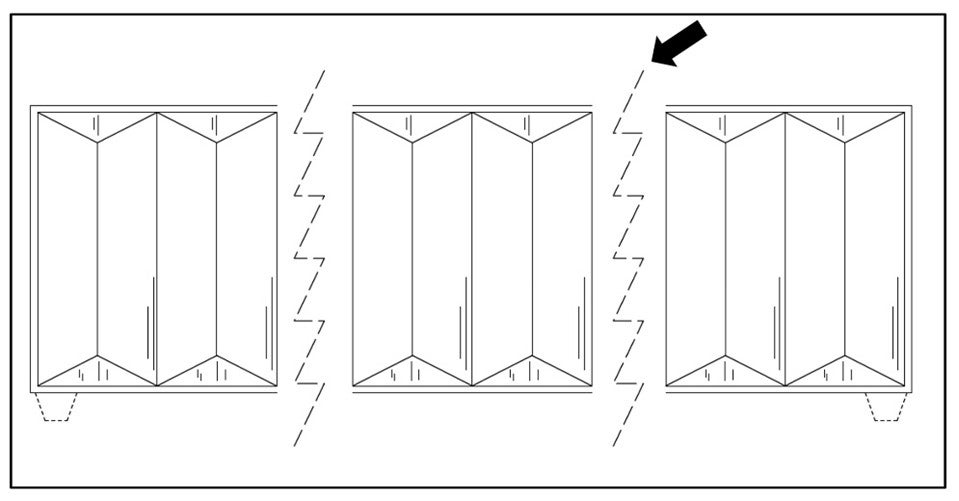
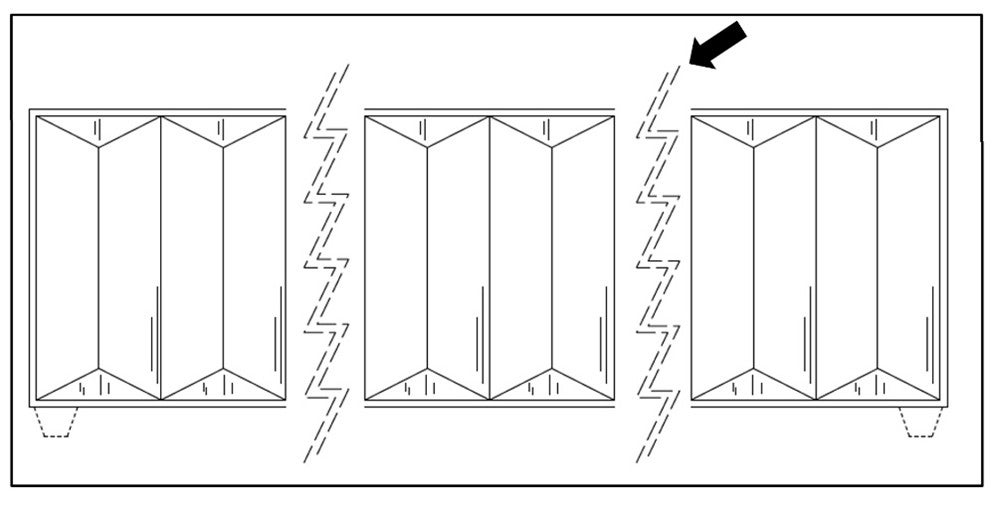
Dashed Lines Versus Break Lines: Many times, design application figures might include both dashed lines (to show optional features) and break lines (to show an article may have varied length and/or width). We have experienced examiners (a) objecting to the type of break lines used to show varied dimension, and (b) objecting to the corresponding descriptive language used in the specification given alleged confusion between dashed versus break lines and their respective purposes.
First, with respect to the type of break lines, examiners seem to prefer the use of sets of double break lines as opposed to singular break lines to illustrate an article having varied dimensions. For example, an examiner required the single break lines in the first image below be changed to double break lines shown in the second image.
See July 21, 2025 Ex Parte Quayle Action in U.S. Application No. 29/900,572
Second, with respect to differentiating between dashed lines versus break lines, consider differentiating between the two types by including language in the specification, such as:
The small, evenly spaced dashed lines form no part of the claimed design. The drawings contain a symbolic break indicated by longer double break lines. The portion between each set of longer doublebreak lines forms no part of the claimed design.
Conclusion
As the current increase in design patent litigation may continue to rise, practitioners must adapt their strategies to ensure robust protection and successful prosecution. By focusing on comprehensive drawings and clear specifications, they can navigate the complexities of design patents and safeguard their clients’ innovations in an increasingly competitive landscape.
Strategies helps businesses and individuals solve the complexities of dealing with the government at every level. Our team of specialists concentrate exclusively on government affairs, representing clients nationwide who need assistance with public policy, advocacy, and government relations strategies.
Troutman Pepper Locke’s program for Startup and Early-Stage Entrepreneurial Development
This unique program provides innovative and affordable opportunities to startups and early-stage emerging companies with a solid technology or scientific foundation. We help companies that have a quality management team in place and do not have other significant legal representation.
Market leading eDiscovery and data management services.
eMerge’s lawyers and technologists work together to deliver strategic end-to-end eDiscovery and data management solutions for litigation, investigations, due diligence, and compliance matters. We help clients discover the information necessary to resolve disputes, respond to investigations, conduct due diligence, and comply with legal requirements.