Strategies helps businesses and individuals solve the complexities of dealing with the government at every level. Our team of specialists concentrate exclusively on government affairs, representing clients nationwide who need assistance with public policy, advocacy, and government relations strategies.
Troutman Pepper Locke’s program for Startup and Early-Stage Entrepreneurial Development
This unique program provides innovative and affordable opportunities to startups and early-stage emerging companies with a solid technology or scientific foundation. We help companies that have a quality management team in place and do not have other significant legal representation.
Market leading eDiscovery and data management services.
eMerge’s lawyers and technologists work together to deliver strategic end-to-end eDiscovery and data management solutions for litigation, investigations, due diligence, and compliance matters. We help clients discover the information necessary to resolve disputes, respond to investigations, conduct due diligence, and comply with legal requirements.
We are pleased to publish our latest white paper, entitled “Driving Change: Scaling Up EVs in the U.S.” The report highlights the challenges of expanding electric vehicles (EVs) and EV battery manufacturing in the U.S. Outdated infrastructure and divergent state and federal environmental regulatory structures are identified as key hurdles.
The report emphasizes the need for a fundamental upgrade and expansion of charging station infrastructure, as well as a supportive regulatory framework for the establishment of new manufacturing facilities for EV batteries and vehicles. It also calls for faster permitting processes for battery gigafactories and clarity on environmental rules for battery factories.
Drawing from insights provided by industry experts, we provide four recommendations:
Expand the public charging station network and clarify the roles of electric utilities and non-utility firms.
Provide regulatory clarity for battery factories, including import or manufacture of chemical components and recycling processes.
Streamline approval processes for key battery chemicals and wastewater management.
Encourage innovation and collaboration in battery recycling and disposal.
The report concludes that a combination of public policy, investment, and innovation is crucial for the EV sector to reach its full potential. Download the white paper for additional information on this evolving and important area.
Summary
Federal incentives, growing consumer demand, and supportive policies are driving efforts by the automotive industry to expand production of electric vehicles. However, outdated infrastructure and environmental regulatory programs may hinder those efforts. We spoke to industry experts about how to address those issues.
Introduction: The Rise of the EV
Record numbers of EVs are on American roads.
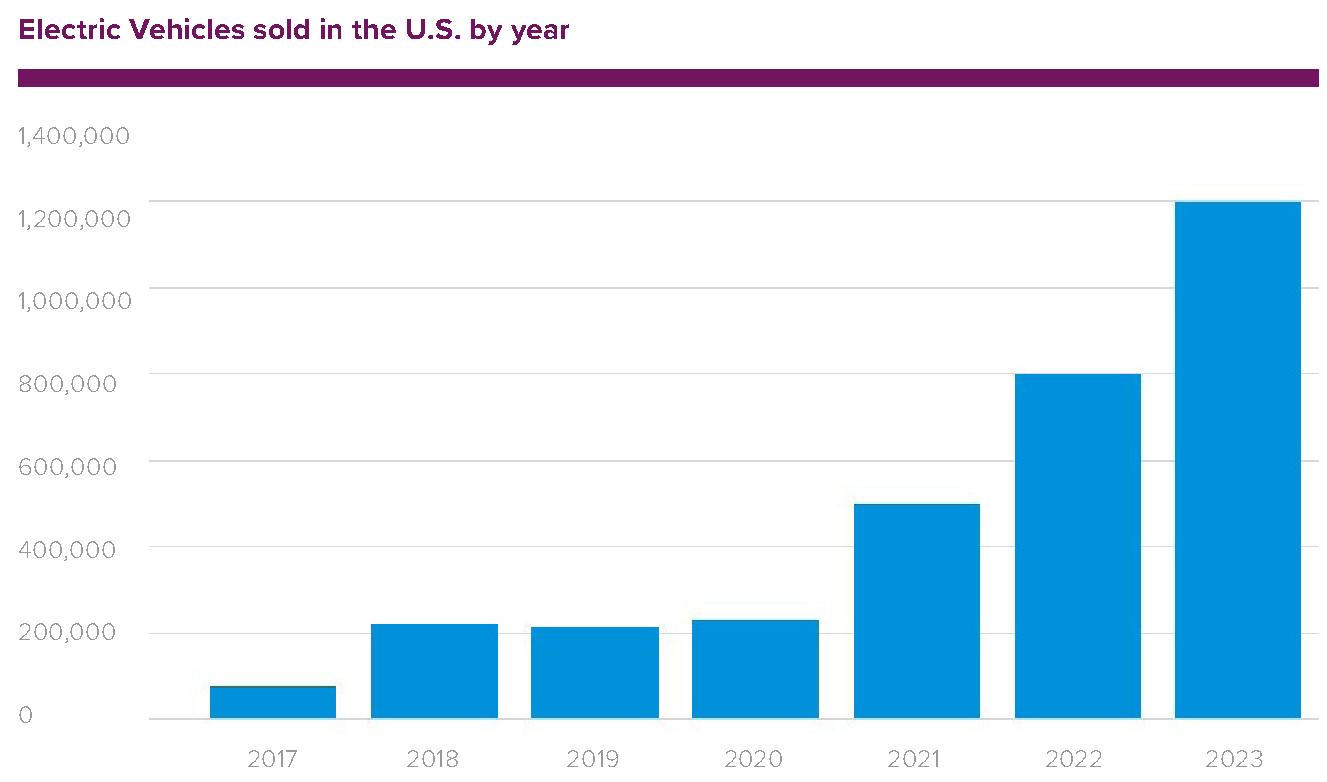
In January 2024, the U.S. Department of Energy reported that at least 4 million EVs are on U.S. roads and that annual sales of EVs in the U.S. have quadrupled since President Biden took office, to nearly 1.2 million in 2023. EVs accounted for 7.6% of new U.S. car sales last year, well past the critical 5% that analyst Cox Automotive identified as a tipping point for mass uptake.
Consumer demand for EVs has grown rapidly in recent years. Cox forecasted that EVs could make up more than 10% of new vehicle sales in the U.S. in 2024.
In 2020, as the world grappled with the immediate effects of the COVID-19 pandemic, nearly 258,000 EVs were sold in the U.S., according to Cox statistics. This rose 89% to 488,000 in 2021; an additional 66% to 810,000 in 2022; and 47% in 2023 (see graph below).
We see three key reasons for this expansion.
First, some consumers seek to make ‘greener’ decisions by selecting EVs, which reduce carbon emissions compared to gas-powered vehicles. A traditional automobile runs completely on fossil fuel. By contrast, EVs draw electricity from the power grid: just over 60% of U.S. power comes from fossil fuels, according to the U.S. Energy Information Administration, with nuclear generating approximately 8%, and renewables at 21% but expected to grow over time. EVs can help consumers to reduce their greenhouse gas emissions.
Other consumers are attracted by the lower running costs of EVs compared to gas alternatives, despite the higher upfront costs.
Second, decisions of consumers and carmakers are being supported by pro-EV policies, including in the Bipartisan Infrastructure Law (BIL) of 2021 and Inflation Reduction Act (IRA) of 2022. The BIL included $25 billion in commitments to support U.S. clean transportation by building a national network of EV chargers; grow the domestic battery supply chain; and increase federal use of EVs.
The IRA added a further $6 billion in support, including loans to help vehicle makers scale up their EV operations.
In addition to direct funding commitments, the Biden administration has proposed policies addressing pollution that are expected to significantly increase demand for EVs. For example, in April 2023, the Environmental Protection Agency (EPA) proposed new, far more stringent emissions standards starting with 2027 vehicle models, which the EPA said would result in EVs accounting for approximately two-thirds of new car sales in the U.S. by 2032.
Supportive policies exist at the state level too, some of which pre-dated the Biden administration by decades. For example, California adopted its Zero-Emission Vehicle Program in 1990 to support the commercialization of EVs in the state, which has continued to expand over the last three decades.
Third, automotive companies have responded to these policies by investing in improvements in the variety and performance of EVs on the market. Bloomberg New Energy Finance reports that battery EVs launched globally in 2022 have an average range of 337km between charges, which is up substantially from 230km in 2018 and follows major technological breakthroughs. More than 40 types of EVs powered solely by EV batteries are for sale in the U.S., double the amount in 2020.
The increased use of EVs in the U.S. is the result of businesses, consumers and policymakers moving in the same direction. However, there are impediments to continuing the EV expansion.
Obstacles to the growth of EVs in the U.S.
The growth of EVs requires a fundamental upgrade and expansion of charging station infrastructure; and new manufacturing facilities are needed in the U.S. to produce EV batteries and EVs themselves. The regulatory framework has failed to keep pace in either of these areas.
Bill Klehm, chairman and chief executive at e-mobility firm eBliss Global, has worked in the automotive sector for 30 years at companies including Ford. He said the commercial challenges to switch the U.S. to an EV-based transportation environment are “multi-dimensional and substantial” as “there are probably 10,000 fundamental inventions that have to be invented and commercialized.”
“This is expensive, and it takes a lot of time… [w]hen I hear the phrase ‘commercial challenges,’ it understates what the problem is. Everything has to change,” he says.
As detailed in this report, we spoke to industry experts who shared their insights on the state of the U.S. EV sector, and in particular on the biggest infrastructure and regulatory challenges facing the industry. Our analysis focuses on the following issues:
The need to roll out public fast-charging infrastructure: There are too few public charging stations, and the faster direct current (DC) chargers represent only a small percentage of the chargers available to the public. As a result, users understandably have range anxiety and concerns about the potential for substantial delays during the charging process.
The need to improve management of the charging station network: Maintenance delays and outages are common at many public charging stations, and information on outages does not always reach drivers on a timely basis. This also contributes to the anxiety of existing and potential EV users.
The need for clarity from federal regulators on environmental rules: The federal regulatory regime is struggling to keep pace with the growth of EVs, and such delays and uncertainty can discourage investment and slow production of new EV batteries. One obvious example where change is needed involves the mixed metal oxides used in EV batteries. The EPA and the Occupational Health and Safety Administration (OSHA) are struggling to develop rules and standards that will allow battery production to progress, while simultaneously protecting public health and the environment.
The need for clarity in the sector about battery recycling standards: The sector needs more clarity from federal and state regulators about the standards and infrastructure that will support the recycling, reuse, and disposal of batteries and battery components at the end of their life cycle.
Below we examine each of these points in turn, based on insights from leading market actors as well as Troutman Pepper’s attorneys.
1) The need to roll out new public fast-charging infrastructure
EV owners need the ability to charge their vehicles efficiently in a way that matches their vehicle use patterns, but evidence shows that the U.S. charging network may be limiting EV uptake.
The U.S. Bureau of Transportation Statistics (BTS) said in its 2023 report that “[p]ublic charging will have to become as accessible, rapid, and economical as refueling with gasoline,” but that EV owners relied on charging their vehicles when they are parked at home, with 80%–90% of charging happening this way. Private on-street chargers will be less viable in urban areas, which limit EV uptake.
A potential fix is expanding direct current (DC) fast chargers – or “level three” chargers – that can charge an EV battery from empty to 80% in under an hour. This compares to up to 10 hours for “level two” chargers, and up to 50 hours for “level one” chargers. At present, level three chargers represent approximately 20% of public EV chargers in the U.S., and this contributes to consumers’ range anxiety.
However, relying on level two chargers at homes is not necessarily a problem.
Jeffrey Kinsey, vice president of engineering at EV infrastructure firm EverCharge, tells us the starting point for rolling out EV charging points should be where there’s a long wait time, and in most cases level two chargers are sufficient. This means that huge and immediate grid upgrades may not be needed.
“You could come home at the end of the day and not leave until the next morning, so you could be talking 12-16 hours when your car is parked,” Kinsey said. “That also doesn’t mean your battery is empty; a level two charger can fill up a charge in less than an hour after an average commute of 15 miles. If you optimize the system for the amount of time these cars are parked, all of a sudden, your infrastructure cost goes way down.” It also means that, for most EV users, the idea they “need a vehicle with 500 miles of range is irrational,” he said.
Kinsey said the focus should be to maximize the efficiency of technology to minimize human involvement. “We talk about charging, but you have to think how expensive it is for an EV driver to move their car because charging is done. You don’t want people moving vehicles, you want technology to move the charging for you,” he said.
This means charging firms can adapt the charging infrastructure to how the power grid currently operates: “It’s super-important to be able to expand that infrastructure without having to go back and do gigantic power grid upgrades,” he says.
Therefore, the discussion about charging infrastructure does not solely need to focus on public level three chargers. The growth of EV charging infrastructure should fit around actual vehicle use — and yet fast level three chargers are still needed for trips far longer than the average daily commute.
While level three chargers represent approximately 20% of public EV chargers in the U.S., the Biden administration is looking to increase this. There are now 170,000 public EV chargers in the U.S., and the federal government is seeking to reach 500,000 by 2030. The Biden administration claimed in January 2024 that it is on track to meet that target by 2026 with its current policies, which include:
$5 billion National Electric Vehicle Infrastructure (NEVI) Formula Program to support the rollout of chargers along U.S. highways.
$2.5 billion Charging & Fueling Infrastructure Discretionary Grant Program, from which the Department of Transportation (DOT) awarded $623 million in grants in January 2024 to fund 47 projects in 22 states and Puerto Rico.
Automakers have also taken steps to improve charger accessibility, with Tesla signing deals in 2023 to permit Ford and General Motors to utilize its charging network. Moves to open up chargers to various vehicle makers can only improve convenience for drivers.
Improving planning of charging network upgrades
Joe George, president of Cox Automotive Mobility Solutions, says that one potential solution to accelerate the rollout of fast-charging infrastructure would be to locate level three chargers along highways, where government already has rights of way for large infrastructure projects, including transmission lines.
He adds that grid upgrades will also be needed as level three chargers become more common: “It’s also important that you have the right grid around level three chargers, and it sometimes takes investment to enhance the grid to support that charger. It’s not that there aren’t enough electrons there, but you’ve got to build the infrastructure to handle the flow of those electrons.”
However, BTS has argued it is tough for policymakers, regulators, and businesses to plan how to develop the U.S. charging network due to shortages of data in key areas. This includes a lack of accurate and reliable data on the amount of energy EVs use, how and where they are charged, and the availability of chargers at workplaces.
John Glassmire, global product manager at Hitachi Energy, agrees it is difficult to plan federal policy. For example, energy and transportation are traditionally regulated separately. He says this needs to change because “electricity is fundamentally different than traditional liquid fuels.”
“We’re past the tipping point of deciding whether we’re doing it. It’s just a question of how,” he says.
This complexity extends to the planning of transmission upgrades, due to the combination of regional grids in the U.S. and different rules governing transmission planning in five major power pools.
Frank Menchaca, president of SAE Sustainability Mobility Solutions, says the growth of the EV fast-charging network requires one of the largest investments in the U.S. transportation system since the great highway-building era that started under President Eisenhower in the 1950s.
Menchaca is part of the ChargeX Consortium, launched in May 2023, to improve reliability and user experience of the charging network. The group’s members include vehicle makers BMW, Ford, General Motors, Stellantis, Rivian, and Tesla, as well as other firms, including ABB, ChargePoint, Electricity America, and Siemens.
“With this group, we’re establishing KPIs [key performance indicators] that will raise the level of reliability and start to get at that question of range anxiety. In the States, we’re a big country and you can drive a great distance before you get to another charging station,” he says. Menchaca also welcomes efforts by automotive firms to standardize their networks.
Yet questions in the market remain about who is responsible to deliver new EV charging infrastructure: vehicle manufacturers; specialist EV charging firms; utilities; or federal or state governments.
Andy Flavin, partner at Troutman Pepper, says more U.S. states are investigating whether regulated public electric utilities can help boost charger installations.
“For a while, there were concerns about letting the utilities have a role because that might squelch competition. But some of the folks who were vocally opposed to that have changed and are now saying, ‘Let’s have the utilities help because we can socialize those costs to millions of rate payers, which is much cheaper and more efficient.’ If the ultimate goal is to get more charging infrastructure out there and sell more EVs…policymakers should seriously consider this approach,” he explains.
Utilities can participate in multiple ways with the approval of state regulators. For example, some utilities have offered rebates to consumers who purchase and install a charger at home. Other utilities have expressed an interest in owning and operating public chargers, which is where growth is primarily lagging. And still other utilities offer “time-of-use” rates to customers that encourage EV charging during periods of lower power demand, particularly overnight.
But even for non-utility operators of EV charging infrastructure, important energy regulatory considerations remain. States regulate the sale of electricity to end users, and many of them prohibit the resale or retail sale of electricity by an entity other than a public utility. Most states have addressed the issue as it relates to EV charging legislatively and/or administratively, determining that EV charging is a service, rather than the sale or re-sale of electricity. However, several other states have not yet addressed the issue or have created ambiguities.
Accordingly, in some states, owners of EV chargers might risk the illegal selling or re-selling of electricity, and/or may be subject to regulation as a public utility. This can only create uncertainty in the sector, and so states must develop statutes or regulations to eliminate this risk.
2) The need to improve management of the charging station network
Building new, fast chargers is important — but so is improving the reliability of the existing network. One reason EV owners choose to charge their vehicle at home is knowing they have a working charger, which is often not the case when relying on publicly available infrastructure.
This is a challenge that the Biden administration is looking to address with its recent announcements of $150 million in grants to help 24 recipients in 20 states fix nearly 4,500 charging ports and, in some cases, ensure they meet minimum standards; and $100 million of federal funding announced in September 2023 to improve EV charging reliability.
Emily Oh, senior director of strategic planning at Cox Automotive, which owns U.S. vehicle valuation source Kelley Blue Book, says a lack of working chargers at busy times is proving both a technical and asset management challenge for the sector. This is partly due to the reliability of the physical infrastructure and partly due to a shortage of skilled professionals who can fix broken chargers promptly.
She explains, “I heard stories of people over the holidays traveling to meet with family and having to go to four different chargers to find one that’s working, and then having to wait in line. Availability of charging infrastructure is a hurdle to overcome.”
This challenge is compounded by the lack of services to repair broken EV chargers in the U.S.
The difficulty of maintaining publicly available EV chargers is also deterring investors from doing deals in the sector.
Angus Scott, financial analyst at Green Giraffe Advisory, says institutional investors hope to gain exposure to the U.S. EV infrastructure sector, but are looking to invest in privately owned systems rather than public charging networks. Green Giraffe Advisory has worked with institutional investors on EV charging projects in Europe, particularly the Netherlands, and is now looking to do likewise in the U.S.
Scott explains that investors had been looking to back public charging projects in the U.S., but that appetite changed for many in the last six months because the federal funding for public chargers has fallen short of expectations: “They’ve shifted their focus and attention toward some of these fleet electrification opportunities,” he says. This includes investments in the electrification of fleets, including trucks and buses, to help operators meet their ESG sustainability goals.
He says more investors are pivoting towards fleet electrification deals because it allows them to “deploy larger sums of capital initially, as well as being inherently less risky due to the predictability of charging times and avoiding the reliance on consumer use.” Concerns over the difficulty of managing chargers is altering how firms invest in the sector.
Dan Anziska, partner at Troutman Pepper, says investment in growing and managing EV charging networks must be supported by global infrastructure investors who will benefit from government grants: “You’re going to need the infrastructure funds in private equity to really jump in and invest in a big way, which they are beginning to do by raising ‘infra light’ funds,” he observes.
In the short term, these investors may also be attracted to projects that aid the electrification of fleets of heavy vehicles, and tough ESG requirements may help unlock these investments. In the longer term, the operators of heavy vehicles will need to be able to link into public chargers away from their central hubs, as many may not want the responsibility of installing and managing their own charging network.
Blain Newton, chief operating officer at Beta Technologies, which is developing electric aircraft initially for use in the cargo and medical sector, says this may open opportunities for firms to act as operators of the charging networks on behalf of private owners.
“The idea is to take away the thinking about ‘how do I ensure the bus is on time every day?’ away from the bus operator and insert a middleman between the utility and the operator to make it simple. There’s a lot of cool work being done on that fleet side,” he said.
Jeffrey Kinsey from EverCharge agrees that companies with fleets need support to make the move to EVs easy.
“We have a lot of companies who need to transition to EVs — yet infrastructure, and even their vehicles — is not their specialty… They need a company to come in to adopt or adapt the charging system to their existing operations, rather than being forced to adapt their operations to charging,” he says.
We need significant evolution in how chargers of all types — public and private — are managed to remove the anxiety from the growing diversity of EV users.
3) The need for clarity from federal regulators on environmental rules
It is not just chargers that pose a challenge for companies in the EV sector. An additional obstacle to the growth of EVs is the need to build the supply chain to produce all-important batteries and their raw materials.
The federal government has offered significant incentives to accelerate EV production, but those incentives include a “made in America” component. Given that most EVs and EV batteries have traditionally been made outside of the U.S., auto manufacturers are scrambling to develop domestic production plants.
However, U.S. environmental regulatory programs have not been updated to facilitate these efforts, and the environmental rulemaking process is lengthy and often litigated. This creates challenges for EV makers.
The IRA includes specific policies to use EVs to support domestic battery production. For example, the IRA stipulates that vehicles in the U.S. can qualify for a $7,500 tax credit if they meet guidelines on where their batteries are made. Half of the tax credit is available for vehicles where 60% or more of battery components are produced or assembled in North America, and that proportion is due to rise to 100% in 2029. The other half of the tax credit is available for vehicles where 50% of the critical materials are sourced from the U.S. or a qualifying free trade country, and that is set to increase to 80% between 2027 and 2032.
But Anziska says a host of further changes are needed to accelerate the rollout of U.S. battery gigafactories.
“A lot needs to happen for EVs by 2026 to be widely adopted. That includes speeding up the permitting process for battery gigafactories and the manufacturing of facilities. It is expensive and time-consuming to build a massive gigafactory, as well as being reliant on many suppliers, and there are so many that have been announced. There’s competition for everything, from labor to equipment and resources,” he explains.
Andrea Wortzel, chair of Troutman Pepper’s Environmental and Natural Resources Group, agrees this is an issue. “While the federal government is pushing out new policies and regulatory guidance to aid in the permitting of battery manufacturing, it is the states that implement those programs. Some states are more cautious than others, and the application of environmental regulatory programs to the various aspects of EV battery manufacturing can vary significantly from state to state.”
By November 2023, approximately 30 battery gigafactories were either operational, being built, or planned in the U.S. That includes facilities developed by automotive firms in partnership with battery specialists and those planned by battery firms alone, such as AESC, LG Energy Solution, and Northvolt.
As Menchaca puts it: “You have original equipment manufacturers like Ford deciding they are creating their own supply chain for batteries, instead of relying on others. I think the growth of EVs really catalyzed this onshoring of manufacturing, shrinking the distance in the supply chain, and that has led to opening new gigafactories to the creation of new jobs and then to a whole host of interesting technology challenges.”
Permitting for imports of essential chemicals
Battery manufacturing in the U.S. faces fundamental challenges, including how to permit the import of the chemicals needed to produce the batteries and how to recycle batteries.
Wortzel says the EPA has taken steps to aid with these, such as the issuance of its May 2023 memorandum regarding recycling of EV batteries, but these steps have been slow in coming and do not go far enough.
“The biggest concern of EV battery recycling operations is the potential to trigger the need for a treatment, storage, and disposal facility permitting under the hazardous waste regulations in the Resource Conservation and Recovery Act,” she says. “These permits are extremely difficult to get, and tend to generate public opposition. The recycling technology, such as wet and dry shredding operations, continues to evolve, meaning the EPA’s guidance becomes quickly outdated.”
In the meantime, many battery makers plan to import the chemicals that their batteries need. Wortzel notes importing such new materials requires a premanufacture notice (PMN) and approval from the EPA pursuant to the Toxic Substance Control Act (TSCA). But while the EPA issued guidance in March 2023 regarding an integrated approach to the PMN process for mixed metal oxides, which are among the key components in battery manufacturing, there remains considerable uncertainty about the conditions the EPA might impose as part of its approval and how these could impact manufacturing operations.
“A lot of the mixed metal oxides that are a component of batteries are new to the U.S. and there are restrictions on air emissions, water emissions, and waste disposal that the EPA may impose as part of its approval process. It is also possible that the EPA will require testing of the material prior to its approval, potentially creating significant delays in the ability to use the material until the testing is complete. There is also increasing confusion between TSCA and OSHA (Occupational Safety & Health Administration) requirements, and sometimes those are conflicting,” she says.
Another example relates to permitting for the wastewater associated with EV battery manufacturing. The EPA has a categorical pretreatment standard for battery manufacturing on the books from 1987, but the EV battery manufacturing process now significantly differs from that contemplated four decades ago. Battery manufacturers must obtain an exemption or other determination that the categorical standard does not apply as an additional step in the permitting process.
The EV industry is still in its early stages, but a robust regulatory framework is needed if companies are to take advantage of the available EV incentives and help U.S. make progress towards its electrified transport goals.
4) The need for clarity in the sector about battery recycling standards
The growth of EVs is forcing companies to examine how to effectively manage and maintain chargers — but this is not the only asset management challenge for EV makers. For traditional internal combustion engine (ICE) vehicle makers, the growth of EVs also brings new challenges related to the maintenance of EVs and their batteries.
Klehm said EVs are a challenging proposition for the makers of ICE vehicles because they wear out more quickly and there are fewer mechanics who can service them. “You wear out tires faster because the vehicle is heavier. You go through brakes faster,” he said, and added, “EVs are more sensitive to heat and cold. Technicians need to be retrained so they can cope with more EVs in the transport mix.”
Then there are the questions around the batteries themselves.
Oh agrees that automotive companies will likely have to stay more closely involved with EVs than with traditional vehicles. “In the past, when they sell the car, the battery would go with it and, historically, that’s the end of their participation in that agreement. It becomes the consumer’s issue after that. But in the future, there could be trends with the OEM staying engaged through the life of the vehicle because of the battery. New firms like Tesla and Rivian are well-positioned to establish that kind of closed loop, but other OEMs are in problem-solving mode,” she says.
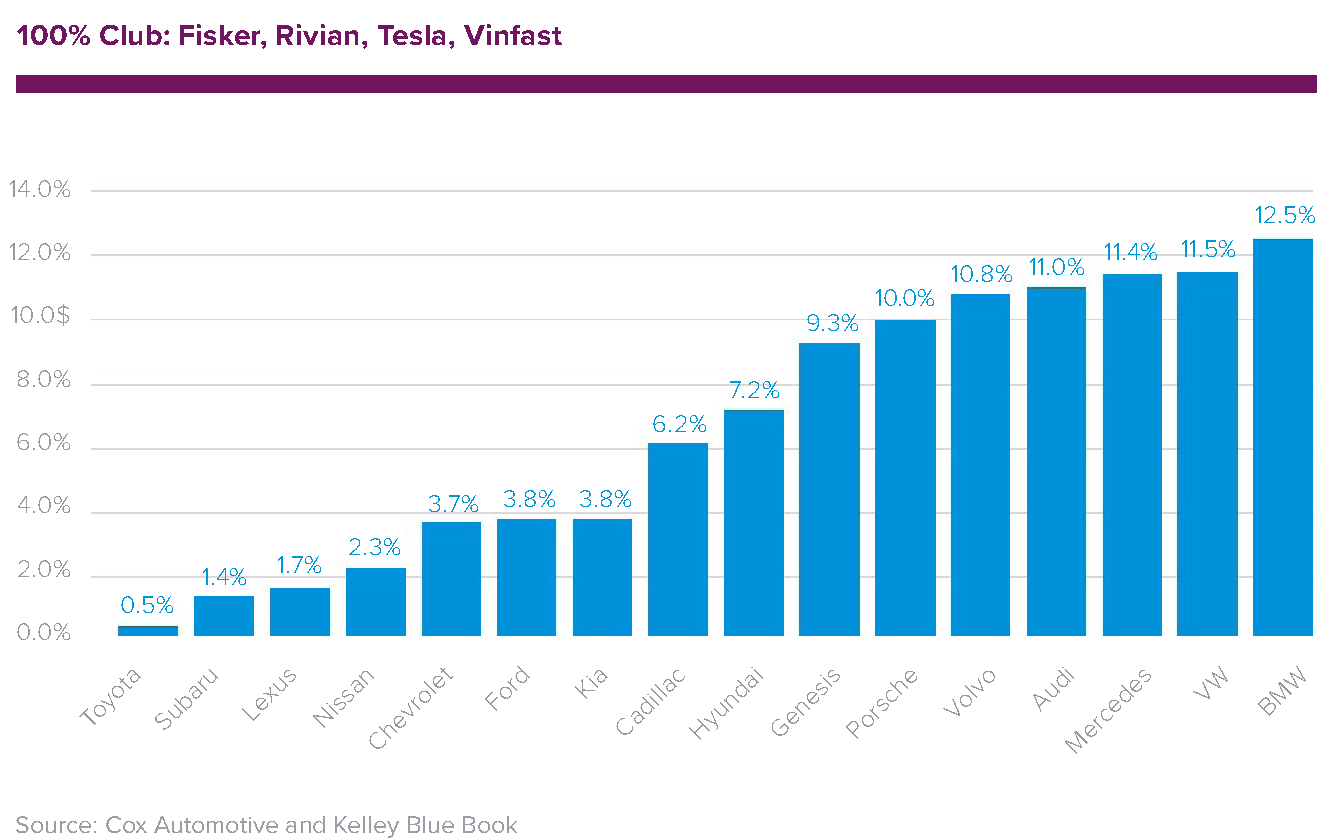
This exposes the potential differences among different auto makers in the U.S. EVs make up 100% of sales for Tesla, as well as smaller players including Rivian, Fisker, and Vinfast, but are a far smaller proportion of sales for most established manufacturers (see graph below), including BMW, Mercedes-Benz, and Volkswagen.
George agrees it is important for the industry to find ways to reuse viable materials and put old batteries into use too. “When these batteries are past their useful lives as automotive batteries, hopefully we can find a good opportunity to reuse them. If we can’t, what happens to the battery module? Does it get shredded and dumped in the ocean? We need to create a life cycle system that makes sure we get the most out of the materials and battery packs as we can in a sustainable way that’s best for the planet,” he argues.
This is where regulation at the federal and state level could be supportive. Marc Machlin, partner at Troutman Pepper, says EV companies could be compelled to take these issues seriously, with regulations focused on life cycle management of the vehicles they produce or the components within the vehicles, including the batteries.
For example, individual states could adopt rules designed to facilitate the recycling of batteries and battery components, or rules designed to educate consumers on how to handle batteries at the end of their lifespan. But he adds that it is highly unlikely that states or federal agencies will force vehicle makers to take responsibility for EVs — or the batteries within them — at the end of their useful lifespan.
He says, “I think vehicle makers would need a lot of convincing to retain any kind of a long-term interest or responsibility for these vehicles, which they don’t really control in any meaningful sense after a sale is made. Consumers do all kinds of crazy things with their vehicles, so you can imagine the liability issues the vehicle makers would be worried about.”
Fostering collaboration between EV makers on best practices and new approaches could reap dividends. Novel strategies will be needed as more EVs are sold and as the batteries within them begin to age.
What happens next: Removing U.S. EV infrastructure bottlenecks
The expansion of EVs means big challenges for the automotive and energy sectors. How can we remove some of the bottlenecks identified so far in this report?
1) Continue to expand the public charging station network.
States need to work aggressively to clarify the charging station functions that can and should be performed by electric utilities. Additionally, in states seeking to encourage non-utility firms to own and operate charging stations, regulators must confirm that operators will not be required to be permitted as public utilities. Charging station operators in those states must be viewed as service providers operating in a competitive environment.
2) Provide clarity on environmental rules for battery factories.
Automotive companies and battery makers are taking steps to innovate in areas such as vehicle technology and battery production. However, a lack of regulatory clarity on core challenges, such as environmental rules governing new battery plants, can delay permits and investments for these facilities. We encourage policymakers to look at how they can bring clarity, particularly related to the import or manufacture of the chemical components of EV batteries, as well as EV battery recycling processes. These rules will facilitate EV battery manufacturing and encourage additional innovation in the manufacturing, recycling, and management of battery waste.
3) Streamlined approvals processes for key battery chemicals.
The EPA should apply its knowledge to streamline the approval process in cases where the chemicals needed for EV battery production are similar to chemicals previously approved. Applicants may not have access to the full body of information available due to trade secret protections, but the EPA does and could use it to make more informed and streamlined decisions.
Similarly, the EPA could issue additional policies or guidance to outline how EV batteries are exempt from the 1986 categorical standard for battery manufacturing. At the very least, the EPA could outline the information and process for demonstrating that the standards do not apply.
4) Encourage innovation and collaboration in battery recycling and disposal.
The EV revolution is challenging traditional car makers in the U.S. on managing these vehicles through their life cycle, including their batteries. The industry would benefit if automotive companies could speak openly to share best management practices and collaborate with the companies operating the shredding operations to ensure uniform, certain, and protective environmental permitting programs.
Additionally, federal and state regulators should collaborate with EV manufacturers on a program to reuse and recycle batteries and battery components whenever possible. Such a group could agree on common approaches in areas as diverse as battery recycling, environmental issues at their factories, and ongoing maintenance of EVs.
Conclusion
The federal government views the transition to EVs as a key component of its plan to address climate issues. Likewise, consumers increasingly see EVs as a way to help reduce the environmental impact of their vehicles; and corporations want to electrify their vehicle fleets to demonstrate that they are reducing their environmental impacts. The result is a tremendous push to grow production of EVs and EV batteries.
We have identified the impediments to satisfying this demand, including the inconsistency, confusion, and delay related to the expansion of charging station infrastructure; environmental permitting for EV battery manufacturing plants; and waste management options for EV batteries and manufacturing processes.
Yet despite the challenges facing the sector, we are optimistic the right mixture of public policy, investment, and innovation will enable the EV sector to achieve its full potential. We look forward to continuing our support of the industry on this journey.
Strategies helps businesses and individuals solve the complexities of dealing with the government at every level. Our team of specialists concentrate exclusively on government affairs, representing clients nationwide who need assistance with public policy, advocacy, and government relations strategies.
Troutman Pepper Locke’s program for Startup and Early-Stage Entrepreneurial Development
This unique program provides innovative and affordable opportunities to startups and early-stage emerging companies with a solid technology or scientific foundation. We help companies that have a quality management team in place and do not have other significant legal representation.
Market leading eDiscovery and data management services.
eMerge’s lawyers and technologists work together to deliver strategic end-to-end eDiscovery and data management solutions for litigation, investigations, due diligence, and compliance matters. We help clients discover the information necessary to resolve disputes, respond to investigations, conduct due diligence, and comply with legal requirements.