Strategies helps businesses and individuals solve the complexities of dealing with the government at every level. Our team of specialists concentrate exclusively on government affairs, representing clients nationwide who need assistance with public policy, advocacy, and government relations strategies.
Troutman Pepper Locke’s program for Startup and Early-Stage Entrepreneurial Development
This unique program provides innovative and affordable opportunities to startups and early-stage emerging companies with a solid technology or scientific foundation. We help companies that have a quality management team in place and do not have other significant legal representation.
Market leading eDiscovery and data management services.
eMerge’s lawyers and technologists work together to deliver strategic end-to-end eDiscovery and data management solutions for litigation, investigations, due diligence, and compliance matters. We help clients discover the information necessary to resolve disputes, respond to investigations, conduct due diligence, and comply with legal requirements.
Before the Dodd-Frank Wall Street Reform and Consumer Protection Act (Dodd-Frank) became law in 2010, inconsistent treatment of expenses across funds and vintages was common. Expense allocation practices in private funds were driven primarily by negotiation rather than regulatory discipline, and disclosure language was typically broad and permissive, with catch-all expense categories left to the discretion of the sponsor. Allocation methodologies were either not disclosed or were described only in high-level, overarching terms.
Institutional investors relied on individual negotiating leverage, side letters, reputation, and trust in the sponsor, supplemented by minimal oversight from limited partner (LP) advisory committees (LPACs) and bespoke reporting commitments. Calculations of internal rates of return (IRR) and other performance metrics were often not comparable across portfolios due to a lack of consistent, comparable qualitative descriptions and quantitative data regarding expenses borne by institutional investors in addition to management fees.
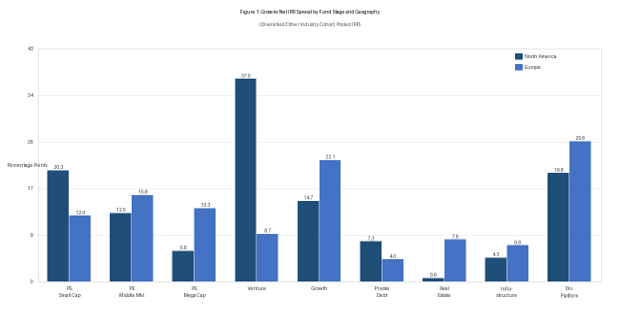
A typical institutional investor or its outside advisers might compute the difference between gross and net IRRs across their portfolio and observe material variation across strategies and geographies. For example, drawing on data from the CEPRES Market Intelligence Database, the pooled gross-to-net IRR spread among North American small-cap private equity funds in the Diversified/Other industry cohort is approximately 20.3 percentage points, while the corresponding spread for European small-cap private equity funds is approximately 12.0 points. For North American venture capital funds, the spread is approximately 37.0 points, while European venture funds show a spread of only 8.7 points.[1] As a result of this lack of consistency and transparency, institutional investors struggled with comparability and insight into conflicts of interest embedded in expense allocation practices.
Dodd-Frank introduced registration requirements for private fund advisers and imported a regulatory framework into an industry historically governed through private negotiations. Once registered, advisers became subject to compliance program requirements and regular examinations by the Securities and Exchange Commission (SEC). Expense allocations began to be evaluated through the lens of fiduciary duties and conflict management, with an affirmative requirement for full and fair disclosure of all conflicts. SEC examinations increasingly scrutinized fee and expense practices, including documentation and compliance infrastructures. The market began transitioning from a contract-driven relationship regime to one governed by fiduciary duties and more robust disclosure.
In response, disclosures of fees and expenses expanded significantly. Fund governing documents and offering materials began to include more detailed expense categories, clarifications of expense allocation methodologies, transparency regarding management fee offsets, disclosures of affiliate and related-party arrangements, and greater consistency between documented terms and actual operational practices. For the first time, institutional investors could understand, at least on a qualitative level, the categories of expenses charged to them over and above management fees. However, investors still lacked quantitative information needed to compare performance metrics across portfolios of dozens of private funds. Simultaneously, sponsors realized the lack of consistency and transparency in the private funds market deprived them of tools to benchmark their own gross-to-net spreads against those of their peers.
Even where a sponsor could determine that the typical pooled gross-to-net spread for North American private debt funds was approximately 7.3 percentage points,[2] how could a general partner (GP) assess how its own spread compared without standardized, granular data?
Expense allocation has become a regulatory priority in the post-Dodd-Frank world because it sits at the intersection of three regulatory concerns: (1) fiduciary duties, (2) fraud and misleading or incomplete or nonexistent disclosures, and (3) books and records and the adequacy of compliance programs.
A sponsor owes fiduciary duties of loyalty and care to a private fund. Without adequate and consistent information about expenses and how they are allocated, investors and regulators cannot identify, evaluate, or negotiate appropriate oversight of the inherent conflicts of interest in expense allocations. A sponsor’s failure to clearly and fully disclose how expenses are allocated, and which ones are borne by the fund versus the manager, impairs investors’ ability to understand how much capital is being deployed into investments versus fees and expenses, and whether those expenses are reasonable or justifiable. Ultimately, the lack of consistent practices and comparable data inhibits investors’ ability to determine how expenses affect returns and properly benchmark a sponsor against its peers. These factors also undermine a sponsor’s ability to benchmark itself against its peers.
This white paper traces the evolution of private fund expense practices from the pre-Dodd-Frank era through the modern registration regime, analyzing the intersection of fiduciary duties, regulatory oversight and enforcement, and market pressures. It explores the dividing line between fund-borne expenses and adviser-borne expenses and explains how, even in the absence of fully operative standardized rulemaking, the combined effect of regulatory scrutiny and market-imposed discipline is producing a de facto transparency regime that requires expense practices to be fair, consistent, and fully disclosed. It incorporates empirical data from the CEPRES Market Intelligence Database to quantify the gross-to-net spread across fund strategies and geographies, and concludes with practical guidance for sponsors and investors, common pitfalls, and a forward-looking discussion of near-term regulatory and market trends affecting fees, expenses, and allocation practices.
II. Introduction and Framing
A. Payor Buckets
To understand the difference between gross and net returns, both at the fund-level and at the investor-level, it is important to identify where different categories of expenses are borne. In private funds, expenses generally fall into two primary categories: fund-level expenses and adviser-level expenses.
Who Typically Pays for Common Private Fund Expenses?
Entity
Expenses
Sponsor / Management Company / Adviser (from management fees)
Compliance (sponsor-specific, e.g., SEC registration); General overhead; Rent (unless disclosed and allocated); Investment professional staffing (unless disclosed and allocated)
Additionally, the adviser or its affiliates may charge fees to portfolio companies in exchange for services rendered. These typically include advisory or monitoring fees, financing fees, and transaction fees. Portfolio companies also bear any fees paid to directors serving on their boards. These fees charged to portfolio companies (which are indirectly borne by investors through the fund’s investments) remained largely undisclosed and historically had not been a focus of investor diligence or regulatory scrutiny.
B. Why Expenses Became a Regulatory Priority
Post-Dodd-Frank, regulatory scrutiny and examinations added a new layer of scrutiny and oversight to what had been a system driven largely by contractual negotiations between sponsors and investors. Registered investment advisers are now subject to extensive policies and procedures, books and records obligations, and compliance program requirements. In addition to accurately disclosing expense categories and allocation practices, sponsors must ensure ongoing operational compliance with those contractual commitments and disclosures. Foot faults and failures of expense allocation are no longer merely private contractual issues between sponsors and affected investors. Regulators are concerned about contractual violations, but often focus more heavily on broader systemic failures in compliance, supervision and oversight, books and records, and conflicts management that stem from an initial contractual violation. In parallel, institutional investors have increasingly added annual testing, verification, and certifications of expense policies and practices to their annual due diligence evaluations of sponsors.
Take, for example, travel and entertainment expenses. If a sponsor has agreed with investors that fund-borne travel expenses will be capped at commercially available business-class fares, but the full cost of first-class or chartered travel is charged to the fund, that constitutes a breach of the limited partnership agreement. Historically, such a violation, if discovered, would have been resolved privately between the sponsor and fund investors. In the post-Dodd-Frank regime, an independent regulator is also involved, increasing both the likelihood that such a violation will be discovered and the scope of its consequences. A regulator may view this not only as a contractual breach, but also as evidence of failures in the sponsor’s fiduciary duties to the fund and the sponsor’s ability to keep accurate books and records, to supervise and monitor employees, to identify and remedy conflicts of interest, and to comply with the fund’s contractual agreements with investors. A regulator may treat each of these as separate, actionable violations.
In this new era, sponsors must internalize and institutionalize their contractual and regulatory obligations and design, implement, and test internal controls to ensure and document compliance with the fund’s contractual commitments. Sponsors are expected to understand their businesses, their businesses’ associated risks, and the magnitude of those risks. Sponsors must also manage those risks and test the effectiveness of how they are managing them. Regarding expenses, this means focusing not only on defining and disclosing expense categories and allocation policies, but also on investigating, identifying, and remediating allocation errors and providing ongoing training and supervision of personnel to reduce the risk of future errors.
In the eyes of regulators, expense allocations and disclosures, and related compliance policies, are not expected to be “one-size-fits-all.” Regulators do not expect internal controls to look the same for every sponsor and firm, nor do they conduct the same examinations or audits for every sponsor and firm. Rather than overlaying a generic regulatory framework onto their contractual commitments, sponsors are expected to tailor their compliance programs to the contours of their specific businesses, taking into account their client base and the particular risks their firms face.
Regulatory Timeline
Period
Key Developments
Pre-2010
Expense practices governed by private contractual negotiation; disclosure broad and flexible; regulatory oversight limited; comparability across funds weak or nonexistent
First wave of enforcement; widespread adviser registration; fiduciary obligations, anti-fraud enforcement, compliance programs, and routine SEC examinations
2017–2020
Convergence of historical contractual regime and new regulatory regime; institutional investors focused on transparency, consistency, and comparability
2021–2023
SEC promulgated private fund adviser rules informed by examination experience, focusing on expenses, allocations, disclosure, and conflicts of interest
2024
Fifth Circuit vacated many SEC private fund adviser rules; no discernible effect on investors’ push for transparency
2025 onward
Examinations continue to focus on expenses and allocations; investor push for transparency continues; convergence of regulatory and market discipline drives best practices
III. Pre-Dodd-Frank: Expense Disclosure and Treatment Before Widespread Registration
A. Pre-Dodd-Frank Registration Landscape
Before Dodd-Frank, many private fund advisers were not required to register with the SEC as investment advisers and were not subject to routine SEC examinations. Their operations, including expense allocation practices, were governed primarily by privately negotiated contracts with investors, such as limited partnership agreements, offering memoranda, and side letters, rather than by standardized regulatory requirements and disclosures. This placed investors at an informational disadvantage.
Inconsistent expense categorizations and limited initial and ongoing reporting meant that there was effectively no “market” for expense allocations and no reliable way for investors to benchmark private funds across their portfolios. Likewise, sponsors had little ability to benchmark their own practices and gross-to-net economics against those of their peers.
Specificity of Expense Disclosures Over Time
Period
Typical Disclosure Style
Allocation Transparency
Investor Reporting
Pre-2010
Broad “may charge” language
Low
Limited, nonstandard
2010–2014
Increasing specificity
Moderate
Growing institutional reporting
2015–2019
Detailed categories + offsets
High
Standardization emerging
2020–2023
Policy-driven disclosure
Very high
Template-based reporting
2024–2026
Governance-driven transparency
Very high
Market-standardized
Levels of Fund Managers’ Expense Management Maturity
Maturity Level
Key Traits
1. Contractual
Broad/vague disclosures; no testing; prefers purely contractual approach; driven by LP negotiation leverage
2. Disclosure-Driven
More detailed qualitative information; some testing in response to LP diligence requests; limited quantitative data
3. Policy-Driven
Written policies periodically reviewed; periodic testing; internally motivated; some interest in best practices
4. Governance-Driven
Regular testing; LP advisory committee (LPAC) oversight; consistent documentation; views expense allocations as core to partnership with investors
5. Institutional
Tone set at top; market-based allocations viewed as best for business; staff internalize policy; seeks benchmarking data
B. Disclosure Norms in the Pre-2010 PPM/LPA Era
Disclosure norms before Dodd-Frank reflected a significant information imbalance in a relatively new industry where LPs had less negotiating leverage. Limited partnership agreements typically included broad “may charge” provisions and other catch-all language — such as “other expenses as determined by the GP/manager” — that gave managers wide discretion over expenses. Managers provided limited specificity regarding expense allocations and offset calculations, offered little detail on timing or impact of leverage, and provided minimal ongoing reporting on expenses beyond annual financial statements and capital account statements.
Expense Category
Pre-2010 Disclosure Frequency
Post-Registration Disclosure Frequency
Organizational expenses
High
High
Broken-deal expenses
Medium
High
Monitoring/transaction fees to portfolio companies
Medium / Low
High
Travel/entertainment
Low
High
Affiliate service provider expenses
Low / None
High
Technology/internal infrastructure; data services
Low / None
High
Compliance/regulatory expenses
Low / None
High
C. LP/Investor Perspective, Pre-Dodd-Frank
Before Dodd-Frank, investors were largely in the dark about fund expenses. To learn about — and, in limited cases, negotiate — expense allocations, investors relied primarily on their bargaining power. This typically took the form of side letters, most favored nation (MFN) provisions, and limited oversight through LPACs. Investors also relied on fund managers’ reputations and track records, as well as on ad hoc or bespoke reporting packages negotiated on a fund-by-fund basis.
This dynamic created persistent friction points, particularly when investors tried to benchmark managers across segments of their broader portfolios. Comparing fee and expense presentations across funds and portfolios was difficult, in part because there was little to no coordination among investors regarding the expense reporting they requested from fund managers. There was no widely accepted “market standard” or “best practices,” and certainly no industrywide standardized reporting templates.
For example, investors might be able to determine, within their portfolio, that the typical pooled gross-to-net IRR spread among North American diversified platform funds was approximately 19.8 percentage points, and the corresponding spread for European diversified platform funds was approximately 25.6 points,[3] but that was where the analysis ended. Without a common understanding of what was “market” versus merely “manager-favorable,” investors could not reliably assess whether particular expense practices were reasonable or outliers. The absence of standardized reporting prevented LPs from evaluating the full economic impact of expense practices or meaningfully comparing IRRs and other performance metrics across portfolios.
Compounding this problem, LPs often did not know what questions to ask — or what information might be missing. They had to rely on time-constrained internal staff to identify and ask the right questions — and the same questions — of every current and prospective manager. Even when relevant information could be obtained, there was no industry-wide framework for interpreting or benchmarking it.
At the same time, many managers lacked robust internal systems and procedures to accurately track and allocate expenses, or test allocations over time. As a result, there was often little reliable data to provide investors, even if the managers had been inclined or required to do so.
IV. Dodd-Frank and Adviser Registration: The Structural Shift
A. Policy and Market Impact of Registration Expansion
Dodd-Frank was enacted in the wake of the 2008 global financial crisis, when private funds were viewed as a potential source of systemic risk. One of Dodd-Frank’s policy goals was to regulate private funds, a framework that was rolled out in 2013.
Dodd-Frank introduced new registration requirements for most private fund advisers, increased oversight for both registered and unregistered advisers, and heightened SEC scrutiny through regular examinations. Instead of operating largely “under the radar” absent a complaint from a disgruntled investor, private fund managers under Dodd-Frank now face a regulatory regime that contemplates periodic SEC reviews as a matter of course. Managers are required to adopt written policies and procedures tailored to the specific risks of their businesses and funds, including policies addressing expense allocations, conflicts of interest, and related disclosures. A manager’s fiduciary duties of care and loyalty are also implicated.
For the first time, a manager’s failure to comply with a contractual commitment to an investor can trigger multiple layers of exposure. A single misstep — such as a misallocation of expenses, whether inadvertent or deliberate — may give rise to not only an investor’s contractual claims, but also to regulatory concerns about internal compliance failures, the adequacy of testing and surveillance, potential breaches of the manager’s fiduciary duties, and the financial impact of the violation itself. In the current environment, issues that historically a manager and its investors might have handled privately can evolve into multi-pronged enforcement matters involving allegations of weakness in compliance, supervision, conflict of interest management, and disclosure inadequacies — areas of particular interest to regulators.
Enforcement Category
Relative Frequency
Disclosure Insufficiency — failing to provide accurate and complete disclosures as required by contractual commitments and/or securities laws
Very High
Expense Misallocations — undisclosed and/or disproportionate allocations between manager, fund clients, other clients, and/or portfolio companies
High
Offset Miscalculations — miscalculating management fee offsets, often concerning transaction, advisory, or monitoring fees
Medium–High
Affiliate Conflict Disclosures — failing to disclose material conflicts of interest regarding fees for use of manager personnel or services
Medium
Control/Monitoring/Supervision Failures — failing to develop, monitor, and test internal controls to prevent, identify, and remedy violations
High
B. Advisers Act Fiduciary and Anti-Fraud Anchor Points
The Investment Advisers Act of 1940, as amended (the Advisers Act), makes it unlawful for an investment adviser to engage in fraudulent, deceptive, or manipulative conduct. This standard is broader than other anti-fraud provisions in the federal securities laws because it is not limited to conduct involving the purchase or sale of a security. All advisers, whether or not they are required to be registered, are subject to this standard.
In addition, the Advisers Act requires advisers to make full and fair disclosures to clients (including fund investors) of issues that may affect the adviser’s independence and judgment. In practice, this obligates the adviser to inform investors of any conflicts of interest and to describe how those conflicts will be addressed so that the client can evaluate them in the context of their investment decisions.
Once advisers were required to register under the Advisers Act, expense allocations and disclosures shifted from being purely contractual commitments to potential violations of federal anti-fraud and fiduciary duty standards. Fund managers now had to ensure that they were completely and accurately describing the expenses that LPs would be required to bear, disclosing any conflicts that could arise from expense allocations, assessing the risk of misallocations within their firms, and designing compliance frameworks capable of identifying and addressing expense allocation and disclosure issues without waiting for an investor or a regulator to raise them.
Meeting compliance program expectations under the Advisers Act is complicated by structural impediments to information flow within many investment firms. Typically, the individuals who negotiate contractual commitments with investors (such as limited partnership agreements and side letters) are senior founders or investment professionals. By contrast, the individuals responsible for developing and implementing compliance policies and procedures, and for day-to-day compliance with those contractual obligations, are often administrative personnel, including chief financial officers, controllers, and, less frequently, in-house legal professionals. It is not uncommon for the “left hand” to have little visibility into what the “right hand” is doing, which poses a significant hurdle to internalizing and operating the regulatory framework applicable to registered investment advisers.
The “tone at the top,” and firmwide compliance commitments, cannot fully permeate an organization without first addressing these structural issues. Funds must recognize the connection between what they negotiate with investors, what their compliance obligations are as registered investment advisers, what regulators expect to see in internal controls, and who within the organization is responsible for designing, monitoring, communicating, and testing these controls. This coordination, which is now an ongoing obligation, requires fund managers to broaden the group of personnel involved in contractual negotiations and compliance, increase internal communication about contractual and regulatory obligations, and collaborate across functions to a greater degree and depth than many firms historically would have done or were equipped to do effectively.
V. Post-Registration Expense Treatment: What Changed in Practice
A. Greater Specificity in Disclosures
Adviser registration fundamentally changed how fund managers treat expenses. The pre-Dodd-Frank disclosures that relied upon broad “may charge” provisions or high-level lists of general expense categories have largely given way to more granular disclosures. Modern fund documents typically enumerate specific categories and types of expenses, such as broken-deal expenses, regulatory and compliance costs, related-party services, travel and entertainment, data and information services and infrastructure, and valuation-related expenses.
Today’s disclosures also provide more detail on expense allocation methodologies. They often describe how expenses are allocated among parallel funds, co-investment vehicles, predecessor and successor funds, and other related entities, and specify the allocation methods used (for example, pro rata based on assets under management (AUM) or on a deal-by-deal transaction basis). In addition, today’s disclosures include greater specificity regarding management fee offsets: what qualifies as an offset, the timing of those offsets, and their impact on LP returns and performance metrics, including IRRs.
B. The Examinations/Enforcement Feedback Loop
Today, SEC examinations place a priority on fees and expenses, specifically, whether advisers consistently follow the fee and expense-related processes set out in their compliance manuals and contractual agreements with investors over the life of a fund. What regulators treat as a priority does not always align with what individual investors might prioritize. From the SEC’s perspective, virtually all aspects of fee and expense practices are a priority. The results of the SEC’s examinations and the corrective actions it requires managers to undertake directly influence how funds allocate and disclose expenses going forward. This influence is independent of, and often precedes, shifts in LPs’ negotiating strategies or priorities from one fund cycle to the next.
Over time, there has been convergence between regulatory focus and investor expectations, as investors increasingly leverage regulatory priorities to advance their goals of greater consistency, transparency, and comparability of fees and expenses and their allocation. Through its authority to regulate advisers, conduct periodic examinations, and provide post-examination feedback and remediation requirements, the SEC exerts significant pressure on managers to adopt consistent, transparent, and comparable expense allocation and disclosure practices. In effect, the SEC is helping to drive and enforce market-based discipline around expense practices and, in the process, provide investors with a fuller and more accurate picture of investment products.
C. LP/Investor Perspective
LPs’ expectations about fund expenses have evolved and matured significantly. Today, most institutional investors expect clear expense policy matrices and consistent treatment and allocation of expenses across funds and vintages. They also increasingly expect periodic testing of internal controls and compliance procedures, along with transparency into how and when expenses were incurred, how they were allocated, and how they were disclosed in periodic reports to investors.
This represents a marked shift from the past. Pre-Dodd-Frank, LPs negotiated for general expense allocation principles at the outset of a fund’s life, based on limited information and vague, general disclosures. Yet a fund’s typical life commonly spans at least 10 years, and more realistically, 12 to 15 years. For much of that period, “trust” was effectively the only practical option for investors. Beyond audited financial statements and an annual opportunity to send follow-up due diligence questionnaires, investors had limited ongoing insight into a fund’s expense allocations, internal controls, or testing processes, and a limited ability to obtain it.
Over time, the SEC’s ongoing regulatory initiatives, examinations, and post-examination feedback, often requiring enhancements to managers’ policies, procedures, and reporting, have given LPs an additional avenue to seek and negotiate information about expense allocations and testing over the life of a fund.
VI. SEC Rulemaking: 2023 Private Fund Adviser Rules and Market Effects
A. 2023 SEC Private Fund Advisers Rules
In August 2023, the SEC adopted a final set of rules and amendments under the Advisers Act that expanded regulatory compliance requirements for private fund advisers. Those requirements included quarterly statements for each private fund that include a table with a detailed accounting of all compensation, fees, and other amounts allocated or paid to the adviser; standardized fund performance information; audits of each private fund; restrictions on the preferential treatment of investors; and restrictions on certain activities, such as charging the fund fees or expenses associated with regulatory or compliance fees or expenses of the adviser.
B. The Fifth Circuit’s 2024 Decision and the SEC’s Response
The victory enjoyed by proponents of the reforms introduced by the 2023 Private Fund Advisers rule was short-lived. In June 2024, the U.S. Court of Appeals for the Fifth Circuit unanimously vacated the rule.
The Fifth Circuit held that the SEC exceeded its statutory authority. It concluded that the SEC could not regulate private funds because the section of the Advisers Act it was using as a basis for the rule applies to “retail customers,” not private fund investors. The court further found that the SEC’s reliance on the Advisers Act antifraud provision was “pretextual,” noting that the SEC’s “vague assertions” of misconduct lacked the “definitional specificity” Congress requires. Finally, the court held that the section of the Advisers Act the SEC was using to impose the new rules did not authorize the SEC to impose the disclosure and reporting requirements embodied in the Private Fund Advisers rule.
In a development that some industry observers viewed as surprising, the SEC chose neither to seek a rehearing in the Fifth Circuit nor to petition the U.S. Supreme Court for review. The SEC’s decision was likely influenced, at least in part, by the Supreme Court’s June 2024 decision in Loper Bright Enterprises v. Raimondo, which overturned four decades of agency deference established by the 1984 case of Chevron U.S.A., Inc. v. Natural Resources Defense Council, Inc.Loper Bright significantly limited regulatory agencies’ ability to interpret federal statutes, thereby narrowing the room for the SEC to defend expansive rulemaking such as in the Private Fund Advisers rule.
C. LP/Investor Viewpoint
Unsurprisingly, the Institutional Limited Partners Association (ILPA), in its role as an advocate for institutional investors and their beneficiaries, expressed disappointment in the Fifth Circuit’s decision. ILPA CEO Jennifer Choi stated that the ruling, along with “the absence of minimum mandated standards,” will allow private funds to avoid an “obligation to provide critical information related to the fees and expenses charged to fund investors and meaningful performance information, leaving LPs to negotiate for terms that should be common-sense.”
Even with the demise of the SEC’s Private Fund Advisers rule, most institutional LPs continue to push for voluntary “quarterly statement-like” reporting, emphasizing standardized templates to reduce comparability roadblocks across portfolios. ILPA has sought to organize and lead this effort, developing and publicizing reporting templates that seek greater granularity on fees, offsets, related-party expenses, and rebates. Notably, in June 2024, ILPA said it viewed the quarterly statements provision “as a catalyst necessary to accelerate the industry’s adoption of minimum reporting standards that promise real cross-industry benefits.” ILPA released new reporting templates in January 2025.
VII. Examination Priorities as a Soft Signal for Expenses
Despite the Fifth Circuit’s decision, private funds’ fee and expense allocation and disclosure practices remain a recurring theme for the SEC’s Division of Examinations. In its fiscal year 2026 Examination Priorities report, the division explained it would continue to prioritize examinations with “operations of particular focus includ[ing]: (1) fund fees and expenses, and any associated waivers and reimbursements; and (2) portfolio management practices and disclosures, for consistency with statements about investment strategies or approaches.”
These 2026 priorities follow on the heels of the Division of Examinations’ fiscal year 2025 Examination Priorities report, in which the division said it would “continue to focus on advisers to private funds and prioritize specific topics, such as reviewing the accuracy of calculations and allocations of private fund fees and expenses (both fund-level and investment-level).”
As always, what is “market” in private funds is driven in part by regulators’ priorities. With the SEC once again prioritizing examinations of fees and expenses for its fiscal year 2026 after doing so in fiscal year 2025 — and in previous years dating back to 2022 — LPs are likely to continue pushing fund managers for expanded consistency, transparency, and comparability of expenses and allocations. Indeed, the SEC Division of Examinations’ June 2026 Risk Alert, titled “Examinations Observations of Investment Adviser Obligations Related to Economic Conflicts of Interest,” signals that expense-related issues remain front and center for the SEC.
VIII. Enforcement Analysis: Themes and Representative Matters
A. Core Enforcement Theories in Expense Cases
Enforcement actions brought by the SEC’s Division of Enforcement against GPs and fund managers for unlawful fee or expense disclosures have tended to focus on four theories.
First, inadequate disclosure of a fund’s fees or expenses. For example, the limited partnership agreement contains “may charge” language regarding an expense where the practice is effectively “will charge.” Or, a disclosure is too generic to enable informed consent by investors.
Second, misallocation, such as when a fund manager charges one or more client funds for expenses that the manager should bear, or for expenses that are not clearly authorized as fund expenses. Also included in this category are expenses that are charged to one fund of an associated group of entities investing in the same asset or obtaining the benefit of the expense, rather than on a pro rata basis.
Third, offsets. Generally, the failure of a manager to apply fee offsets per a fund’s governing documents, or to allocate any offsets among an associated group of entities investing in the same asset or obtaining the benefit of the expense against which the offset is being applied.
Finally, a failure of internal compliance controls, procedures, and oversight. Weak internal policies for determining all the expenses that could be charged to a fund client, how common expenses will be allocated, how contractual commitments to investors will be monitored, and timely preparation and delivery of agreed disclosures.
B. Representative Examples
One recent example of the SEC’s enforcement approach in expense cases is its September 2023 settlement with American Infrastructure Funds LLC (AIM), a California-based registered investment adviser to private funds. AIM settled charges that it breached its fiduciary duty to private funds that it advised by inadequately disclosing its conflict of interest in receiving accelerated monitoring fees paid by a portfolio company when that portfolio company was sold.
Another example is the $250,000 civil money penalty assessed against two private fund managers and their sole owner in January 2025. The penalty was assessed after the SEC found the managers breached their fiduciary duties by improperly charging certain types of expenses to funds managed by the advisers, including outsourced financial services, public relations services, certain legal fees of the manager, and personal credit card expenses, when none of those expenses were disclosed under the funds’ governing documents.
The SEC is also targeting instances of management fee overcharging, alleging they constitute breaches of fiduciary duty. In August 2025, TZP Management Associates, LLC, a New York-based private equity investment adviser, agreed to pay more than $680,000 to settle SEC charges that it failed to offset interest on deferred transaction fees and improperly duplicated transaction fee reductions.
This follows a $2.35 million settlement that Insight Venture Management LLC reached with the SEC in June 2023 after the SEC found that Insight overcharged management fees payable by Insight’s fund clients after failing to properly mark down the value of impaired investments held by those funds.
C. How Enforcement Changed Post-Dodd-Frank
In the post-Dodd-Frank world, SEC enforcement has played a central role in shaping modern expense governance. Rather than relying solely on rulemaking, the SEC has used enforcement to outline the borders of fiduciary standards and how they apply to expense practices. Across enforcement actions, the SEC has made clear that disclosures must be sufficiently specific to permit informed investor consent and that actual practices must conform to disclosed methodologies.
Given the SEC’s focus on fee and expense disclosures, and the assured periodic examination of every registered investment adviser, the likelihood that a manager’s disclosure deficiencies will be detected through regulatory examinations rather than through updated or annual diligence by LPs or by prospective LPs during fundraising is greatly enhanced. As part of the SEC’s increased focus on expense disclosures, it is increasingly focusing on “process failures,” including the absence of written expense incurrence and allocation policies, and inconsistent expense allocations, rather than isolated conduct. Importantly, the SEC can levy repayments, restitution, penalties, and future undertakings on advisers who improperly disclose their expenses — none of which are remedies available to LPs.
More generally, the evolution of private fund expense practices reflects broader developments in fiduciary law. The traditional fiduciary doctrine emphasized loyalty, disclosure of conflicts of interest, fair dealing, and procedural integrity. Modern expense governance operationalizes these principles through written expense allocation policies, LPAC conflict oversight, ongoing testing and documentation, and disclosures aligned with a manager’s operational practices.
Notably, the newest edition of the SEC’s Division of Enforcement’s Enforcement Manual, released in February 2026, states that when ranking investigations for the purposes of which ones should be prioritized to receive resources, the first consideration is “whether the matter involves potentially widespread and extensive harm to investors.”
D. LP/Investor Perspective on Enforcement and Transparency
In our conversations with LPs and investors in the ordinary course of business, the consensus is that they view funds’ and advisers’ transparency on fees and expenses, and enforcement actions against them for disclosure issues, as due diligence items. This transparency highlights a track record of robust disclosures (or a lack thereof) and provides a window into the manager’s true view of its fiduciary duties to investors and willingness to partner with investors on consistent, complete, and comparable disclosures. As one institutional investor put it, “It provides good insight as to the ‘tone at the top’ of the firm and how the managers really view their ‘partnership’ with investors.”
Investors are also using the SEC’s focus on fee and expense allocations and disclosures as a negotiating lever, enabling them to secure stronger contractual protections, more fulsome and comparable information on expenses and expense allocations, and tighter affiliate-transaction oversight and controls.
As with earlier examples, institutional investors now have a better chance to take data suggesting that the typical pooled gross-to-net IRR spread in North American real estate funds (in the Diversified/Other industry cohort) is approximately 0.6 percentage points,[4] and use the more fulsome and comparable information received from an existing or potential manager to benchmark against this typical spread and determine the likely reason or reasons for any divergence.
IX. LP/Investor Perspectives on Funds’ Expenses
A. What LPs Say Changed Most
LPs have told us that what has changed the most about private funds’ expenses over the past two decades has been a move from “trust and negotiate” to “verify and standardize.” Expenses were, at one time, a category of information that investors had to rely on funds to provide through negotiations, and to do so in good faith. Now, they are more standardized across the industry, allowing investors to devote their due diligence to verifying fund managers’ expense disclosures (on a qualitative and quantitative level) rather than determining what those expenses are in the first place.
Today, LPs increasingly insist on expense allocation schedules, including what can and cannot be changed, offset transparency, related-party transparency, and standardized fee/expense reporting comparable across GPs. Through their influence, institutional investors have become quasi-regulators in shaping expense transparency. Investor-driven standards for expense disclosure and transparency often exceed regulatory minimums and contribute to market convergence. Managers are seeing the benefit of this convergence, and the resulting ability to benchmark themselves against their peers.
B. The Rise of Standard Reporting
With expense disclosures becoming a regulatory focus in the post-Dodd-Frank world, and investors requiring more of GPs and fund managers regarding their disclosures, there has been a rise in standard reporting of expenses. This effort has been led by ILPA, which makes available several templates and forms, including a “Reporting Template,” a “Performance Template,” a “Capital Call and Distribution Template,” and a “Portfolio Company Metrics Template.” These templates include information LPs seek from GPs and fund managers, such as detailed information on rebates, waivers, offsets, and expenses allocated or paid to related persons.
C. Negotiation Dynamics Between GPs and LPs
The SEC’s and industry’s approach to expenses today impacts how GPs and LPs negotiate them. LPs more often push for explicit caps on organizational expenses and certain categories of operating expenses. LPs also push for tighter broken-deal allocation mechanics, especially across parallel vehicles and co-investments. In addition, LPs more aggressively negotiate for mandated LPAC or LP approval rights for conflicts and certain expense categories. Finally, some LPs insist on MFN clauses for fees and expense terms.
D. Strategy-Specific LP Concerns
Private equity: Private equity LPs look for clarity on monitoring/transaction fees, acceleration on exit, offset miscalculations, broken-deal allocations, and affiliate operating partner allocations. Private equity funds historically generated the largest volume of expense-related enforcement due to the complexity of portfolio-level economics and the prevalence of affiliate arrangements.
Hedge funds: Hedge fund LPs look for disclosures regarding funds’ expenses for research, travel, data, soft-dollar-type concerns, affiliate expenses, and pass-through administrative costs.
Private credit: Private credit LPs pay close attention to their funds’ servicing/administrative fees, workout expenses, and valuation agent costs. Because private credit returns are yield-driven, investors scrutinize expense leakage closely, making transparency and predictability central governance objectives.
Real estate funds: Real estate funds often operate through layered structures, including a fund-level entity, co-investment vehicles, property-level LLCs, and joint ventures. Each layer can generate its own fees and expenses, so sophisticated LPs often demand layer-specific disclosures.
X. Fiduciary Issues
The transformation of private fund expense practices cannot be understood solely through rulemaking or enforcement. It reflects a deeper structural shift: the embedding of fiduciary governance into operational decision-making.
Expense allocation — once treated as an administrative accounting or controller function — has become a core fiduciary process involving disclosure design, conflict mitigation, documentation, and supervisory control.
Under modern regulatory expectations, disclosure alone is insufficient. The SEC has emphasized that compliance requires procedural integrity — a system ensuring that expense decisions are made consistently with governing documents and disclosed practices. This reflects a broader shift in securities regulation from formal disclosure to process-based fiduciary compliance.
The administrative accounting function holds the key to avoiding fiduciary issues. Failing to properly manage and disclose the allocation of expenses, the timing of their impact on the fund, anti-commingling measures, affiliated vendor payments, and regular audits open the door to fiduciary duty concerns. LPAC oversight of administrative accounts is increasingly seen as an industry best practice.
GPs and fund managers have various ways to manage and test their fiduciary risk. During pre-commitment diligence, LPs’ diligence questions can serve as a stress test of fund managers’ policies and allocation rules. In the context of fund management over the life of a fund, LPAC or LP review and approval, and affiliate transaction controls, are vital checks against fiduciary risk. Finally, effective verification can minimize fiduciary risk. Annual audits, compliance testing, and contemporaneous documentation all provide evidentiary integrity when LPs and the SEC question certain actions.
XI. Economic Issues
The adviser controls the classification and allocation of expenses but does not bear the economic burden when they are charged to the fund. This creates structural incentives toward expense shifting. Unlike management fees or carried interest, which are negotiated in advance prior to any commitments, expense practices operate dynamically and are often less visible to investors, increasing the potential for inadvertent or opportunistic behavior.
Economically, shifting expenses from the adviser to the fund increases the adviser’s net compensation without altering the stated management fees. Academic literature on investment management fees has long recognized that non-headline costs materially affect investor returns. This explains why regulators and institutional investors increasingly treat expense transparency as a central investor-protection issue rather than a peripheral accounting matter.
Misleading disclosures about expenses, including allocation issues and hidden compensation, reflect the inherent incentive gap and misalignment of interests between GPs and LPs that have attracted regulatory scrutiny in the post-Dodd-Frank world. For that reason, GPs would be wise to view expense governance as risk management. Whether in the regulatory context, with examinations and threats of enforcement actions, or in the market context, with reputations and fundraising efforts vulnerable to negative sentiment, GPs have much to lose when their poor expense governance causes misleading expense disclosures.
Modern expense governance must also reflect the shift in how regulators have instilled a disclosure discipline that differs from what the market has provided. Historically, the market provided nonstandard disclosures, with limited or no comparability across portfolios, leading to high monitoring and verification costs for LPs. Additionally, because market practices evolve faster than diligence practices, LPs had difficulty designing tools and methods to evaluate how GPs allocate and disclose expenses.
The discipline that regulators have forced upon private funds has smoothed out much of the information asymmetry problem that existed pre-Dodd-Frank. Fund managers would note that this regulatory discipline has come with significant annual compliance costs: roughly the cost of a deal. Private equity fund managers have reported that the cost of their compliance for expense disclosures results in them doing one less deal in each of their funds each year. Venture capital fund managers have reported that the cost of their compliance causes them to do one less deal each year.
XII. Quantifying the Gross-to-Net Spread: CEPRES Market Intelligence Data
To quantify the economic impact of fees, expenses, and carried interest on investor returns, we partnered with CEPRES Market Intelligence, one of the world’s leading private market data providers, to design a custom dataset. The analysis draws on fund-level performance data spanning multiple vintage years, segmented by fund stage and geography (North America and Europe). The resulting data provides a rare, empirical window into how much of the gross IRR generated by private fund managers is transferred to investors as net IRR and how much is absorbed by fees, expenses, and carried interest.
A. Methodology and Data Limitations
The CEPRES analysis segments fund-level IRR data by fund stage (Private Equity Small Cap, Middle Market, Mega Cap, Venture, Growth, Private Debt, Real Estate, Infrastructure, and Diversified Platform), geographic region (North America and Europe), and industry focus (Diversified/Other, Software & Technology, Consumer, Healthcare, Energy, Financial Services, and Industrials). The spread figures referenced below are derived from the Diversified/Other industry sub-cohort within each fund stage and region, using pooled IRR methodology. The Diversified/Other cohort represents the broadest cross-section of each stage’s fund universe and provides the most generalizable benchmarks.
Data Limitation Note: All of the information contained in the CEPRES analysis is based on information obtained from private equity fund managers, which CEPRES believes to be reliable. CEPRES does not in all cases audit or verify the truth or accuracy of such information. As a result, the information is provided “as is” without any representation or warranty of any kind. The data should not be relied upon as authoritative or taken in substitution for the exercise of judgment by any recipient. The dataset excludes 3,130 funds with a global strategy that may include investments in both North America and Europe, in order to ensure geographic precision.
B. Gross-to-Net IRR Spread by Fund Stage and Geography
The data reveals that the spread between gross and net IRR varies dramatically across strategies and geographies. These spreads represent the cumulative economic impact of management fees, fund-level expenses, carried interest, and other costs on investor returns. As illustrated in Figure 1 below, the spreads range from less than one percentage point to 37 points.
Source: CEPRES Market Intelligence Database, Custom Analysis (Diversified/Other industry cohort, pooled IRR). Data excludes 3,130 funds with a global investment strategy.
Table: Gross-to-Net Pooled IRR Spread by Fund Stage and Geography (Diversified/Other Industry Cohort)
Fund Stage
Region
Gross IRR (Pooled)
Net IRR (Pooled)
Spread (pp)
RelativeSpread
# Funds
PE Small Cap
North America
67.71%
47.42%
20.29
30%
264
PE Small Cap
Europe
40.23%
28.24%
11.99
30%
284
PE Middle Market
North America
31.00%
18.52%
12.48
40%
125
PE Middle Market
Europe
34.07%
18.30%
15.77
46%
327
PE Mega Cap
North America
20.29%
14.71%
5.58
28%
249
PE Mega Cap
Europe
28.64%
15.29%
13.35
47%
565
Venture
North America
42.97%
5.97%
37.00
86%
644
Venture
Europe
19.62%
10.97%
8.65
44%
181
Growth
North America
34.50%
19.80%
14.70
43%
95
Growth
Europe
27.64%
5.52%
22.12
80%
37
Private Debt
North America
19.04%
11.75%
7.29
38%
360
Private Debt
Europe
12.25%
8.23%
4.02
33%
335
Real Estate
North America
10.15%
9.54%
0.61
6%
633
Real Estate
Europe
16.11%
8.48%
7.63
47%
298
Infrastructure
North America
13.77%
9.45%
4.32
31%
156
Infrastructure
Europe
14.42%
7.84%
6.58
46%
259
Div. Platform
North America
38.29%
18.48%
19.81
52%
102/396*
Div. Platform
Europe
31.21%
5.61%
25.60
82%
66
* Net IRR fund count (102) differs from Gross IRR fund count (396) for NA Diversified Platform, reflecting different reporting availability.
C. North America: Gross vs. Net Performance
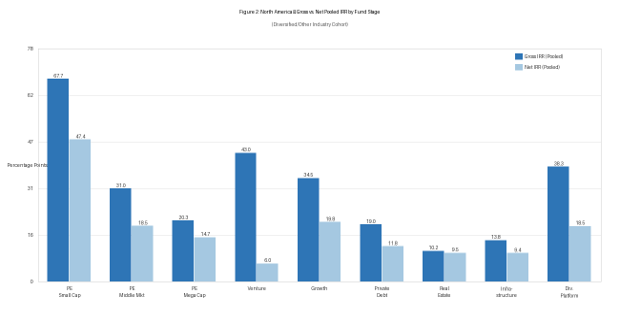
Figure 2 illustrates the absolute levels of gross and net pooled IRR for North American funds across all stages. The visual contrast between gross and net performance underscores the economic significance of the expense burden, as does the relative spread between them. Notably, North American venture capital funds exhibit a gross pooled IRR of 42.97% that is reduced to only 5.97% on a net basis, which is a compression of 37.0 percentage points. In addition, the relative spread is 86%. These extreme spreads likely reflect the combination of high management fee ratios in venture (often 2.0–2.5% of committed capital), substantial carried interest on the strongest performers, and the long holding periods during which fees compound against deployed capital.
Source: CEPRES Market Intelligence Database, Custom Analysis (Diversified/Other industry cohort, pooled IRR, North America only).
By contrast, North American real estate funds display a spread of only 0.61 percentage points (gross 10.15% vs. net 9.54%), likely reflecting the yield-driven nature of real estate returns, lower carried interest structures, and the institutional maturity of real estate fund fee arrangements. Infrastructure funds also exhibit relatively modest spreads (4.32 points in North America), consistent with the lower-return, yield-oriented profile of the asset class.
D. Europe: A Different Pattern
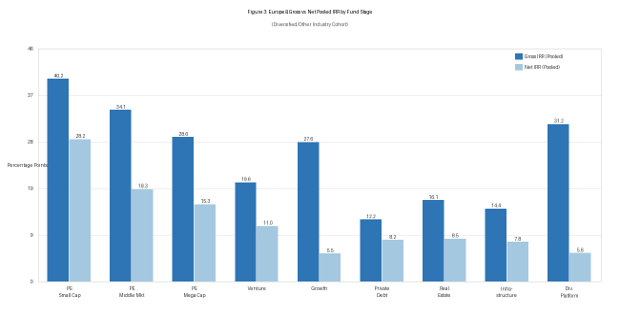
Figure 3 presents the same analysis for European funds. Several notable contrasts with North America emerge. European venture funds show a spread between gross and net IRR of only 8.65 points (compared to 37.0 in North America), potentially reflecting smaller average fund sizes, lower gross performance, and different fee-and-carry structures in the European venture market. European growth funds, conversely, show a notably wider spread between gross and net IRR (22.12 points) than their North American counterparts (14.70 points), suggesting that European growth managers may extract a proportionally larger share of gross returns through fees and carry.
Source: CEPRES Market Intelligence Database, Custom Analysis (Diversified/Other industry cohort, pooled IRR, Europe only).
European real estate funds show a spread between gross and net IRR of 7.63 points — substantially higher than the 0.61-point spread observed in North America. This divergence may reflect structural differences in European real estate fund fee arrangements, smaller fund sizes creating higher per-dollar fee burdens, or differences in the mix of strategies (e.g., opportunistic vs. core) within the European real estate sample.
E. Industry Variation Within Fund Stages
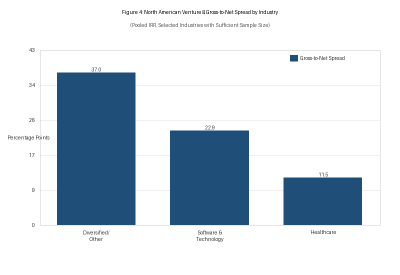
The CEPRES data also permits analysis of gross-to-net spreads within a given fund stage across different industry concentrations. As shown in Figure 4, the spread between gross and net IRR within North American venture capital varies significantly by industry focus. The Diversified/Other cohort shows a 37.0-point spread, while venture funds focused on Software and Technology show a spread of approximately 22.9 points, and Healthcare-focused venture funds show a spread of approximately 11.5 points. These differences likely reflect varying levels of portfolio concentration, valuation volatility, and the relationship between realized carry timing and fee accrual across industry-focused strategies.
Source: CEPRES Market Intelligence Database, Custom Analysis (North American Venture, pooled IRR, selected industries with sufficient sample size).
Similarly, North American growth funds show meaningful industry variation: the Diversified/Other cohort spread is 14.70 points, Software and Technology is 9.33 points, and Consumer-focused growth funds show a spread of only 5.89 points. These patterns suggest that industry composition is a meaningful driver of gross-to-net economics and should be considered by investors when benchmarking managers.
F. Key Observations and Implications
The most striking finding in the CEPRES data is the 37.0-point spread between gross and net pooled IRR for North American venture funds in the Diversified/Other cohort. This spread suggests that for every dollar of gross value created by a typical North American venture fund, approximately 86 cents is absorbed by the combination of management fees, fund expenses, and carried interest before reaching investors’ pockets on a pooled basis. For LPs evaluating venture allocations, this underscores the importance of understanding not only gross returns but the full economic cost of achieving those returns.
At the opposite end of the spectrum, North American real estate funds show a gross-to-net spread of only 0.61 points, suggesting that the combination of mature fee structures, yield-driven return profiles, and competitive market dynamics have compressed the total economic burden on investors to near parity between gross and net performance.
Regional disparities also merit attention. European growth funds show a wider spread (22.12 points) than North American growth funds (14.70 points), while European venture funds show a dramatically narrower spread (8.65 points) than North American venture funds (37.0 points). LPs with allocations across geographies should consider these structural differences when evaluating the “all-in” cost of their private fund investments and when benchmarking managers within a given strategy across regions.
The CEPRES data provides powerful empirical support for the proposition that expense transparency and standardized performance reporting are central investor-protection imperatives, not mere administrative preferences. For LPs, understanding the gross-to-net spread is essential to properly benchmarking managers, comparing funds across a portfolio, and assessing whether the economic terms of a fund, including fees, expenses, and carry combined, are appropriate relative to the gross returns the manager is generating. For regulators and the broader market, this data illustrates precisely why the SEC’s sustained focus on fee and expense disclosures, and the industry’s movement toward standardized reporting, serve a genuine economic function: enabling investors to assess the full cost of private fund investing with the same rigor they apply to other asset classes.
XIII. Forward-Looking Trends
Private fund expense regulation today reflects a hybrid governance structure that combines fiduciary doctrine, a regulatory examination and enforcement feedback loop, contractual disclosure, and institutional investor monitoring. This hybrid model differs from purely prescriptive regulation and relies heavily on process, transparency, and market discipline.
The following are examples of how these four governance structures are converging today and tomorrow:
Greater documentation of expenses and standardization of expense categories across the industry;
Expanded focus on governance expectations and increased specificity in the disclosure of expenses;
Continued standardization of the reporting of expenses, including adoption of ILPA templates;
Regulatory examinations focused on expense disclosures as a recurring priority;
Increased investor reporting granularity for expenses and expense categories;
For GPs, robust expense governance signals operational maturity and investor alignment;
A view among regulators and investors that disclosure alone is insufficient without governance;
A view among regulators and investors that documentation is central to fiduciary defensibility;
A view among regulators and investors that process-based compliance can substitute for rigid rulemaking;
A view among regulators and investors that conflicts of interest must be governed, not merely disclosed;
Both LPs and GPs relying on artificial intelligence tools to conduct more due diligence in a shorter amount of time; and
The SEC’s Division of Enforcement’s potential increased interest in misleading expense disclosures, based on its newest edition of its Enforcement Manual, released in February 2026.
XIV. Practical Recommendations
Private funds can no longer view their expense disclosures in the context of “only what the LPA allows.” Today, fund managers must view those disclosures as standing at the intersection of fiduciary duty expectations, examination scrutiny, and market-standard transparency. Investor demands, coupled with the SEC’s examination priorities, will continue to push funds toward more standardized visibility for their fees and expenses.
A. For Advisers
Advisers have no choice but to adapt to this “new normal” for fee and expense disclosures. To do so, they will need to change their disclosure-related processes across the board. When drafting their disclosures, category labels will no longer suffice. They will need to include examples of expenses, their methodology for allocating expenses, and the guardrails they have in place for ensuring those expenses are not misallocated.
Regarding governance of expenses, advisers will need to prioritize documentation. They should document disclosures and approvals, and ensure the LPAC process is clean and free of conflicts. Turning to controls, advisers should expect to periodically test their allocations and offsets. Maintaining exception logs will enhance the credibility of the testing process.
Finally, when it comes to reporting, LPs have increased expectations for standardized expense reporting. Whether those expectations stem from ILPA’s standardized disclosures or LPs’ own bespoke expectations, advisers should plan on adopting a standardized expense reporting template.
B. For LPs/Investors
To continue to drive more transparent fee and expense disclosures from advisers, LPs and investors should ensure their own processes hold advisers accountable concerning those disclosures. During due diligence, LPs and investors should seek a written allocation policy and historical allocation testing. When contracting, they should demand explicit expense schedules, affiliate constraints, and clear calculations for offsets. Finally, when monitoring, they should use standardized templates to compare expense disclosures and allocations across portfolios and flag intra-fund and intra-portfolio “creep.”
Endnotes
[1] Source: CEPRES Market Intelligence Database, Custom Analysis. Gross-to-net IRR spread figures are derived from pooled Gross IRR and Net IRR data for the Diversified/Other industry cohort within each fund stage and geography. Data excludes 3,130 funds with a global investment strategy. All information is based on data obtained from private equity fund managers, which CEPRES believes to be reliable; CEPRES does not in all cases audit or verify such information.
[2] Id. North American Private Debt, Diversified/Other cohort: Gross Pooled IRR 19.04% less Net Pooled IRR 11.75% = 7.29 percentage point spread (n = 360 funds).
[3] Id. North American Diversified Platform: spread of 19.81 pp (Gross 38.29%, Net 18.48%); European Diversified Platform: spread of 25.60 pp (Gross 31.21%, Net 5.61%).
[4] Id. North American Real Estate, Diversified/Other cohort: Gross Pooled IRR 10.15% less Net Pooled IRR 9.54% = 0.61 percentage point spread (n = 633 funds).
Strategies helps businesses and individuals solve the complexities of dealing with the government at every level. Our team of specialists concentrate exclusively on government affairs, representing clients nationwide who need assistance with public policy, advocacy, and government relations strategies.
Troutman Pepper Locke’s program for Startup and Early-Stage Entrepreneurial Development
This unique program provides innovative and affordable opportunities to startups and early-stage emerging companies with a solid technology or scientific foundation. We help companies that have a quality management team in place and do not have other significant legal representation.
Market leading eDiscovery and data management services.
eMerge’s lawyers and technologists work together to deliver strategic end-to-end eDiscovery and data management solutions for litigation, investigations, due diligence, and compliance matters. We help clients discover the information necessary to resolve disputes, respond to investigations, conduct due diligence, and comply with legal requirements.