Strategies helps businesses and individuals solve the complexities of dealing with the government at every level. Our team of specialists concentrate exclusively on government affairs, representing clients nationwide who need assistance with public policy, advocacy, and government relations strategies.
Troutman Pepper Locke’s program for Startup and Early-Stage Entrepreneurial Development
This unique program provides innovative and affordable opportunities to startups and early-stage emerging companies with a solid technology or scientific foundation. We help companies that have a quality management team in place and do not have other significant legal representation.
Market leading eDiscovery and data management services.
eMerge’s lawyers and technologists work together to deliver strategic end-to-end eDiscovery and data management solutions for litigation, investigations, due diligence, and compliance matters. We help clients discover the information necessary to resolve disputes, respond to investigations, conduct due diligence, and comply with legal requirements.
We are pleased to announce the release of our latest whitepaper, Fueling Up: How to Make U.S. Clean Hydrogen Projects Happen. This comprehensive report explores the critical steps needed to unlock the potential of clean hydrogen in the U.S., and the related challenges faced by developers and utilities.
Our report addresses key topics such as the need for certainty on tax credits, improved certification standards to boost off-taker confidence, and supporting strategic investments in domestic manufacturing and infrastructure. We also discuss the potential for the U.S. to become an exporter of clean hydrogen and related products.
Download the whitepaper here to gain valuable insights and to learn how to navigate the complexities of this emerging sector.
Summary
The Inflation Reduction Act (IRA) and Bipartisan Infrastructure Law (BIL) have helped drive interest from companies keen to develop “clean” and “green” hydrogen projects in the U.S. These companies also hope to benefit from more industrial demand for greener alternatives to fossil fuels.
In this report, we look at the factors guiding clean hydrogen development activity in the U.S. Clean hydrogen is an alternative to fossil fuels and can help cut carbon dioxide emissions in hard-to-abate sectors such as chemical production and transportation. This is why the federal government has sought to support the growth of clean hydrogen with large policy announcements in recent years, including production tax credits (PTCs) made available by the IRA and billions of dollars in funding to support the development of regional hydrogen hubs and to stimulate demand.
However, developers face a series of obstacles as they seek to take projects to financial close, which is the vital point in a project’s development cycle when it shifts from planning to execution. These challenges include needing clarity on PTCs under the proposed Section 45V rules from the Internal Revenue Service (IRS); needing greater demand for clean hydrogen; and the need to secure other vital infrastructure.
Our report shares insights from leading market experts about the state of clean hydrogen in the U.S. and steps needed to move early projects into utility-scale schemes. These experts reflect on the opportunities and challenges presented by accelerating the growth of clean hydrogen, the impacts of policy and regulatory support announced in the last three years, and how federal and state policymakers can further boost production and demand.
Introduction
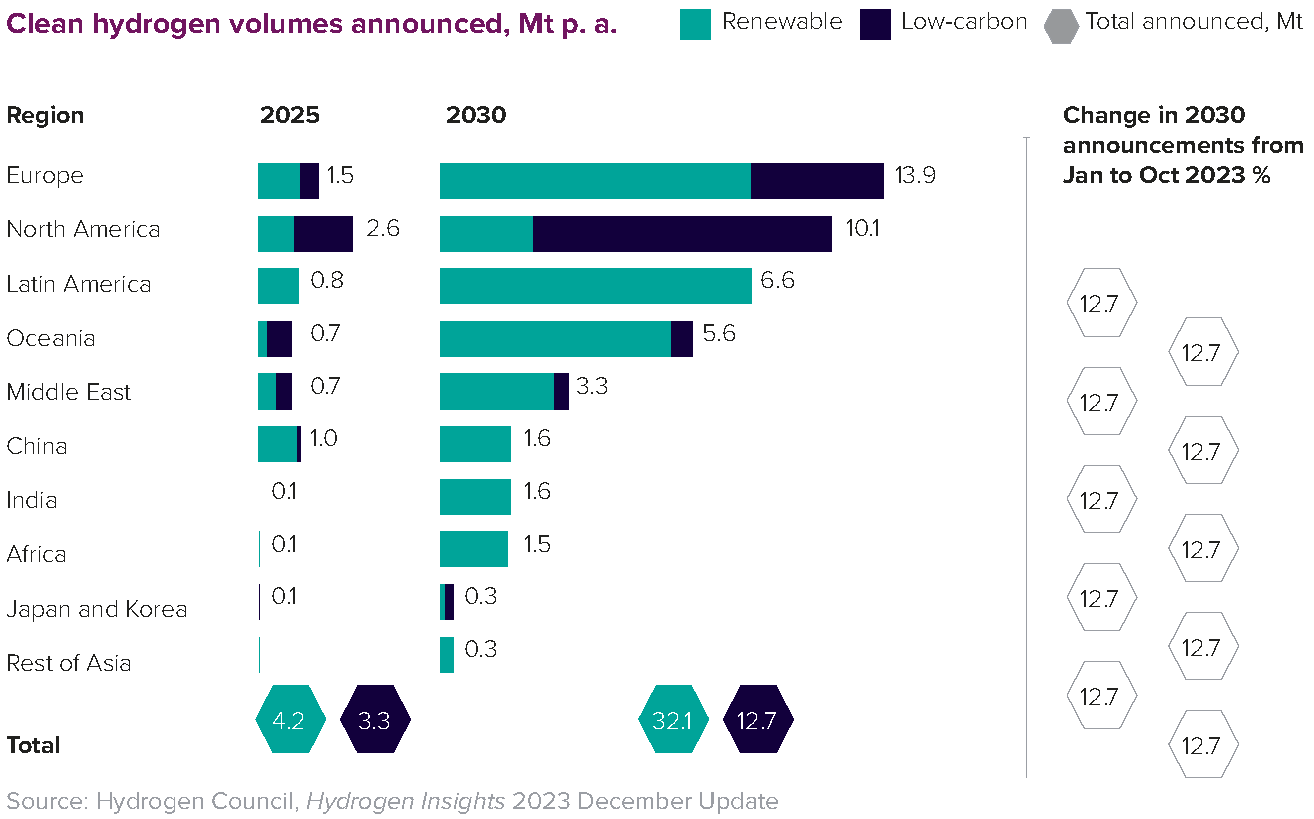
North America is second only to Europe in terms of announced clean hydrogen projects.
The Hydrogen Council, a global industry association, reported in December 2023 that 248 clean hydrogen production facilities were in development or under construction in North America, compared to 540 in Europe. The number of projects in North America grew by around 20% last year as new developments worth a combined $12 billion were announced.
That increase in development activity follows moves by the Biden Administration to accelerate investment in the U.S. clean hydrogen sector in the last three years, including the passage of the BIL in November 2021 and the IRA in August 2022.
These laws created incentives, primarily in the form of PTCs, to encourage companies to produce clean hydrogen, and established $7 billion in funding to support the creation of regional hydrogen hubs. These laws also provided $1 billion of financial support to boost demand for clean hydrogen among would-be off-takers.
Utilities, independent power producers and developers now have a window of opportunity to advance their clean hydrogen production projects, consistent with state clean energy policies and corporate initiatives aimed at cutting carbon emissions.
Notwithstanding the progress that has been made to date, this report highlights five key areas where more must be done to ensure the development of successful clean hydrogen projects.
What is clean hydrogen?
Although there is currently no universal definition of ‘clean’ hydrogen, organizations such as the Hydrogen Council and the International Energy Agency are seeking to establish definitions for the different types of hydrogen based on their emissions intensity. In the interim, below are common industry terms:
Green (or renewable) hydrogen refers to hydrogen that is produced using power from renewable sources, including solar or wind farms, or produced via the gasification of sustainable biomass that is reformed or pyrolyzed.
Blue hydrogen refers to hydrogen produced by processes such as natural gas reforming linked to carbon capture and storage facilities.
Low-carbon hydrogen refers to hydrogen that is produced using non-renewable sources but with carbon footprints below a defined threshold. This includes ‘blue’ hydrogen; and hydrogen produced with nuclear power, which is sometimes referred to as ‘pink’ hydrogen.
Clean hydrogen refers to ‘green,’ ‘blue,’ and ‘low-carbon’ hydrogen. We will use ‘clean’ hydrogen in this context as it aligns with definitions used by the Biden Administration in its regional Hydrogen Hubs program.
Turquoise hydrogen refers to hydrogen made using a process called methane pyrolysis to produce hydrogen and solid carbon.
Gray, black, or brown hydrogen refers to hydrogen produced using fossil fuels, mainly via the reforming of natural gas or the gasification of coal.
From Policy to Reality
The IRA and BIL are not the only demonstrations of the federal government’s commitment to unlocking growth in clean hydrogen.
On May 5, 2024, the Department of Energy (DOE) Hydrogen & Fuel Cell Technologies Office released a multi-year plan to cut the cost of producing clean hydrogen and fuel cells. The plan is focused on practical steps to help achieve the goal set in the DOE’s June 2021 ‘Hydrogen Shot’ initiative, which aimed to reduce the cost of clean hydrogen production by 80% by 2031; and cut the cost of hydrogen electrolyzer systems to $250–$500 per kW by 2026. This plan aligns with the priorities of the National Clean Hydrogen Strategy and Roadmap, and the Industrial Decarbonization Roadmap.
Despite these advances, businesses still face obstacles if they want to develop clean hydrogen facilities, as acknowledged by DOE Hydrogen Program Coordinator Sunita Satyapal, who is also director of the Hydrogen & Fuel Cell Technologies Office.
According to Satyapal, “progress in clean hydrogen today is encouraging [but] it is also clear that more is needed – and the actions must be well-planned, deliberate, carefully executed with measurable outcomes, and they must come without delay.”
This comment is a welcome acknowledgement from DOE that companies developing clean hydrogen projects in the U.S. face challenges when transitioning from early-stage development and planning to construction. Satyapal’s view echoes comments made by the industry experts in interviews for this report.
This report summarizes what we deem to be the five biggest obstacles standing in the way of developing green hydrogen projects in the U.S.
1) More clarity needed on clean hydrogen tax credits
Section 45V of the Internal Revenue Code added new PTCs of up to $3/kg, or alternatively investment tax credits of up to 30%, for clean hydrogen projects based on their greenhouse gas emissions. The intention was to give the biggest incentives to the least-polluting and ‘greenest’ schemes.
However, companies had to wait nearly 16 months for further guidance from the IRS about how these would work in practice.
In December 2023, the IRS finally issued proposed regulations on the Section 45V rules. Despite industry participants’ hopes that the IRS rules would be more flexible than those in the European Union, U.S. utilities and developers are confronting equally strict rules that caused more market uncertainty.
For hydrogen to be considered ‘clean’ and eligible for the Section 45V credits, it must meet three criteria, commonly referred to as the “three pillars:”
1. Additionality: The hydrogen facility cannot draw power from a project that is more than three years older than the hydrogen project. This ‘additionality’ requirement is meant to support construction of new renewables.
2. Time Matching: Beginning in 2028, the electricity used to produce the hydrogen must be generated within the same hour as the hydrogen. This ‘time matching’ requirement demonstrates that the project is using renewable power.
3. Deliverability: The electricity source and the hydrogen facility must be in the same geographic area based on DOE’s transmission needs analysis. This ‘deliverability’ requirement limits the possibility that grid congestion results in curtailment of the renewable power while fossil fuel power increases to meet the energy demands of the hydrogen facility.
Developers and utilities have warned that the ‘additionality’ and ‘time matching’ rules will make it harder to get projects off the ground and are too onerous for an industry that is still taking shape. They are now awaiting further clarity from the IRS when the regulations are finalized: optimists are hoping for additional information this summer, while others expect it only after the November election.
Nicolas Beck, head of market intelligence for North America at mining and energy giant Fortescue, said the proposed Section 45V rules have stopped progress on U.S. clean hydrogen projects. Fortescue is developing green hydrogen projects, including an 80MW facility in Phoenix, Arizona, where it held a groundbreaking ceremony last month; and is also involved in the development of the Pacific Northwest Hydrogen Hub, which won DOE backing in October 2023.
“We’ve got some concerns about it that were reflected in our public comments, namely that the rules as they currently stand would really constrain the scale of projects that we could do and would drive up the cost of green hydrogen. That is important because we need the cost of hydrogen to be as low as possible to encourage adoption,” he said.
Beck added: “If we had clean hydrogen at $1/kg today, we would have buyers out of the door and that would be fantastic in terms of building the ecosystem. But if the regulations make it more expensive to produce, to qualify for a tax credit, that’s a problem.”
Katrina Fritz, president and chief executive of the California Hydrogen Business Council, said the 45V rules were a “huge issue” for companies.
“I wish I was saying this is a valuable incentive for hydrogen production, based on carbon intensity, but the way Treasury has interpreted the statute is so counterproductive that CHBC became involved at the federal level. We are not normally involved at this level, but this is really mission critical to the whole industry,” she said.
Fritz added that one difficulty with 45V is that a few legislators at the state level have been trying to base their own policies on the draft guidance, which could restrict development.
“In California, they tried to pass policy mapped to the draft 45V guidance. We’ve pushed back successfully by saying this is draft guidance, it’s not final, and successfully stopped a couple of bills,” she said. “Treasury’s draft regulations would stifle electrolytic hydrogen and entrench fossil hydrogen, which was not the intent of Congress.”
Mike Kramer, vice president of finance – growth and projects, at Constellation Energy, said the IRS had received a “significant amount of comments” on the rules. Constellation is working on clean hydrogen projects including the nuclear-powered LaSalle Clean Energy Center in Illinois, which is part of the Midwest Alliance to Clean Hydrogen hub that was one of seven major clean hydrogen projects to win DOE backing in October 2023.
“The hubs that are trying to get their projects built, a lot of them have similar problems whether it’s additionality, whether it’s the time matching for hourly, and other challenges that are now coming about as it relates to the uncertainty regarding the rules. It makes it so that the infrastructure that you were trying to build to help these projects fit together, and really accelerate the potential for clean hydrogen, that is stuck too,” he said.
2) Improved certification to improve off-taker confidence
Most federal support for clean hydrogen in the U.S. is focused on stimulating production.
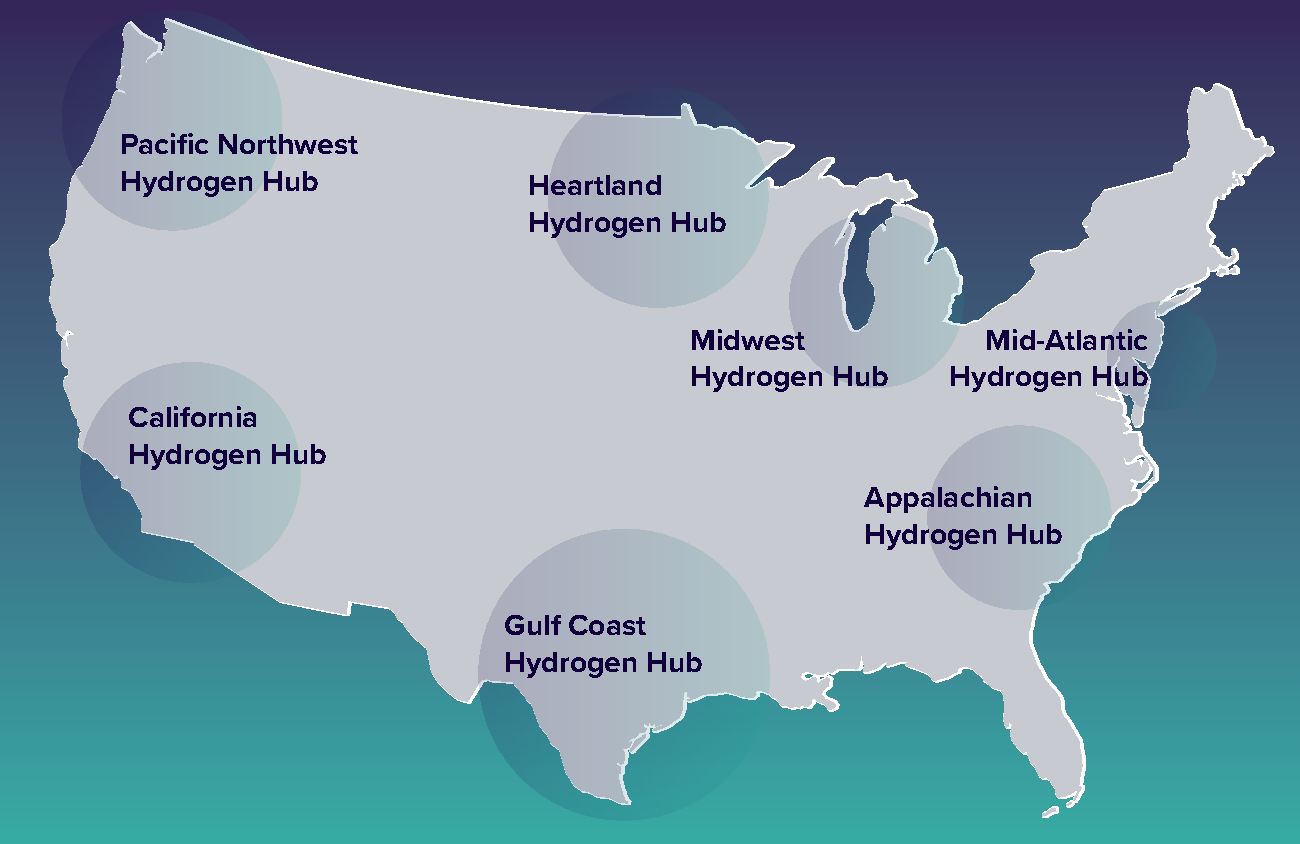
However, in addition to PTCs, the Biden Administration has made $7 billion of funding available to support seven regional clean hydrogen production hubs across the country (see box on Page 11). These hubs aim to stimulate off-taker demand for hydrogen, as well as production.
Our interviewees reported that the major opportunities for the industry are to use clean hydrogen to replace gray hydrogen, which is widely used in sectors such as chemicals production; metals production; and oil refining. Transportation and utility companies also are looking to renewable fuels to replace fossil fuels.
The U.S. is poised to reveal details in September 2024 of a $1 billion subsidy program to help link clean hydrogen producers with users, although many of our interviewees said that federal support has been focused on stimulating production rather than demand.
Tiffany Wallace, legal counsel at Volvo Trucks, argued that companies have already been looking to clean hydrogen to make their operations more sustainable, as they are facing pressure to reduce their environmental impacts. She said one difficulty for clean hydrogen users is the lack of certification to verify how green the fuel really is.
“I think all companies are probably trying to see what’s the best way forward for using hydrogen,” she said. “For us, when we’re looking to purchase hydrogen, it’s imperative that we get green hydrogen, so we need the appropriate certification, and I don’t know if that’s in place yet. We need true visibility of our supply chain to see if their hydrogen is really green. Something that needs to be addressed is making sure there are appropriate policies and certification in place that we know we can rely on.”
The pressure on manufacturers to become more sustainable will increase the pressure on companies in their supply chains, which should increase clean hydrogen demand.
“We have fossil-free specialists who focus on procuring fossil-free materials and we are working with our suppliers to meet carbon reduction targets,” Wallace said. “We see green hydrogen as a big part of that in the way forward.”
Jacob Susman, chief executive at Ambient Fuels, which works with hydrogen users to add green hydrogen production supply into their operations, said more states could encourage greater uptake of clean hydrogen by introducing low-carbon fuel standards. So far, only California, Oregon, and Washington have introduced such policies.
“When we saw wind and solar rise in the early 2010s, most of it was off the back of a renewables portfolio standard (RPS) in about 30 states. In the U.S., we have no such demand driver for, broadly, decarbonizing industrial heat or, specifically, green hydrogen thus far. What we should be doing is mobilizing state level demand drivers that mimic what the RPS did for wind and solar,” he said.
Susman added that it made sense for hydrogen users to start by taking small steps to add green hydrogen to their operations in the short term: “Like the Jim Collins quote, we usually advise them to shoot bullets now and cannonballs later. In other words, you don’t have to decarbonize your entire industrial heat process on day one. You can pick a relatively small part of your operation, use green hydrogen on a smaller scale to see how it works and, once it’s a huge success, go on from there,” he explained.
Brian Foody, chief executive officer at Iogen Corporation, said the standards in the 45V rules were helpful because they would give off-takers confidence that the hydrogen they use is ‘clean,’ while also supporting a wide range of hydrogen production methods. Iogen converts renewable natural gas into green hydrogen to be used in green transport fuels.
“There is a broad set of people saying they really want the rules to be more development friendly and that will unleash billions of dollars of investment,” Foody said. “But I think the Biden Administration has worked hard to say, ‘We will support the sector as much as we possibly can, so long as what we do is entirely environmentally responsible.'”
A commitment to rigorous rules should provide clean hydrogen users with confidence, and confident users will help support the development of a domestic clean hydrogen market in the U.S.
Where are U.S. regional clean hydrogen hubs?
The Biden Administration announced in October 2023 that it would support the growth of seven regional hydrogen hubs in the U.S. These projects are intended to support both the production of clean hydrogen and increase the demand for it.
Appalachian Hydrogen Hub is being developed by companies that include Battelle, EQT, and GTI Energy, in partnership with the state of West Virginia. It is set to produce green hydrogen that will primarily help decarbonize transportation.
California Hydrogen Hub includes over 200 partners, including technology giants Amazon and Microsoft; industrial gas companies Air Liquide, Air Products, and Linde; and other companies, including Bloom Energy, Chevron, Plug Power, and General Motors. This green hydrogen project is led by the state of California.
Gulf Coast Hydrogen Hub is being developed in Texas by seven core partners: AES, Air Liquide, Chevron, ExxonMobil, Mitsubishi Power Americas, Ørsted, and Sempra Infrastructure. It is set to produce green and blue hydrogen.
Heartland Hydrogen Hub is a blue hydrogen project being developed by partners including Marathon Petroleum, TC Energy, and Xcel Energy.
Mid-Atlantic Hydrogen Hub is being developed by 15 anchor partners including Air Liquide, Bloom Energy, Chesapeake Utilities, and PSEG. This is set to produce low-carbon hydrogen from renewable energy sources and nuclear.
Midwest Hydrogen Hub is set to produce low-carbon hydrogen and has 71 partners, including Air Liquide, ArcelorMittal, Bloom Energy, BP, Constellation Energy, ExxonMobil, GTI Energy, Nikola Motors, and Plug Power.
Pacific Northwest Hydrogen Hub is a green hydrogen scheme including projects from 17 companies including Air Liquide, Amazon, Fortescue, Mitsubishi Power Americas, Portland General Electric, and Puget Sound Energy.
These hubs are complex networks of projects, and negotiations are underway between their developers and the federal government about their final funding deals.
3) Boosting exports to provide additional routes to market
Encouraging companies within the U.S. to use more clean hydrogen and related products is one opportunity, but some of our expert interviewees argued that there is also potential to establish the U.S. as an exporter of clean-hydrogen-based products.
Pedram Fanailoo, director for low-carbon segment – North America at DNV, the risk management and assurance firm, pointed to the fact that industries globally are under regulatory pressure to decarbonize. He said the usual rule in energy was “the cheapest fuel always wins,” but noted that regulatory pressures on companies meant clean hydrogen could grow even if it is more expensive.
He suggested that an opportunity is open to export clean hydrogen products from the U.S. to parts of Europe and Asia: “We see good opportunities for the export of hydrogen to other jurisdictions such as Europe. There’s an attractive opportunity to take ammonia as an energy carrier to Europe, and also Japan.”
Fanailoo said the opportunity exists because the regions have taken different approaches to encouraging the energy transition.
“What’s exciting is the interplay between the regulations and incentives in the U.S. and Europe. The U.S. has taken an all-carrot approach to the energy transition, whereas we can think of Europe as taking an all-stick approach. That combination makes it much easier for clean hydrogen to overcome this rule that the cheapest fuel always wins, because Europe is paying a premium for fuels compared to North America. It makes sense to look at Europe as a premium export market,” he said.
However, trade between regions is also dependent on compliance with regulations, and there are currently uncertainties about the potential for exports in the regulations in the U.S. and Europe. Further clarification is needed in this area.
Andy Ralph, Americas region hydrogen leader at Arup, said growing the international export market for clean hydrogen products from projects like World Energy GH2’s Project Nujio’qonik in Newfoundland and Labrador was a great opportunity for developers and investors because it would help the market become more mature.
“First, it brings in capital and the off-take certainty from around the world. It also grows the transportation capability to export ammonia, where people say there aren’t enough vessels at present. And it links us globally, which is very important. You see that global link in oil markets and gas markets, and it’s an important stabilizing risk mitigating factor in the whole process,” he said.
Ralph said this would aid development of a spot market for clean hydrogen and related products, and give hydrogen producers and users greater transparency about open market prices: “One of the by-products that would come out of large-scale export projects is the growth of a spot market, and you can see in LNG (liquefied natural gas) how that spurs growth. It stabilizes the market overall and it matures the market,” he argued.
But he said there would also be opportunities for developers and producers to export clean hydrogen and related products between regions of the U.S.
“You could call it ‘internal export.’ We’re seeing that’s pretty normal for projects here in Texas. Everybody wants to make ammonia and get it to the coast and on a boat,” he said. “That’s a mechanism that people are looking at and aiming for right now.”
4) Building the U.S. manufacturing footprint for hydrogen technology
The cost to produce clean hydrogen is linked to the price of the energy used to create it, as well as the price of technology. That is why the federal government has committed to reduce the cost of electrolyzers to $250–$500/kW by 2026.
However, Bloomberg New Energy Finance (BNEF) warned in March 2024 that there is already a severe oversupply of hydrogen electrolyzers globally. It said that electrolyzer makers are looking to grow annual production to more than 50GW by the end of 2024 and nearly 75GW in 2025, which far outpaces the amount of clean hydrogen production projects being built.
BNEF also reported that 68% of global electrolyzer manufacturing is located in China. In the short term, this represents an opportunity for developers to import the electrolyzers they need from China, but in the longer term, the federal government has committed to grow domestic electrolyzer production capacity so it is not reliant on imports from China. Developers may need support to navigate these market dynamics.
Antonio Fayad, senior manager for H2 strategy & origination at clean energy owner and operator EDP Renewables North America, which is developing green hydrogen projects, said access to electrolyzers is not currently the main challenge for project developers. But he added that electrolyzer production capacity still needs to grow in the U.S. if the country is to meet its goals with locally made machines.
“Electrolyzer technology has been around for several decades, so it is not completely new. There are manufacturers that have a significant track record, but they were done at a size and scale that is much smaller than what we are envisaging to develop,” he said.
Fayad added that a large number of new players are coming into the market: “We see the need for a significant increase in manufacturing capacity in the U.S., but we don’t, as of today, see access to technology as a key barrier for the development of hydrogen.”
Steve Schueneman, hydrogen development manager at Puget Sound Energy, which is involved in the Pacific Northwest Hydrogen Hub, said electrolyzer manufacturers would find it easier to invest in the U.S. if they see strong demand from off-takers. He identified petroleum refining to make sustainable liquid fuels as an ideal sector to take the lead and prove the demand.
“That would be an ideal first mover. You give the supply side a market signal to increase production capacity; the R&D space a signal to make electrolyzers more efficient and reliable; and, because of the power demands of a refiner, you are also going to drive new investment in renewables and new transmission. If you were able to scale that one up then I think you would start to see growth in adjacent industries. Transit agencies and bus fleets are also poised to be a first mover, as the operational characteristics of a hydrogen fuel cell bus appear to be better than battery electric buses in many cases,” he said.
Schueneman added that the capital expenditure involved in installing a large electrolyzer for industrial clean hydrogen production is not very well known because the industry is still scaling. He also said that the rapid expansion of low-cost solar and wind power, combined with tax credits, may bring the cost of electrolytic hydrogen production near the cost of natural gas, but that this may not last due to the uncertainty around the application of those tax credits and the rocketing power demand for technologies such as artificial intelligence.
Chris Kroeker, head of decarbonization services at Oregon’s largest gas utility, NW Natural, said more investment is needed in other hydrogen-producing technologies too. The company is working on pilot projects to make turquoise hydrogen, which is produced through the process of methane pyrolysis.
Kroeker said the expansion of turquoise hydrogen would help its 2 million customers to decarbonize, both because NW Natural is working towards blending hydrogen into its natural gas supplies and through direct off-take deals with hydrogen buyers. But he explained it is hard to find producers of the pyrolysis units because the industry is still in its early days.
“The biggest issue we have is finding companies that have technology available to sell to us so we can take the carbon out of our energy stream. We’re trying to help them to grow and mature at the same time as deploying these units,” he said. “There really isn’t anyone in the space that has a commercial scaled-up product as we speak. Some have one or two units deployed, but it’s nothing like a production line.”
Even with cheaper electrolyzers and other hydrogen-producing technologies, there may not be a straightforward path to developing profitable clean hydrogen projects.
5) Prioritizing ‘backbone’ infrastructure to reduce project risks
Growing the clean hydrogen industry relies on developing more than production facilities and increasing off-taker demand. Operators will also need to be able to store and move the hydrogen they produce, so the government will need to unlock investments in supporting infrastructure too.
The DOE recognized this challenge in its June 2023 National Clean Hydrogen Strategy & Roadmap, where it reported that between $2 billion and $3 billion of investment annually is needed in hydrogen infrastructure projects between 2023 and 2030 to enable the U.S. to achieve annual production of 10 million metric tonnes of clean hydrogen by 2030.
Beyond that, the DOE said investment in supporting infrastructure would need to grow to between $15 billion and $20 billion annually by 2050.
Our interviewees largely agreed that this infrastructure is not needed immediately. Green hydrogen and related products can be transported by vehicles. However, the challenge is that this infrastructure takes years to plan and deliver. There is currently little clarity over what this infrastructure should look like and how it should be delivered.
A lack of infrastructure could be an obstacle for the sector over the medium- to long-term unless companies have the confidence that the appropriate infrastructure will be there when it’s needed.
One hydrogen specialist at an international bank, who did not want to be named, said a potential solution could be for U.S. gas companies to work together to plan a pipeline network similar to the European Hydrogen Backbone (EHB) scheme being proposed in Europe. The EHB plans for a network of 39,700km of hydrogen pipelines to be developed by 2040 and connected to 21 European countries.
“The main challenge is time. Because of the urgency around temperature rise, people want to do this very fast, but nothing is in place yet. We don’t have the basic infrastructure in place, we don’t have the fleets, we don’t have the long-term off-take market at scale. But the key problem is time,” she said, adding that it took decades for the U.S. renewable energy market to reach the level of maturity needed to unleash the capacity growth we have seen this decade.
“There’s basic infrastructure that needs to be put in place and that needs a lot of political, regulatory and subsidy support,” she added. “For hydrogen trucks and buses, the amount of refuelling stations we need is not as large as we think to kick start the hydrogen economy. I would say you need, at least pipeline infrastructure and refuelling stations in place to give certainty.”
Michelle Detwiler, recently retired executive director of the Renewable Hydrogen Alliance, said one challenge to building a hydrogen network in the U.S. is the fragmented nature of the country’s grid, which could make it challenging for the country to follow the example of Europe.
She explained: “As far as the EU is concerned with the way its energy infrastructure is set up, it doesn’t look like the U.S. Arguably, it’s easier to establish the boundaries and the requirements around hydrogen production, distribution, and end use in Europe, because geographically and infrastructure-wise, it’s much more connected and homogenous. The EU doesn’t work with the same number of different regional energy markets as we do in the U.S.”
Recently, the DOE and Federal Energy Regulatory Commission have started to address the challenges confronting the electricity grid and they may come under pressure to do the same for clean hydrogen. Simply put, developers and utilities need clarity on infrastructure.
How to accelerate investment in U.S. clean hydrogen projects
The IRA and BIL have the potential to be transformational legislation for clean hydrogen, despite the challenges faced by developers in the U.S. But what steps can policymakers and those in the industry take to benefit from the current window of opportunity?
Here are five priorities to help more projects reach financial close and develop a healthy clean hydrogen industry in the U.S. in the coming years:
1) Maintain pressure for 45V clarity and state green fuel targets
Companies are awaiting the final version of the 45V rules, and accompanying guidance, that will provide clarity on production tax credits. Those in the industry must continue to lobby for these clarifications as a matter of urgency, and ensure state laws align with the final rules. In addition, state low-carbon fuel standards can drive clean hydrogen demand.
2) Work with off-takers to establish best practice in certification
Clean hydrogen producers must be aware of the importance of clean fuel standards to off-takers, and work to provide the proof that the hydrogen they produce meets those standards. This will help developers put in place off-take deals that make their projects more bankable, while international alignment on certification can help boost exports too.
3) Collaborate on international standards to unlock export markets
Rapid growth in the U.S. clean hydrogen industry can open opportunities to export clean hydrogen and related projects around the world. However, U.S. policymakers will need to work with regions, including the European Union, to establish common standards. Those in the industry who work across these regions can play an important role in this process.
4) Build U.S. manufacturing base but recognize China’s short-term role
Investment is needed in the U.S. electrolyzer supply chain if the country is to achieve its goals for domestic production, but developers should also see that global oversupply represents an opportunity too. In the short term, developers must not be penalized for importing vital electrolyzer technology as that is crucial to help build scale in the clean hydrogen market.
5) Support progress of supporting infrastructure – but don’t rely on it
Over the long term, the health of the U.S. clean hydrogen sector will rely on the emergence of ‘backbone’ supply infrastructure. Companies and policymakers must work together to deliver this infrastructure. However, in the short term, developers can seek to mitigate their project risks by focusing on schemes not reliant on third-party infrastructure.
Strategies helps businesses and individuals solve the complexities of dealing with the government at every level. Our team of specialists concentrate exclusively on government affairs, representing clients nationwide who need assistance with public policy, advocacy, and government relations strategies.
Troutman Pepper Locke’s program for Startup and Early-Stage Entrepreneurial Development
This unique program provides innovative and affordable opportunities to startups and early-stage emerging companies with a solid technology or scientific foundation. We help companies that have a quality management team in place and do not have other significant legal representation.
Market leading eDiscovery and data management services.
eMerge’s lawyers and technologists work together to deliver strategic end-to-end eDiscovery and data management solutions for litigation, investigations, due diligence, and compliance matters. We help clients discover the information necessary to resolve disputes, respond to investigations, conduct due diligence, and comply with legal requirements.