Strategies helps businesses and individuals solve the complexities of dealing with the government at every level. Our team of specialists concentrate exclusively on government affairs, representing clients nationwide who need assistance with public policy, advocacy, and government relations strategies.
Troutman Pepper Locke’s program for Startup and Early-Stage Entrepreneurial Development
This unique program provides innovative and affordable opportunities to startups and early-stage emerging companies with a solid technology or scientific foundation. We help companies that have a quality management team in place and do not have other significant legal representation.
Market leading eDiscovery and data management services.
eMerge’s lawyers and technologists work together to deliver strategic end-to-end eDiscovery and data management solutions for litigation, investigations, due diligence, and compliance matters. We help clients discover the information necessary to resolve disputes, respond to investigations, conduct due diligence, and comply with legal requirements.
This article was originally published in PV Magazine on July 10, 2026 and is republished here with permission.
A decade-long surge in smart grid patent grants has created a maturing portfolio of rights entering a prime window for assertion. At the same time, a new wave of AI- and machine-learning-enabled smart grid patents is building, extending both opportunity and IP risk for utilities, solar developers, and storage providers well into the next decade and beyond.
For much of the last century, electric utility infrastructure changed slowly, and patent disputes rarely sat at the center of grid planning. That picture is shifting as increasingly complex and connected and smart grid management technologies, become core to system operations. The complexity of the grid itself is also increasing, with deep and increasing integration of both distributed and centralized solar power and grid-connected storage technologies. Advanced meters, edge controllers, and cloud-based platforms now shape how solar and storage resources are monitored, dispatched, and compensated. These same technologies have driven a substantial increase in smart grid patenting activity.
An initial wave of patents covering communications, metering, and system-level control accumulated over the past decade and is now entering mid-life, when enforcement and licensing activity often intensifies. A second wave, focused on AI and machine learning (ML) techniques applied to those same systems, is emerging on top of the first. Together, these portfolios will influence how utilities and their partners design and operate solar- and storage-rich grids, how they manage the associated intellectual property (IP) risk, and how patent owners leverage the resultant opportunities.
The first wave of smart grid patents
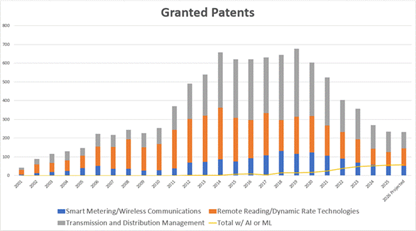
One way to understand this evolution is to look at patenting trends in the core technologies that enable the modern smart grid. For example, systems for transmitting utility meter data, remote metering and reading, and integrated platforms for liking power systems operations with communication and information technologies are all key to enabling and managing the increasingly complex grid with deep solar penetration. Figure 1, which was generated with data from the USPTO’s patent database, shows patent grants in these technologies since 2001.
Fig. 1: Granted patents per year (since 2001) in three smart-grid-related technology areas, selected using CPC codes H04Q 2209/60, G01D 4/00, and Y04S (10, 20, 40)/00. Secondary overlay is granted patents in all three technology areas that also reference AI or ML CPC Codes (G06N20/00 or G06N 3/04 02 08). Data compiled from USPTO patent database.
Plotting smart grid technologies over the past twenty-five years reveals a clear upward trajectory. As utilities rolled out advanced metering infrastructure, developed remote reading capabilities, and piloted more sophisticated distribution management systems, the number of patents granted covering these technologies increased tremendously.
Critically, many of these patents are now several years past grant, placing them in a period where owners may be more inclined to enforce, license, or otherwise monetize them. Patent licensing and enforcement activity characteristically intensifies during the mid-life of a patent because it is at that stage that the underlying technology has matured sufficiently to achieve broad commercial adoption, creating the largest pool of potential enforcement and licensing opportunities. In short, the mid-life of a patent is the most commercially valuable window for the patent holder to assert rights before the patent’s remaining term – and attendant damages exposure – begins to diminish. For solar and storage stakeholders, this means that the smart grid infrastructure connecting their assets to the grid may already sit under a dense layer of existing rights.
AI and machine learning
Figure 1 reveals a second trend – the influx of AI and machine learning (“ML”) patents, as reflected by the increase in patent grants referencing AI or ML CPC codes. While the overall smart grid portfolio began building in the early-to-mid 2000s, and peaked between 2014 and 2020, a second subset of smart-grid patents is just beginning entering its growth phase. Powered by recent breakthroughs in AI and ML, utilities and vendors are adopting algorithmic methods for managing data streams and control options unlocked by digitalization.
Rather than forming a distinct category, these AI- and ML-enabled patents represent technologies that are embedded in the same metering and system-level architectures covered by the first wave of smart-grid patents. As a result, they create a second wave of rights that will remain in force well after many first-wave smart grid patents have matured, extending both licensing and enforcement opportunity and risk further into the future.
Smart grid examples
AI and ML solutions are changing the landscape of an increasingly solar-dense grid at every level: from smart metering and dynamic rate programs for the end-user to system-level grid management.
For example, the growth in remote metering and communications patents in the utility space reflects the increase in technologies underpinning net metering and dynamic rate structures. These technologies depend on granular, near real-time data enabled by the smart grid to forecast solar generation and load, detect anomalies in meter data, optimize storage dispatch, and coordinate distributed energy. a As AI and ML techniques are layered onto these systems, meter data becomes a platform for further innovation. Models can estimate behind-the-meter solar output, flag unusual consumption or production patterns, and help design dynamic rate structures that better align customer behavior with system needs.
Similarly, system-level smart grid architectures are also operating in an increasingly patent-dense environment. Grid management technologies, which forecast and react to demand in real-time, are critically important to grids with high percentages of power derived from solar (solar penetration). Increased instability can accompany increased solar penetration; where traditional fossil fuel-powered grids can manage demand directly by increasing or decreasing supply, solar-dense grids must rely on forecasting (e.g., forecasting weather-related solar production, forecasting demand) to prepare in advance and manage supply and demand. Rapidly evolving technologies integrate management of these grids at all points, including generation, transmission, distribution, and end use, and focus on the communications and information technologies that support monitoring and control. The growth in these technologies corresponds with an increasingly crowded patent thicket.
As AI and ML become increasingly central to both end-user and system-level technologies, the combination of a maturing first wave of smart grid patents and a growing AI/ML overlay creates several risk scenarios for solar and storage stakeholders. As patent activity in these areas continues to increase, the overlap between operational practice and patented methods is likely to grow. Utilities and vendors deploying new metering, dynamic rate, and system level grid management technologies need to recognize that they may be operating in an environment shaped by both legacy smart grid patents and newer AI-enhanced ones. For example, deployment of new distribution management platforms or upgrades to existing platforms may be complicated where the underlying architectures and control strategies intersect with existing patents. Similarly, vendors offering AI-based forecasting tools, virtual power plant platforms, or advanced inverter control solutions may confront competing portfolios that cover similar techniques.
In an industry accustomed to iterative, predictable growth, this new and complex patent landscape requires careful consideration. Now more than ever, coordinating technology rollouts with legal teams to ensure freedom-to-operate is critical to program success. Likewise, industry players with existing IP assets (or in the process of developing IP assets) should recognize the opportunities generated by increased adoption of smart grid technologies.
Mitigating risk and capturing opportunity
Managing these risks does not mean slowing the deployment of solar and storage or avoiding AI tools that can enhance performance and reliability. Instead, it calls for integrating IP considerations into technical and commercial decision-making. For utilities and developers, this includes proactive measures like analyzing key smart grid and DER initiatives against the existing patent landscape to understand where they are entering crowded patent territory, integrating infringement and indemnity provisions into supplier contracts, and working with legal teams to obtain freedom-to-operate opinions before rolling out new programs. Early engagement with in-house or external IP counsel can help identify potential conflicts and inform choices about technology partners, architectures, and control strategies.
At the same time, companies investing in AI-enabled solar and storage solutions should consider building their own targeted patent portfolios. Protecting differentiated and unique approaches to system and user-level technologies can support licensing, cross-licensing, or collaborative arrangements that reduce friction and clarify rights. Companies operating in a dense patent thicket benefit from carrying their own portfolio, enabling cross-licensing or enforcement opportunities rather than strictly playing defense. Clear contractual allocation of IP ownership and licensing between utilities and vendors, particularly for joint development projects, can also mitigate later disputes. Taken together, these steps position stakeholders to use smart grid and AI innovations as strategic assets rather than unmanaged sources of risk.
Finally, companies with existing patent portfolios may find the current diverse technological landscape provides ample opportunities to monetize existing IP assets. Engaging IP counsel early can help drive forward business decisions including identifying potential infringers and exploring monetization options like litigation and licensing.
Conclusion: A long view on AI, smart grids, and IP
Smart grid technologies are now central to how solar and storage resources connect to and support the power grid. The patent landscape underlying those technologies has evolved from a first wave focused on communications, metering, and basic system control to a second wave emphasizing AI and ML. As the earlier portfolios enter a prime window for assertion where widespread commercial adoption creates the largest pool of licensing and enforcement opportunities and the newer ones continue to grow, utilities, developers, and vendors operating in solar- and storage-intensive markets will find IP considerations increasingly intertwined with technical and commercial decisions.
Treating smart grid IP as part of long-term infrastructure planning can help avoid surprises and unlock value. By understanding where their projects intersect existing patents, monitoring trends in AI- and ML-enabled filings and aligning contracts and investment strategies with this evolving landscape, industry participants can support the continued expansion of solar and storage while managing the legal and business risks that accompany it.
Strategies helps businesses and individuals solve the complexities of dealing with the government at every level. Our team of specialists concentrate exclusively on government affairs, representing clients nationwide who need assistance with public policy, advocacy, and government relations strategies.
Troutman Pepper Locke’s program for Startup and Early-Stage Entrepreneurial Development
This unique program provides innovative and affordable opportunities to startups and early-stage emerging companies with a solid technology or scientific foundation. We help companies that have a quality management team in place and do not have other significant legal representation.
Market leading eDiscovery and data management services.
eMerge’s lawyers and technologists work together to deliver strategic end-to-end eDiscovery and data management solutions for litigation, investigations, due diligence, and compliance matters. We help clients discover the information necessary to resolve disputes, respond to investigations, conduct due diligence, and comply with legal requirements.