


Our Cannabis Practice provides advice on issues related to applicable federal and state law. Cannabis remains an illegal controlled substance under federal law.
The SEC announced on May 16 that it will host a roundtable discussion with representatives from public companies, compensation consultants, lawyers, investors, and other stakeholders on the topic of executive compensation programs and the related disclosures required in public company proxy statements. The roundtable will take place on June 26 at the SEC’s headquarters. If you are interested, you can register in advance to attend in-person, or you can watch the roundtable virtually. The virtual link will be available on June 26 at www.sec.gov, and the SEC intends to make a recording available at a later date. The agenda and panelists for the roundtable were announced on June 11 and are described in more detail here.
The SEC initially implemented tabular executive compensation disclosure requirements in 1992, intending to provide investors with an easy-to-understand way to measure compensation paid to executives against issuer performance and peer company practices. These disclosures were substantially revised in 2006, with significant additions in the intervening years, most notably pursuant to Congressional mandates introduced under the Dodd-Frank Act of 2010. The SEC is now exploring whether the complexity and extensive nature of the current disclosure requirements is providing investors with enough bang for the buck, given the cost to companies to produce these disclosures.
As a prompt for the roundtable, the SEC has provided nine questions for comment, which center on the following themes:
(i) How executive compensation packages are developed and what adjustments can be made to current disclosure requirements to better explain this process.
(ii) Whether the disclosure requirements adopted in the last 20 years are effective in communicating material information to investors and if changes are necessary for clarity and cost-efficiency.
(iii) Assessing concerns regarding the disclosure requirements related to executive perquisites, pay-versus-performance and clawbacks.
Do you think the current executive compensation disclosure framework continues to be effective? Do you have a wish list for what you’d like to see changed? Members of the public may submit comments to the SEC by following the instructions here. Stay tuned for a more detailed blog post following the roundtable on this timely topic.
Authors:
Ryan Last
Daniel N. Anziska
Daniel Gorman
Charlene C. Goldfield
Luke LoFrumento*
Republished on EACCNY.com on June 12, 2025.
On May 28, the U.S. Court of International Trade ruled that the tariffs imposed by President Trump under the International Emergency Economic Powers Act (IEEPA) were unlawful. In the case of V.O.S. v. United States, the court found that IEEPA does not delegate such broad tariff powers to the president and that the tariffs addressing illegal migration and illicit drug flows “do not deal with an unusual and extraordinary threat.”
Immediately following the ruling, the Trump administration filed an appeal with the U.S. Court of Appeals for the Federal Circuit (the Federal Circuit). On June 10, the Federal Circuit granted the government’s motion for a stay, leaving the IEEPA-based tariffs in place while the full court hears the expedited merits appeal. Citing the case’s “exceptional importance,” the Federal Circuit took the unusual step of having the full 11-member panel hear the appeal, with arguments set for July 31 and a decision expected by the end of the summer. All other tariffs are still in effect and were not challenged in this case, including the tariffs imposed under Section 232 of the Trade Expansion Act of 1962 and Section 301 of the Trade Act of 1974.
The court’s ruling covered the tariffs on Canada, Mexico, and China that were designed to combat fentanyl trafficking (the Fentanyl/Migration IEEPA Orders), as well as the tariffs designed to rectify trade imbalances (Reciprocal Tariffs). The Fentanyl/Migration IEEPA Orders imposed a 25% tariff on Canada and Mexico, and a 20% tariff on China, in addition to the Reciprocal Tariffs. We discussed these tariffs and their developments here and here. The Reciprocal Tariffs imposed a 10% ad valorem duty on all imported goods from almost all countries, which later would increase to up to 50% for 57 trading partners. China was the exception and was temporarily hit with a 125% ad valorem tariff rate. We discuss these Reciprocal Tariffs in a prior alert, here.
Court Found that IEEPA Does Not Authorize Unlimited Delegation of Tariffs
In analyzing the Reciprocal Tariffs under the nondelegation and major questions doctrines, the court found these tariffs could not be authorized because they exceeded the limits imposed by IEEPA under § 1702, “which authorize the President to ‘regulate … importation.'” Since administering tariffs is an essential legislative function, as delineated by the U.S. Constitution, Congress must impose “’meaning[ful] constraints’ [on] the President’s authority.” When “Congress delegates powers of ‘vast economic and political significance,’ it must [also] speak clearly.” The court found that the words “regulate … importation” “cannot grant the President unlimited tariff authority” because those words cannot be read to grant the president the authority “to impose whatever tariff rates he deems desirable… [as] such a reading would create an unconstitutional delegation of power.” The Reciprocal Tariffs “contain no …[sufficient] limit” and are “unbounded as it is by any limitation in duration or scope, exceed[ing] any tariff authority delegated to the president under IEEPA.”
The court determined that Congress had removed the president’s ability to use IEEPA to impose tariffs to address trade deficits through the enactment of Section 122 of the 1974 Trade Act, which serves essentially the same policy purpose as the Reciprocal Tariffs. Therefore, in imposing tariffs for this purpose, the president must adhere to the strict limits of Section 122 and cannot rely on the broader and more flexible IEEPA authority. These limits under Section 122 include a maximum 15% tariff rate and a maximum duration of 150 days without approval from Congress.
Court Found that the Fentanyl/Migration IEEPA Orders Do Not “Deal With” an Unusual and Extraordinary Threat
Rejecting the government’s assertion of deference doctrines such as the political question doctrine, and invoking Loper Bright Enters v. Raimondo, 603 U.S. 369, 403 (2024), the court found that the Fentanyl/Migration IEEPA Orders did not actually “deal with” the “unusual and extraordinary threat” that the administration purported to be trying to address: trafficking drugs and migrants into the United States. Rather, these tariffs were designed to pressure the governments of other countries to deal with the problem. The court found that pressuring another government to deal with the threat does not address it directly and therefore is outside the bounds of IEEPA’s authority. As the court put it: IEEPA does not authorize the president merely to seek “leverage” over another government.
This is a remarkable finding by the court that, if applied in other contexts, could meaningfully reduce the U.S. government’s ability to use IEEPA authority in a variety of areas, including economic sanctions. Sanctions are frequently – some may even say most commonly – used to pressure other governments to address a threat to the United States or its allies and partners. It will be important to watch, therefore, whether this leg of the court’s ruling survives.
Increased Steel and Aluminum Tariffs
On June 3, President Trump issued Proclamation 10947, increasing the tariff rates on steel and aluminum and derivative products from 25% to 50%, effective June 4. However, steel and aluminum and their derivatives from the United Kingdom (UK) are temporarily excluded from the increased 50% tariff rate due to the U.S.-UK Economic Prosperity Deal (the EPD) signed by the US and UK on May 8, although they remain subject to the 25% tariff until July 9, at which point the U.S. could increase the tariff rate to 50% if the U.S. determines the UK has not complied with relevant aspects of the EPD. We have previously discussed the background of these tariffs on steel and aluminum under Section 232 of the Trade Expansion Act, which is based on national security determinations.
These Section 232 tariffs were not part of the recent efforts to challenge the tariffs imposed under IEEPA. In fact, the court previously upheld Section 232 tariffs implemented during the first Trump administration.
Next Steps
The administration appears to be undeterred by the court’s ruling finding the IEEPA tariffs to be unlawful. Commerce Secretary Howard Lutnick vowed to employ other presidential powers to effectuate the same tariff policy if the Trump administration does not prevail on appeal.
It is possible that the president will seek to expand sectoral tariffs enacted under Section 232 or look to other legislation for authority to enact tariffs. The president could increase the use of Section 301 tariffs, which are intended to combat unfair trade practices. The first Trump administration introduced Section 301 tariffs against China in 2018, and they were expanded under the Biden administration. Now there are Section 301 tariffs ranging from 7.5% to 100% on certain sectors of the Chinese economy. President Trump could increase the use of these tariffs on China and/or apply them to other countries, but would need to go through a more rigorous process and conform with certain limitations set out in the statute in order to do so.
The president could also potentially use Section 338 of the Tariff Act of 1930, which grants sweeping authority to implement up to a 50% tariff in response to countries that discriminate against U.S. commerce.
Other Litigation
The U.S. District Court for the District of Columbia similarly ruled in Learning Resources, Inc. v. Trump that the tariffs imposed under IEEPA were unlawful, but applied its ruling only to the two companies that brought the suit. On June 3, the district court stayed its decision until the U.S. Court of Appeals for the District of Columbia Circuit has heard the appeal.
Troutman Pepper Locke will continue to monitor the rapidly changing tariff landscape and provide updates on ongoing developments.
* Luke LoFrumento is a summer associate with Troutman Pepper Locke and not admitted to practice law in any jurisdiction.
The SEC announced on May 16 that it will host a roundtable discussion with representatives from public companies, compensation consultants, lawyers, investors, and other stakeholders on the topic of executive compensation programs and the related disclosures required in public company proxy statements. The roundtable will take place on June 26 at the SEC’s headquarters. If you are interested, you can register in advance to attend in-person, or you can watch the roundtable virtually. The virtual link will be available on June 26 at www.sec.gov, and the SEC intends to make a recording available at a later date. The agenda and panelists for the roundtable were announced on June 11 and are described in more detail here.
The SEC initially implemented tabular executive compensation disclosure requirements in 1992, intending to provide investors with an easy-to-understand way to measure compensation paid to executives against issuer performance and peer company practices. These disclosures were substantially revised in 2006, with significant additions in the intervening years, most notably pursuant to Congressional mandates introduced under the Dodd-Frank Act of 2010. The SEC is now exploring whether the complexity and extensive nature of the current disclosure requirements is providing investors with enough bang for the buck, given the cost to companies to produce these disclosures.
As a prompt for the roundtable, the SEC has provided nine questions for comment, which center on the following themes:
(i) How executive compensation packages are developed and what adjustments can be made to current disclosure requirements to better explain this process.
(ii) Whether the disclosure requirements adopted in the last 20 years are effective in communicating material information to investors and if changes are necessary for clarity and cost-efficiency.
(iii) Assessing concerns regarding the disclosure requirements related to executive perquisites, pay-versus-performance and clawbacks.
Do you think the current executive compensation disclosure framework continues to be effective? Do you have a wish list for what you’d like to see changed? Members of the public may submit comments to the SEC by following the instructions here. Stay tuned for a more detailed blog post following the roundtable on this timely topic.
eMerge recently hosted a webinar exploring the latest changes to Microsoft 365 Purview’s eDiscovery solution. Our panel of attorneys and technologists examined the nature of these updates and discussed the preparatory steps organizations using Microsoft 365 should consider implementing now. View the webinar recording.
Timeline of Changes
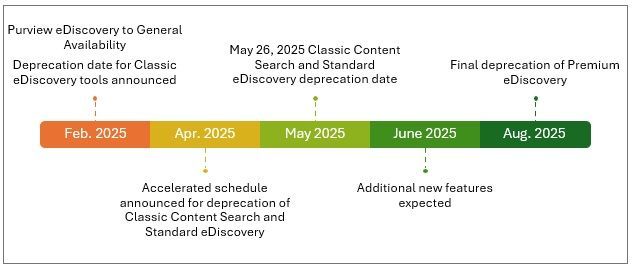
In February 2025, Microsoft released its new unified eDiscovery experience (Purview eDiscovery) within the Purview portal. Microsoft describes Purview eDiscovery as “a modernized user interface for key eDiscovery workflows, with simplified creation for cases, searches, and holds.” With a single, centralized platform, Purview eDiscovery sets the stage for long-anticipated features like the eDiscovery Hold Report and the Review Set Query Report and allows for increased insight into eDiscovery task metrics for long-running processes. Instead of locking into a single set of features within Standard (E3) or Premium (E5) eDiscovery, organization administrators can now choose the eDiscovery options that best meet the needs of their individual case.
Purview eDiscovery is a centralized, unified eDiscovery experience, allowing organizations to take advantage of basic and premium features from the same “Case.”
In tandem with the rollout of Purview eDiscovery, Microsoft initially announced that its longstanding eDiscovery tools (Content Search, Standard eDiscovery, and Premium eDiscovery) would all be deprecated in August 2025.
Then, on April 14, Microsoft revised the retirement date of classic Content Search and Standard eDiscovery to May 26, 2025. See Microsoft Purview | Retiring Classic Content Search, Classic eDiscovery (Standard) Cases, Export PowerShell Parameters (MC1055528). If you do not have access to your organization’s Microsoft 365 Message center, consider engaging with your IT team to receive updates or following one or both of these aggregator sites:
Microsoft provided more detail in its Upcoming changes to Microsoft Purview eDiscovery Security Community Blog post dated April 16, 2025. According to this post, several PowerShell cmdlet parameters related to Export automation in Standard eDiscovery were also deprecated in May 2025.
As of this writing, the deprecation date for Premium eDiscovery remains August 2025.
Key Changes
As Purview eDiscovery is a fully rearchitected product, eDiscovery administrators should expect significant feature and functionality changes, especially in these key areas:
- Holds, including new processes to add custodial and non-custodial data sources
- Search, including screen layout changes and additional search conditions
- Export, including major changes to export settings and formatting options
Through the updated Hold Policy screen, eDiscovery Managers and Administrators can create preservation holds. Custodial data sources, including Exchange mailboxes and OneDrive locations, are auto detected by searching for or selecting the custodian’s name. Related custodians or locations can be quickly added. Collaborative locations like SharePoint and Teams can also be added to preservation hold policies.
Each hold policy can include all identified data sources or can be filtered using keywords and other criteria.
The Search interface is fully redesigned with expanded search condition options including natural language searching if properly licensed. Committing content to a Review Set includes additional options related to versioning and hyperlink file management.
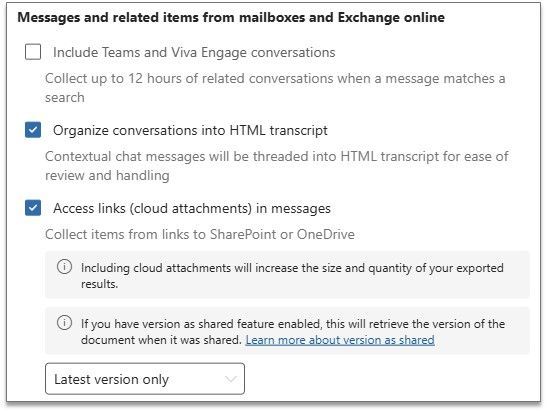
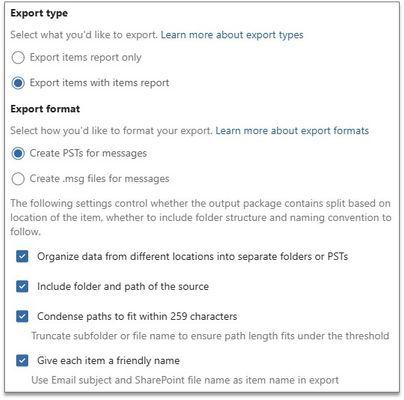
Purview eDiscovery unifies the Export experience whether the export is initiated from a Review Set or Search results. The Export options panel includes many new options that should be tested to ensure the resulting output meets the needs of your matter, including:
- Organizing contextual chat messages into an HTML transcript (with or without committing data to a Review Set)
- Customizable options for SharePoint/OneDrive version inclusion
- Simpler export formatting options
| What Stays the Same
• Core search capabilities • Existing matters (after migration to Purview eDiscovery) • Legal preservation functionality, including existing legal holds • Licensing restrictions for “Premium” features |
What Will Change
• Unified user interface and navigation • Case management workflow • Export formats and functionality • Advanced search capabilities |
What Actions Should You Take Now?
If you were previously using classic Content Search or Standard eDiscovery, those experiences have been moved to Purview eDiscovery Content Search and Cases, respectively. If you have not yet fully tested your end-to-end workflows with the outputs from Purview eDiscovery, consider adopting simplified workflows until testing can be completed.
Please note: Many third-party tools integrate with Standard eDiscovery through PowerShell commands. Test these integrations as well.
If you are using Premium eDiscovery, there is still time to test your existing workflows within Purview eDiscovery. Engage with your internal and external stakeholders (including legal, IT, and eDiscovery providers) to ensure that the new export options generate data sets that will achieve parity with the legacy interface’s outputs. This consistency will be especially critical for in-flight matters.
eMerge is available to provide comprehensive or on-demand Microsoft 365 assistance to organizations that are confronting these looming deadlines and are rightfully concerned about workflow defensibility and the need to maintain eDiscovery service levels without interruption.
Helpful Resources
Microsoft Security Community Blog
A recent Supreme Court decision clarified that discrimination claims brought by members of majority groups in so-called “reverse discrimination” cases cannot be subject to a heightened evidentiary burden. In Ames v. Ohio Department of Youth Services, the Court ruled that a Sixth Circuit requirement that members of a “majority group” (such as heterosexual employees) must satisfy a heightened evidentiary standard for discrimination claims was incompatible with the language of Title VII and with Supreme Court precedent. The unanimous decision written by Judge Ketanji Brown Jackson resolves a circuit split, as the Sixth, Seventh, Eighth, Tenth, and D.C. circuit courts of appeals had previously imposed a higher evidentiary burden on discrimination claims brought by majority group members.
The Sixth Circuit’s “Background Circumstances” rule previously imposed a heightened evidentiary burden for discrimination claims brought by majority group members.
Before the Ames ruling, the Sixth Circuit applied a “background circumstances” rule for discrimination claims brought by members of a majority group. This heightened evidentiary burden required that such employees prove that “background circumstances support the suspicion that the defendant is that unusual employer who discriminates against the majority.”
In Ames, a heterosexual employee of the Ohio Department of Youth Services brought a discrimination action against her employer alleging that she was denied a management promotion and demoted because of her sexual orientation. The district court granted summary judgment in favor of her employer, holding that the employee had not provided “background circumstances supporting the suspicion that her employer would discriminate against a majority group.” The Sixth Circuit affirmed this decision.
The Supreme Court’s Ames ruling held that the same standard must apply to majority and minority group members.
Justice Brown Jackson’s majority opinion clarified that the “background circumstances” rule was incompatible both with Title VII’s text and with the Court’s longstanding precedent. Title VII’s language prohibits discrimination against “any individual” without reference to a majority or minority group. Justice Brown Jackson’s opinion specifically cited prior Supreme Court precedent—including McDonald v. Santa Fe Trail Transportation Co., (1976), and Bostock v. Clayton County, (2020) among others—as examples where the Court had expressly applied the same standard for discrimination against minority or majority groups. Joined by Justice Gorsuch, Justice Thomas’ concurrence took aim at the McDonnell Douglas framework in its entirety—stating that in an appropriate case, “this Court should consider whether the McDonnell Douglas framework is an appropriate tool to evaluate Title VII claims at summary judgment.”
Next Steps and Takeaways for Employers
The Court’s unanimous decision in Ames reduces the evidentiary burden on majority group employee plaintiffs to bring discrimination actions in jurisdictions that previously applied the “background circumstances” rule. Read more about how employers can navigate DEI policies and reverse discrimination claims in a shifting legal landscape in our recent publication.
Investing in the cannabis industry is not without its risks, given the evolving regulatory landscape and the varying state and federal statuses of the product itself. The Financial Crimes Enforcement Network (FinCEN) has shown it will continue to enforce its 2014 Marijuana Bank Secrecy Act (BSA) Guidance, despite the rescission of the Cole Memo in 2018, which initially informed this guidance. Additionally, for public companies and other entities subject to oversight by the Securities and Exchange Commission (SEC), recent SEC enforcement cases reinforce the necessity of rigorous due diligence and adherence to anti-money laundering (AML) protocols, especially given that FinCEN maintains that all financial transactions involving marijuana remain federally illegal.
Enforcement Priorities Under the Cole Memo
When conducting due diligence on marijuana-related customers, financial institutions should determine whether the customer’s activities align with any of the six enforcement priority areas outlined in the Cole Memo. FinCEN has advised financial institutions to apply these priorities to identify cannabis-related activities that must be reported to law enforcement[1]:
-
Preventing distribution to minors: ensuring marijuana is not distributed to individuals under the legal age.
-
Revenue financing criminal enterprises: preventing the use of legal marijuana business revenue to fund criminal activities or the trafficking of other drugs.
-
Preventing violent activities: avoiding involvement in or association with violent activities related to marijuana.
-
Distribution to illegal states: preventing the distribution of marijuana to states where its sale remains illegal.
-
Public health consequences: mitigating adverse public health impacts, such as impaired driving due to marijuana use.
-
Cultivation on public lands: Preventing the cultivation of marijuana on public lands.
Where financial institutions find their customers engaging in any of the above activities, they must report those activities as part of their BSA compliance obligations.
Other Key Compliance Considerations
Due Diligence Requirements: Financial institutions are obligated to conduct thorough due diligence when assessing marijuana-related businesses for reportable activity. FinCEN’s guidance emphasizes the following key requirements:
-
Verification of state licensure: financial institutions must verify and review state licensure and application documents.
-
Understanding business activities: institutions should develop a comprehensive understanding of the business’s normal and expected activities, including product types and customer demographics.
-
Ongoing monitoring: continuous monitoring of publicly available sources for adverse information and suspicious activity is essential.[2]
Suspicious Activity Reporting (SAR): Financial institutions must file a SAR for any transactions involving marijuana-related businesses, whether that marijuana-related business is clear of the above-mentioned Cole Memo priorities. FinCEN has outlined specific SAR types — Marijuana Limited, Marijuana Priority, and Marijuana Termination — to address varying compliance scenarios.
-
A Marijuana Limited SAR is appropriate where the customer follows state law and does not implicate one of the Cole Memo priorities.
-
A Marijuana Priority SAR is appropriate where a customer’s marijuana-related activity is either in violation of state law or implicated one of the Cole Memo priorities.
-
A Marijuana Termination SAR is filed when the financial institution ends its relationship with a marijuana-related business
Ultimately, financial institutions must submit an SAR to FinCEN within 30 days after providing financial services to a business involved in marijuana-related activities — whether the institution believes the business is violating one of the Cole Memo priorities or state law.[3]
Recent Enforcement Actions
The SEC has highlighted the importance of robust AML procedures through recent actions against financial firms for issues related to anti-money laundering (AML) compliance. Some of those charges included: misleading investors about a firm’s AML/CFT policies; allowing sanctioned individuals to invest in a firm’s fund; discrepancies between the firm’s stated and actual due diligence practices; and inadequate customer identification processes.
Action Steps
-
Review and update AML policies: ensure your AML policies are comprehensive and reflect current regulatory expectations, particularly concerning cannabis-related activities.
-
Enhance due diligence processes: implement risk-based procedures to verify customer identities and monitor ongoing activities, ensuring compliance with both federal and state regulations.
-
Monitor regulatory developments: stay informed about changes in the regulatory landscape to proactively adjust compliance strategies.
The evolving scrutiny of marijuana-related financial activities necessitates vigilance and proactive compliance measures. Firms must prioritize robust AML protocols to mitigate risks and avoid significant legal and financial repercussions.
For further guidance on navigating these complex regulatory requirements, please consult with our legal team at Troutman Pepper Locke.
[1] Financial Crimes Enforcement Network. “BSA Expectations Regarding Marijuana-Related Businesses.” FIN-2014-G001, February 14, 2014. https://www.fincen.gov/sites/default/files/shared/FIN-2014-G001.pdf.
[2] Id.
[3] Id.
Published in Law360 on June 10, 2025. © Copyright 2025, Portfolio Media, Inc., publisher of Law360. Reprinted here with permission.
Generative artificial intelligence is everywhere. It seems that every industry — even the most sophisticated — is evaluating how to ethically and efficiently integrate generative AI into their business models and work streams.
Amid these innovation efforts, however, is an underlying current of suspicion, distrust and skepticism about how and whether generative AI can be used ethically.
For the legal industry, state statutes governing generative AI, and standing court orders setting parameters for when and how generative AI may be used in court filings, are helpful guideposts. Those guideposts indicate that, when lawyers or legal professionals use generative AI, disclosure and vetting of the generative AI-created content are key.
The February California bar exam offers a timely case study on how the failure to disclose the use and vetting of generative AI can break trust, create scandal and call ethical integrity into question.
Undeniably, California’s February bar exam was rife with controversy and caused a public scandal. The exam — administered virtually and on a new testing platform for the first time — presented myriad glitches, irregularities and disruptions for test-takers. These issues included the platform crashing before the exam even began, delays between a user’s input and the screen’s display, frequent error messages, and an inability to save essay responses.
Needless to say, these are all issues no bar examinee wishes to experience on what could be one of the most determinative days of their career.
Adding fuel to the frenzied fire of media coverage is the revelation in April that the State Bar of California‘s Committee of Bar Examiners used generative AI to craft some of the exam’s questions. This discovery has exacerbated the broken trust that now exists between the bar examiners, test-takers and California’s legal community.
But it is important to stick to the facts, which can often be buried or overlooked in the coverage of scandalous events. What exactly happened here?
After the exam took place, the bar examiners disclosed in a statement that some multiple choice questions — 29 out of 200, 23 of which were used for scoring — were “developed with the assistance of AI and subsequently reviewed by content validation panels and a subject matter expert in advance of the exam.”
It is worth noting that the AI-generated questions were created by ACS Ventures, a “psychometric consulting company that works with clients for the design, development, and evaluation of their assessments” and that “partner[s] with testing agencies.”
As the usage of generative AI becomes more mainstream, this kind of arrangement — i.e., a company using a third party with generative AI expertise to produce generative AI-created content — will likely become more common, as well.
Here, ACS Ventures — the entity that actually used generative AI to draft the questions — does not appear to be under scrutiny related to the incident. The bar examiners who enlisted their services, however, are the ones who have to answer for the undisclosed choice to use generative AI. This is further evidence that the bar examiners’ usage of generative AI alone is not the issue, but the manner in which they used it.
Specifically, the bar examiners have conceded that the use of generative AI was “not clearly communicated to state bar leadership.” While some commentators seem critical of the fact that the bar examiners used generative AI in the first place, the broader public condemnation likely arises from broken trust that had already resulted from the exam’s numerous failures.
Prior to the exam, no one aside from the bar examiners and ACS Ventures knew that generative AI was used to craft some of the questions. No one — from the legal community to the test-takers to the California Supreme Court, which oversees the State Bar of California and the bar examiners — was aware that any of the questions on the exam were drafted with the use of generative AI. Now, many of these stakeholders are critical after learning what occurred.
This is evident in several respects. The California Senate Judiciary Committee has approved a bill that calls for a full audit of the exam. Current State Bar of California Executive Director Leah Wilson has announced that she will resign from her role, effective July of this year. And, most importantly for the test-takers, the California Supreme Court approved adjustments to the passing score.
Setting aside the justified public outrage over the exam’s failures, proponents of generative AI in the legal profession cannot help but wonder: Had the bar examiners’ usage and vetting of generative AI been clearly communicated before the exam took place, would it have been met with the same ire? The answer is likely no.
Indeed, the ethical and transparent use of generative AI is in keeping with California’s stated priorities, as evidenced by the enactment of the California AI Transparency Act, which becomes effective Jan. 1, 2026. The act will require generative AI systems that are publicly accessible within California, and that have more than 1 million monthly visitors or users, to implement robust measures to disclose when content has been generated or modified by generative AI.
Additionally, and quite notably, the State Bar of California’s Standing Committee on Professional Responsibility and Conduct also released its own “Practical Guidance for the Use of Generative Artificial Intelligence in the Practice of Law.”
This guidance includes a recommendation for how practitioners should communicate the use of generative AI: “The lawyer should consider disclosure to their client that they intend to use generative AI in the representation, including how the technology will be used, and the benefits and risk of such use.”
Further, numerous California judges — in both state and federal courts — have issued standing orders outlining guidelines that parties must follow if they choose to use generative AI as an aid in the drafting of legal documents. To name a few examples:
- Judge Kimberly Knill in the Orange County Superior Court has issued a standing order requiring that the use of generative AI in preparing any “paper filed with the Court” must be disclosed in a clear and plain factual statement noting that the AI-generated work product has been verified as accurate.
- U.S. District Judge Anne Hwang in the U.S. District Court for the Central District of California entered a similar order, requiring that any filing containing content created by AI must include a separate declaration disclosing that generative AI was used and verified.
Other California judges have all entered similar orders.[1]
The common thread in all of these orders is twofold: (1) The use of GenAI must be disclosed, and (2) the attorney who used generative AI must certify that they checked and verified the accuracy of the AI-created work product.
Given all this, it should come as no surprise that organizations such as the State Bar of California would use generative AI to draft bar exam questions. But the bar examiners’ admitted failure to clearly communicate that it planned to use generative AI in drafting test questions is perhaps where they erred.
California’s policies and its own courts’ standing orders demonstrate that the use of generative AI can be both acceptable and appropriate if it is done transparently. It’s the secret or undisclosed use of generative AI, however, that makes people feel misled.
What can the legal industry and practitioners take away from this? While a bar exam is not a legal proceeding, it represents an important professional milestone for applicants who wish to become lawyers, and the drafting of exam questions is a weighty task that determines who can practice law.
It is held to a high standard in the industry, as evidenced by the fact that the California Supreme Court has direct oversight over the California bar exam. Practicing attorneys are similarly held to high standards by their clients, their colleagues, the rules of professional conduct and the rules of courts.
Here, the California Supreme Court has not condemned the bar examiners’ usage of generative AI, but it has stated that it was not informed about it, and, accordingly, it has demanded answers from the bar examiners. Because the bar examiners disclosed their usage of generative AI after the fact, they will now have to provide those answers publicly amid a maelstrom of already negative reporting.
To avoid this kind of quasi-adversarial public spectacle in their own practices, practitioners are advised to do the following:
- Use a generative AI provider that is trusted and legitimate.
- Before you use generative AI, have a process in place to vet and verify any and all generative AI-created content that you will include in any work product.
- If you are submitting work product that was produced with the assistance of generative AI-created content anywhere — to courts, clients, colleagues, etc. — disclose both that you used generative AI, and that you vetted and verified the content created by generative AI. If you are submitting this work to a court, make sure you are in compliance with any standing orders that court may have been entered regarding generative AI.
Following these steps will help legal practitioners ethically use generative AI in a manner that fosters transparency and preserves trust in the profession.
[1] This includes Fred Slaughter (C.D. Cal.), Todd Robinson (S.D. Cal.), Eumi Lee (N.D. Cal.), Araceli Martínez-Olguín (N.D. Cal.), Stanley Blumenfeld (C.D. Cal.), Rita Lin (N.D. Cal.), Rozella Oliver (M.J. C.D. Cal.), and Peter Kang (M.J. N.D. Cal.).
State attorneys general increasingly impact businesses in all industries. Our nationally recognized state AG team has been trusted by clients for more than 20 years to navigate their most complicated state AG investigations and enforcement actions.
State Attorneys General Monitor analyzes regulatory actions by state AGs and other state administrative agencies throughout the nation. Contributors to this newsletter and related blog include attorneys experienced in regulatory enforcement, litigation, and compliance. Also visit our State Attorneys General Monitor microsite.
Contact our State AG Team at StateAG@troutman.com.
Troutman Pepper Locke Spotlight
Facial Recognition and Legal Boundaries: The Clearview AI Case Study
By
In this episode of the Regulatory Oversight podcast, Stephen Piepgrass welcomes David Navetta, Lauren Geiser, and Dan Waltz to discuss the $51.75 million nationwide class settlement involving Clearview AI and its broader implications. The conversation focuses on Clearview AI’s facial recognition software, which has sparked controversy due to its use of publicly available images to generate biometric data.
American Bar Association’s State and Local Government Law Section Webinar Series: State Attorneys General Enforcement Actions and Litigation: The Unwritten Rules
By
Join Troutman Pepper Locke attorneys Ashley Taylor and Michael Yaghi as they participate in a two-part webinar series hosted by the American Bar Association’s State and Local Government Law Section. This series is designed to highlight chapters from the recently published book, “Consumer Protection: Understanding Enforcement Actions Brought by State Attorneys General.“ The webinar series will explore the complexities and nuances surrounding enforcement actions brought by consumer protection staff in state attorneys general offices.
State AG News
New AG on the Block: Wyoming Interim Attorney General Ryan Schelhaas
By
On May 27, Wyoming Governor Mark Gordon announced the appointment of Ryan Schelhaas as interim attorney general (AG). Schelhaas succeeds AG Bridget Hill, who will join the Wyoming Supreme Court as its newest justice. Governor Mark Gordon has indicated he plans to nominate Schelhaas as the permanent replacement, enabling him to serve the remainder of the term as the state’s attorney general.
Streaming Under Scrutiny: Michigan AG Alleges Roku Violates COPPA and Other Privacy Laws
By
On April 29, Michigan Attorney General (AG) Dana Nessel filed a lawsuit against Roku, Inc. (Roku), the smart TV and device provider and streaming service, alleging that Roku collects and monetizes personal data from children without proper parental consent in violation of the Children’s Online Privacy Protection Act (COPPA) and other laws, including the Video Privacy Protection Act (VPPA) and the Michigan Consumer Protection Act.
Texas Legislature Passes Comprehensive AI Governance Act
By
On June 2, the Texas legislature passed the Texas Responsible Artificial Intelligence Governance Act, (TX AI Act or bill) which heads to the governor for his signature or veto. The bill will take effect January 1, 2026, if the governor signs it into law. It is the most comprehensive piece of AI governance legislation to pass a state legislature to date. If enacted, Texas will become the fourth state after Colorado, Utah, and California to pass AI-specific legislation.
NY AG Reaches $3.2M in Settlements With 8 New York Nissan Dealerships
By
New York Attorney General (AG) Letitia James’ office has reached a cumulative total of $3.2 million in settlements with eight Nissan dealerships that the office accuses of overcharging New Yorkers for purchasing leased vehicles at the conclusion of their lease term.
Colorado Cracks Down on Hemp Misrepresentation
By
On May 14, Colorado Attorney General (AG) Phil Weiser announced that the state reached a settlement with MC Global Holdings, LLC, its associated companies, and owners (collectively MC) to resolve allegations that MC’s business practices violated the Colorado Consumer Protection Act (CCPA).
AG of the Week
Peter F. Neronha, Rhode Island
Peter Neronha was elected as Rhode Island’s 74th attorney general (AG) on November 6, 2018, and sworn in on January 1, 2019. As the top legal officer in Rhode Island, Neronha leads an office that prosecutes criminal cases, represents state agencies, and initiates legal action to protect Rhode Islanders’ interests.
Appointed by President Barack Obama, Neronha served as the U.S. attorney for the District of Rhode Island from 2009 to 2017. In this role, he supervised the prosecution of federal crimes and the litigation involving the federal government. As U.S. attorney, he was appointed by U.S. Attorney General Eric Holder and later AG Loretta Lynch to terms on the AG’s Advisory Committee.
Neronha’s public service career began in 1996 as a Rhode Island special assistant AG, later becoming an assistant AG. He served in the Rhode Island AG’s office until 2002, prosecuting various criminal matters. Neronha joined the U.S. Attorney’s Office as an assistant U.S. attorney in 2002, serving in roles including chief of the Crime Strike Force.
A fourth generation native of Jamestown, RI, Neronha graduated summa cum laude from Boston College in 1985 and magna cum laude from Boston College Law School in 1989, where he was a member of the Boston College Law Review. From 1989 to 1996, he worked at the Boston law firm Goodwin, Proctor L.L.P.
Rhode Island AG in the News:
-
On May 28, Neronha announced a series of sweeping actions to address what he called the state’s “failing health care system.”
-
On May 21, Neronha announced an $11 million settlement with a construction company to resolve allegations of unlawful dumping of solid waste. The settlement money will be used to fund dental care services for Providence city youth.
Upcoming AG Events
-
June: AGA | 2025 Annual Meeting | U.S. Virgin Islands
-
July: RAGA | Victory Fund Golf Retreat | Pebble Beach, CA
-
July: DAGA | Presidential Partners Retreat | Santa Fe, NM
For more on upcoming AG Events, click here.
Our Cannabis Practice provides advice on issues related to applicable federal and state law. Marijuana remains an illegal controlled substance under federal law.
On Monday, June 9, the U.S. Fish and Wildlife Service (FWS) opened a short, 30-day public comment period soliciting information and comments to, “improve the overall efficiency and effectiveness” of Section 10(a) take permitting under the Endangered Species Act (ESA). If it seems like Section 10(a) just underwent a comment period not too long ago, that’s because it did. In 2023, under the Biden Administration, FWS solicited comments on proposed revisions to the regulations implementing that section, which were finalized last April. Now, the Trump Administration is seeking suggestions on how to further revise its ESA permitting rules.
The April 2024 rule revisions created a new type of agreement, called a “conservation benefit agreement,” that combines both safe harbor agreements and candidate conservation agreements under Section10(a)(1)(A) of the ESA to facilitate voluntary conservation of not-yet-listed species on non-federal lands. This change was made in an effort to reduce costs and time associated with the permit processes and to encourage further participation in these voluntary programs.
With this new request for information and feedback, the FWS is taking a different approach. Instead of drafting revisions and asking stakeholders to provide feedback on the expected efficacy of those revisions, FWS is asking for feedback from stakeholders first, before proposing any specific rule revisions. The scope of this request includes the newly created conservation benefit agreements as well as habitat conservation plans and associated incidental take permits for listed species under ESA Section 10(a)(1)(B). Specifically, the FWS notice solicits information and suggestions from stakeholders on the following topics:
-
barriers that prevent applicants from pursuing development of conservation benefit agreements and habitat conservation plans;
-
methods to streamline conservation benefit agreement and habitat conservation plan development and their associated permit issuance;
-
strategies to enhance FWS communications on conservation benefit agreements, habitat conservation plans, and their associated permits;
-
whether any clarification is needed on the roles and responsibilities of the FWS and applicants during conservation benefit agreement and habitat conservation plan development and permit issuance;
-
funding and resources necessary to develop and implement conservation benefit agreements and habitat conservation plans;
-
strategies the FWS could pilot to improve the overall effectiveness of the Section 10(a) program.
This request for information follows on the heels of a broader request issued by the Department of the Interior (Interior) on May 16, seeking public input on potential regulatory revisions for Interior-issued regulations. That request encompasses the broader ESA implementation regulations. The comment period for that initial request for information closes on June 20, 2025.
With an Administration actively pursuing permitting reform and seeking ways to reduce regulatory burdens on industry, this solicitation is a prime opportunity to provide feedback and suggestions for meaningful reform of the often cumbersome and lengthy ESA permitting process.
On June 6, the U.S. Supreme Court denied the petition for certiorari in the case of Navellier & Associates, Inc. v. Securities and Exchange Commission (SEC). This decision effectively upholds the lower courts’ rulings, allowing the SEC to continue its practice of disgorging profits obtained through fraudulent activities without needing to prove direct financial harm to investors.
Background
As discussed here, Navellier & Associates, Inc., a registered investment advisor, was charged with alleged violations of § 206 of the Investment Advisers Act of 1940. The SEC accused Navellier of misrepresenting the performance of certain investment strategies, claiming that the firm touted hypothetical data as actual performance to attract clients. The district court ruled in favor of the SEC, ordering Navellier to disgorge $22,734,487 plus pre-judgment interest. The U.S. Court of Appeals for the First Circuit affirmed this decision, prompting Navellier to seek review from the Supreme Court.
Key Issues in the Cert Petition
- Disgorgement and Investor Harm: Navellier argued that the SEC should demonstrate that investors suffered pecuniary harm to justify disgorgement. The SEC countered that disgorgement is an equitable remedy aimed at stripping wrongdoers of ill-gotten gains, regardless of direct investor loss.
- Materiality Standard: Navellier contended that the court of appeals applied an incorrect materiality standard, suggesting that proof of investor reliance on misrepresentations should be required. The SEC maintained that the misrepresentations were significant enough to influence a reasonable investor’s decision-making process.
Implications
The Supreme Court’s denial of certiorari means the SEC’s approach to disgorgement remains intact. This decision reinforces the SEC’s ability to recover funds obtained through fraud without proving direct financial harm to investors.