Strategies helps businesses and individuals solve the complexities of dealing with the government at every level. Our team of specialists concentrate exclusively on government affairs, representing clients nationwide who need assistance with public policy, advocacy, and government relations strategies.
Troutman Pepper Locke’s program for Startup and Early-Stage Entrepreneurial Development
This unique program provides innovative and affordable opportunities to startups and early-stage emerging companies with a solid technology or scientific foundation. We help companies that have a quality management team in place and do not have other significant legal representation.
Market leading eDiscovery and data management services.
eMerge’s lawyers and technologists work together to deliver strategic end-to-end eDiscovery and data management solutions for litigation, investigations, due diligence, and compliance matters. We help clients discover the information necessary to resolve disputes, respond to investigations, conduct due diligence, and comply with legal requirements.
On June 22, 2026, Executive Order 14413 directed the Department of Defense/War to identify at least three next-generation quantum sensor projects to prioritize for fielding by September 30, 2028.
Following Executive Order 14413, the Defense Innovation Unit announced plans to invest up to $200 million over the next year to accelerate deployment of quantum sensing and timing technologies for intelligence, surveillance, and reconnaissance missions across the U.S. military.
Because magnetic navigation frameworks are more resistant to jamming and spoofing than conventional GPS, quantum sensing systems that employ them can provide continuous positioning, navigation, and timing in contested or GPS-denied environments.
The SBIR and STTR programs, overseen by the Small Business Administration, fund quantum sensing companies through Phase I proof of concept and Phase II technology development, while Phase III commercialization proceeds through follow-on, non-SBIR/STTR contracts rather than program funding.
Venture investment in quantum technologies rose more than sixfold in 2025 from 2024, and investors are drawn to quantum sensing for its national security and dual-use applications and its comparatively faster path to commercialization than quantum computing.
In this three-part series, we will provide a broad overview of certain funding options and considerations regarding dual-use technology, intellectual property (IP), government contracting, national security, and employment and talent management for quantum sensing companies doing business with both private- and public-sector customers. Drawing on our deep experience advising quantum technology companies, our government contracting team’s increasing engagement with quantum companies navigating federal procurement, and our IP and employment practices’ work in this rapidly evolving space, this series will help equip founders, investors, and advisors with practical guidance for navigating this increasingly complex landscape.
This series is organized as follows:
Part 1: We begin with the quantum sensing landscape: what the technology does, why investors are paying attention, how companies can access funding (including the Small Business Innovation Research (SBIR) and Small Business Technology Transfer (STTR) programs), and where commercial and defense demand is emerging.
Part 2: We then turn to the legal and regulatory issues that arise as quantum sensing companies move toward commercialization, including IP strategy; government contracting compliance; cybersecurity; export controls; foreign ownership, control, or influence (FOCI) planning; and other national security considerations.
Part 3: We conclude with workforce and talent-management considerations, including how export controls, security-clearance requirements, workforce structuring, and immigration strategy can affect hiring and growth.
Part 1: The Quantum Sensing Landscape, Funding Options, and Market Applications
Background on Quantum Sensing Technologies
Quantum sensing technologies enable highly reliable positioning, navigation, and timing (PNT) systems and are well positioned to augment and, in some cases, ultimately replace traditional radar and GPS. In 2024, there were more than 240,000 reported incidents of GPS interference, a figure that has steadily risen in recent years and that presents significant national security concerns. These incidents can be mitigated by deploying quantum sensing systems that employ magnetic navigation frameworks that are more resistant to jamming and spoofing tactics than conventional GPS. Quantum sensing technologies are also well suited to operate in environments where GPS struggles to provide PNT information (e.g., indoors, underground, and underwater), offering a clear advantage for operations in these settings and enabling continuous, resilient PNT in contested or GPS-denied environments.1 Investors are becoming increasingly attracted to quantum sensing technologies specifically for their national security and dual-use applications and their ability to leverage existing photonics, semiconductor, and radio frequency (RF) hardware, thus lowering capital needs and time-to-market.2
Quantum sensing technologies also intersect with traditional radar systems and Light Detection and Ranging (LiDAR) applications. These subsets of quantum sensing, quantum radar and LiDAR, focus on measuring an object’s properties, such as speed and range, rather than on broader PNT capabilities and are being developed to exploit quantum entanglement and surpass the precision of conventional systems. Early prototypes have shown potential in defense, aerospace, autonomous systems, and industrial sensing.
For venture capital investors, these dynamics make quantum sensing a particularly attractive entry point into the broader quantum technology ecosystem, which has already experienced a surge in venture investment in recent years (up more than sixfold in 2025 from 2024).3 Specific to quantum sensing, the combination of government-backed demand for resilient PNT and advanced sensing, near-term commercialization timelines, and strong potential for defensible intellectual property supports a thesis that quantum sensing companies can scale revenue on timelines consistent with venture-backed growth. Companies that successfully translate laboratory advances in quantum PNT, radar, and LiDAR into ruggedized, certifiable products are positioned to win large defense and industrial contracts, access nondilutive public funding, and build durable competitive moats in markets characterized by high technical complexity, regulatory barriers, and lengthy customer relationships. These are features that align well with venture-backed growth and long-term value creation. And the evidence is already there; in recent years, venture capital investment in quantum technologies has surged. Although much of the attention and investment has centered on quantum computing to date, investors are increasingly attracted to quantum sensing technologies because of their broad national security and dual-use applications and their comparatively faster, more incremental path to commercialization relative to quantum computing technologies.
Funding Options and Market Applications
Quantum sensing companies have multiple funding avenues, including the nondilutive SBIR and STTR programs,4 which are a cornerstone source of early-stage, nondilutive capital for deep-tech and defense-focused ventures. Overseen by the Small Business Administration (SBA) and administered by various federal agencies, such as the Department of Defense/War (DoD/W) and Department of Energy, these programs support early-stage companies in the R&D phase and help bridge them to commercialization by funding high-risk technical work, generating government-validated milestones, and signaling technical credibility to private investors. The SBIR/STTR programs’ funding is structured in three phases, creating a staged on-ramp from concept validation to commercial deployment:
Phase I – Proof of Concept: Intended to establish technical merit, feasibility, and commercial potential of proposed federal R&D and technology, and to assess the small business’s performance before Phase II and verify readiness for further support. Phase I awards typically do not exceed $150,0005; however, some agencies such as the National Institutes of Health (NIH) may issue Phase I awards over $300,000.6 Phase I awards have short durations of typically six to 12 months.
Phase II – Technology Development: Aimed at continuing the Phase I R&D. Funding depends on Phase I results and the project’s scientific/technical merit and commercial potential. Generally, only Phase I awardees are eligible for Phase II; however, under the “Direct to Phase II” authority available in certain SBIR/STTR solicitations, a project that has already completed the equivalent of Phase I R&D (without prior SBIR/STTR funding) may be allowed to apply directly for Phase II funding, subject to the specific agency’s rules and requirements.7 Phase II awards can be up to $2.1 million and have a two-year period of performance. In practice, Phase II can support systems engineering, field testing, and integration work that moves quantum sensing hardware from lab setups toward deployable systems, and it often coincides with or helps catalyze early venture rounds and strategic partnerships with defense primes or major industrial customers.
Phase III – Commercialization: Used to pursue commercialization of Phase I/II outcomes. Note, the SBIR/STTR program does not fund Phase III. Instead, agencies may offer follow-on, non-SBIR/STTR R&D or production contracts for products, processes, or services intended for U.S. government use. Phase III can take the form of multiyear procurement, pilot deployments, or follow-on development contracts, providing meaningful revenue visibility and a strong validation signal for private capital.
In addition to SBIR/STTR opportunities, the White House has made quantum innovation a policy priority, which may spur development and new government funding opportunities. Notably, the White House issued Executive Order 14413 on June 22, 2026. Among other items, the order tasked the DoD/W with identifying at least three next-generation quantum sensor projects to prioritize for fielding sensors by September 30, 2028, and mandated that various agencies develop a five-year plan for advancing quantum sensing and networking.8 The next day, the Defense Innovation Unit announced plans to invest up to $200 million over the next year to accelerate the deployment of quantum sensing and timing technologies for intelligence, surveillance, and reconnaissance missions across the U.S. military.9
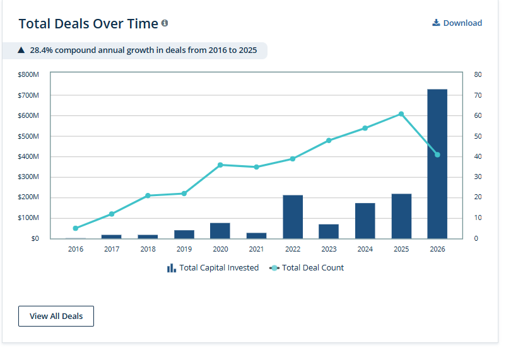
While public funding will continue to be significant in the quantum sensing sector, the private markets should not be overlooked. With a growing number of funds dedicated to quantum technologies and quantum sensing specifically, private investment into quantum sensing companies is pouring in. Compare the ~$220 million reported by PitchBook as invested into quantum sensing deals in 2025 to the ~$732 million invested already in 2026.10 Regardless of where funds originate, the quantum sensing market is expected to continue growing: McKinsey & Company’s research predicts the global quantum market will grow to $60 to $100 billion by 2035, which nearly doubled its 2025 prediction.11
Broad-Based Commercial and Defense Applications
Quantum sensing technologies span broad-based commercial and national security applications. In the defense context, quantum sensors can enable stealth aircraft detection, missile detection, submarine detection, and underground facility mapping, while quantum-enhanced radar and LiDAR systems can improve target discrimination and performance in low-visibility conditions. In the commercial context, quantum sensing can advance biotech, life sciences, health care, infrastructure, mineral exploration, and PNT capabilities for logistics, transportation, and autonomous systems. These diverse applications present various business and legal implications, which are addressed in the remaining installments of this series.
We expect quantum sensing to continue attracting significant investment in coming years, and we encourage readers to reach out to the authors for a more detailed discussion of the topics addressed in this series.
4 Quantum sensing companies must be eligible to apply for SBIR/STTR funding. Generally, eligibility requirements include being a (1) for-profit entity located in the U.S. (2) with fewer than 500 employees that is (3) owned and controlled by U.S. citizens or permanent residents. Note, nonprofit entities are not eligible (except as research institution partners with an otherwise eligible applicant under only the STTR Program). There are nuances to eligibility requirements – especially for ownership and control considerations when venture capital companies, hedge funds, or private equity firms are involved. For more information, refer to 13 C.F.R. Part 121 and the SBA’s SBIR/STTR Full Eligibility Guidelines.
5 SBIR/STTR FAQs, SBA, https://www.sbir.gov/faq (SBIR Phase I awards normally do not exceed $150,000 and have a six-month period of performance . . . SBIR Phase II awards normally do not exceed $1,000,000 and have a two-year period of performance.)
Strategies helps businesses and individuals solve the complexities of dealing with the government at every level. Our team of specialists concentrate exclusively on government affairs, representing clients nationwide who need assistance with public policy, advocacy, and government relations strategies.
Troutman Pepper Locke’s program for Startup and Early-Stage Entrepreneurial Development
This unique program provides innovative and affordable opportunities to startups and early-stage emerging companies with a solid technology or scientific foundation. We help companies that have a quality management team in place and do not have other significant legal representation.
Market leading eDiscovery and data management services.
eMerge’s lawyers and technologists work together to deliver strategic end-to-end eDiscovery and data management solutions for litigation, investigations, due diligence, and compliance matters. We help clients discover the information necessary to resolve disputes, respond to investigations, conduct due diligence, and comply with legal requirements.