Strategies helps businesses and individuals solve the complexities of dealing with the government at every level. Our team of specialists concentrate exclusively on government affairs, representing clients nationwide who need assistance with public policy, advocacy, and government relations strategies.
Troutman Pepper Locke’s program for Startup and Early-Stage Entrepreneurial Development
This unique program provides innovative and affordable opportunities to startups and early-stage emerging companies with a solid technology or scientific foundation. We help companies that have a quality management team in place and do not have other significant legal representation.
Market leading eDiscovery and data management services.
eMerge’s lawyers and technologists work together to deliver strategic end-to-end eDiscovery and data management solutions for litigation, investigations, due diligence, and compliance matters. We help clients discover the information necessary to resolve disputes, respond to investigations, conduct due diligence, and comply with legal requirements.
The Inflation Reduction Act (IRA) has supercharged global interest in U.S. battery storage, forcing companies to change their approach to the market. We look at how this generational legislation is driving growth and influencing investment opportunities.
In this report, we look at how the IRA has accelerated growth in the U.S. battery storage sector. This transformational legislation has prompted firms around the world to pivot toward the U.S. market in the short and medium terms.
However, the rapid expansion of battery storage brings challenges too. These include constraints on battery supply; labor and expertise shortages; a continued lack of clarity over parts of the IRA; and prohibitively long interconnection queues in some regions. Energy storage in the U.S. is on the cusp of explosive growth, but successful market actors need to maneuver strategically to avoid growing pains.
In this report, companies in the energy storage sector and our in-house experts share insights into how firms should respond to the new challenges facing the U.S. market.
Introduction
The IRA became law in August 2022, and the impacts have been immediate and far-reaching. The $369 billion package that the White House has earmarked in the IRA for clean energy has already transformed the way the U.S. is seen globally, while also supercharging investment in the cleantech sector.
One of the biggest beneficiaries has been the U.S. battery storage industry.
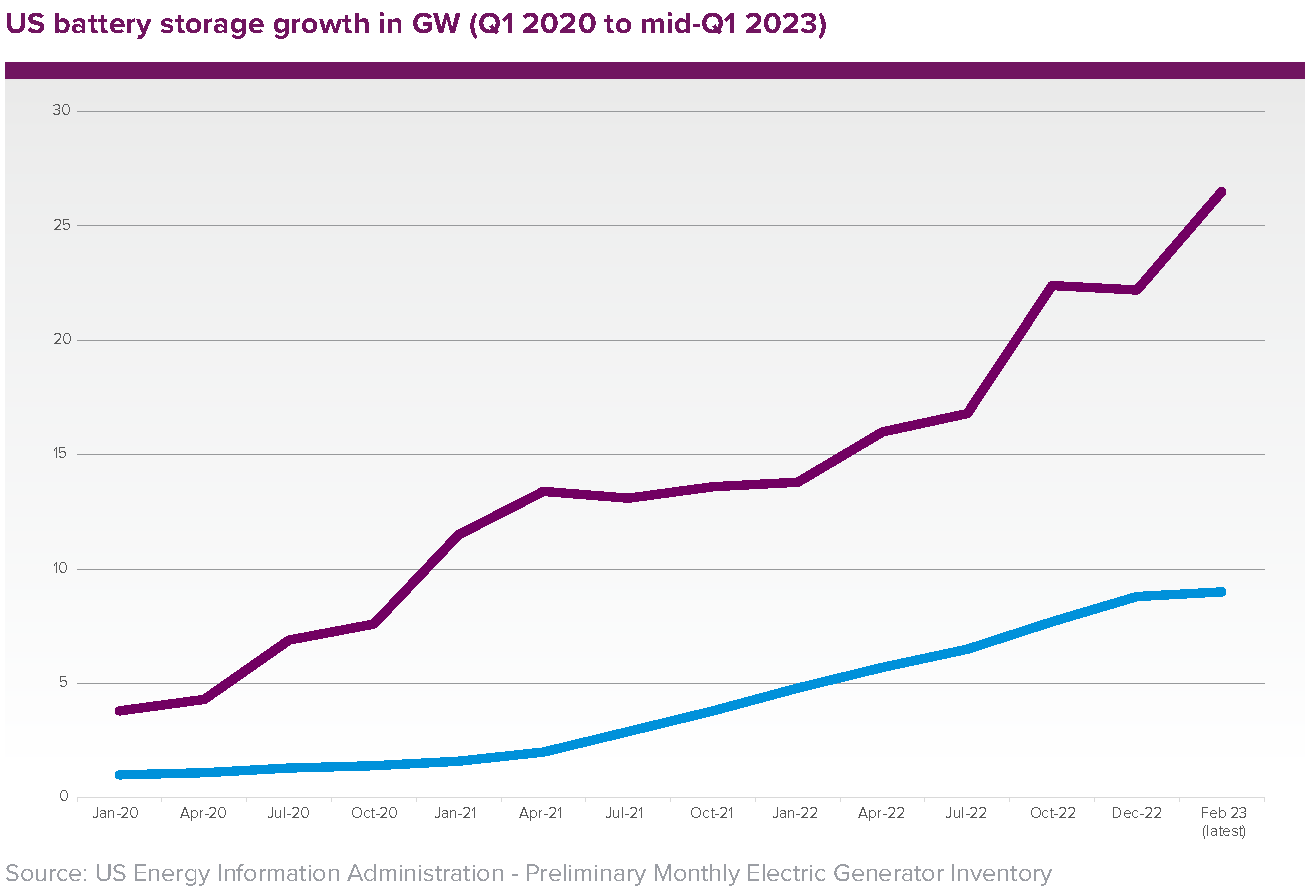
The industry was growing before the IRA. According to the U.S. Energy Information Administration (EIA), in January 2020 1GW of battery storage projects were in operation and 3.8GW were planned in the U.S. This had grown to 6.5GW operational and 16.8GW being planned by July 2022.
The IRA has led to a steep increase in the capacity of battery storage projects in the development pipeline (graph 1). In February 2023, the EIA reported that projects of 26.5GW being planned. That means firms are planning an extra 10GW of batteries since the Biden administration unveiled its IRA last summer, and we expect that has expanded even further in recent months.
These figures bear out what we have seen in the market. The generous incentives in the IRA have prompted developers to dust off plans for utility-scale battery projects that they might previously have shelved because they deemed them uneconomical.
Standalone storage ITC
The biggest change in the IRA for the energy storage industry was the introduction of an investment tax credit (ITC) for standalone battery storage projects, at a base rate of 6% and a full (“bonus”) rate of 30% for projects that meet requirements related to apprentice labor and prevailing wages.
Previously, the ITC was only available for energy storage projects if they were paired with an ITC-eligible renewable generation technology, typically solar. This dollar-for-dollar credit can transform the economics of standalone storage projects.
However, there is another side to the surging interest in battery storage. Rapid growth in the development pipeline for battery storage projects is putting more stress on the supply chain, and developers need additional clarity from the Department of Treasury regarding how certain key elements of the IRA will work.
In this report, we look at five features of the U.S. battery storage market in 2023 and their significance for companies. The IRA has made the U.S. storage sector far more attractive, even when compared to the growing interest we were seeing between 2020 and 2022, but it is exacerbating the challenges too.
The five key trends we will focus on are:
Expansion of standalone storage.
More constraints on battery supply.
Greater impetus to reform interconnection queues.
Concerns over growing skills gaps.
Continued lack of clarity on policy.
We will look at each of these topics in greater detail below and recommend how businesses should respond to them.
1) Expansion of standalone storage
The most important IRA change for the battery storage sector was the introduction of an ITC for standalone storage projects. It made some projects economical, which otherwise would not have been, and provided developers with greater flexibility.
Specifically, the standalone storage ITC is for projects of 5 kWh or larger; and the higher 30% ITC rate applies to projects, that can demonstrate that: (1) all workers have been paid prevailing wages based on the U.S. Department of Labor’s statistics; and that (2) a required percentage of total labor was performed by apprentices during construction. There are extra 10% credits for projects that satisfy domestic content standards and attract investment in certain economically depressed communities or polluted sites.
Even at 30%, though, the impact has been sweeping.
Mark Hardin, senior battery energy storage consultant at independent engineering group Leidos, says he has seen a dramatic shift in the projects that his team is advising on: “Pre-IRA, 80%–90% of projects we were reviewing in our storage practice were solar-PV-plus-battery with 10%–20% standalone storage. That has completely inverted.”
Hardin says some of this growth was likely coming anyway because the industry was growing even before the IRA, but the standalone storage ITC has accelerated the trend.
Standalone storage projects are not alone in benefitting from the IRA. The IRA is also increasing potential returns for co-located projects, which is where storage is on the same site as wind or solar generation. Independent ITC qualification for the storage liberates developers from the requirement to charge exclusively from the co-generation site, providing developers more flexibility and resulting in many of them now having full project pipelines for 2023, 2024, and 2025.
Hardin adds that the standalone storage ITC also gives firms more incentive to build oversize battery energy capacity at the beginning of the project to offset energy degradation over time. This gives the projects bigger tax credits, and overbuilding helps mitigate future uncertainty in battery prices.
“When the IRA came out and gave you a tax credit based on how much you install on the capital expenditure of your project, all of a sudden it might make more sense to way overbuild at the beginning of life. Instead of installing 110MW, for example, you may install 140MW to get price certainty and the tax credit on 140MW,” Hardin says.
He added, “Not everyone is doing that, but we are seeing more than we did pre-IRA.”
Increased interest in U.S. battery storage post-IRA has not only been from companies based in the U.S. European-headquartered developers and investors have also seen the attractive incentives and doubled down on their plans to invest stateside.
Alex O’Cinneide, CEO and founder at Gore Street Capital — the investment manager of Gore Street Energy Storage Fund — says his company was already looking at the U.S. before the IRA passed. The fund bought a portfolio of energy storage assets in Texas in March 2022, three of which were already operational.
“The market for renewable energy solutions was buoyant. Solar and wind were having a huge boom in the States even before the IRA, and storage was following that as a key enabler for integrating that renewable generation. But, of course, the IRA helps the economics and de-risks the assets,” he says.
The fund has since acquired its biggest project to date, the 200MW Big Rock asset in California, which is due online in the second half of 2024.
O’Cinneide adds that the ERCOT grid in Texas and CAISO in California have both seen “considerable energy storage capacity deployed in recent years” to balance wind and solar production, while also improving grid resilience: “The incentives available under the IRA will help us to ensure the technology continues to be deployed where it is most needed to help decarbonise the U.S. markets in which we operate,” he says.
The IRA has forced firms outside the U.S. to take note and is one reason the European Union is looking at how best to respond in order to retain investment interest in Europe’s cleantech sector.
Dries Bruyland, head of U.S. renewable investments at Glennmont Partners, says the rapid increase in development activity in standalone storage will give investors more influence over which projects they choose to back. Glennmont has been active in the U.S. since the start of 2022, including in the solar-and-storage market.
“I see it becoming more of a buyer’s market… Before the IRA, there were so many buyers turning up for the same opportunities — solar, standalone storage, co-located storage — and it was always very competitive, but now it feels like there’s a change. There’s still a lot of capital in the market, but there are so many opportunities with the IRA,” he says.
The influx of newly viable standalone storage projects will enable buyers to be more selective and focus on those that offer higher returns. Investors’ interest in storage is huge, but developers will need to operate smartly in this buyers’ market.
2) More constraints on battery supply
The acceleration of U.S. battery storage is exciting for developers and investors but can be challenging too. One of the biggest issues for developers is the constraint on the supply of batteries that firms need to build their projects — especially considering that they are competing with electric vehicle manufacturers.
The Biden administration’s goal with the IRA is clear: it wants to stimulate growth in the U.S. cleantech sector, including building its supply chain so that batteries and the raw materials used in them are produced in the U.S. In the medium and long terms, the U.S. wants to challenge the dominance of Asian markets, most notably China.
But the short-term challenge for the U.S. is that it does not have the battery factories needed to meet the huge rise in demand. This means the IRA will provide a boost for Chinese and South Korean firms that produce batteries and materials, such as lithium.
There is room for optimism, though. In 2022 alone, U.S. battery gigafactories worth at least $73 billion were announced, according to consultancy Atlas Public Policy.
Jeff Stoddard, chief financial officer at battery manufacturer Pomega Energy Storage Technologies, part of the Kontrolmatik group, said Pomega had already committed to grow in the U.S. before the IRA. The company is working on plans for a $300 million battery factory in South Carolina, where production is set to start in September 2024.
Stoddard says the IRA made Pomega “put the pedal to the metal” for its U.S. expansion: “It created a gold rush in what was already a very attractive market,” he explains.
The challenge for developers who cannot access batteries is not solely that it poses difficulties for individual projects, but also that it affects their firm’s financial performance.
“Some of the largest developers in the U.S. are running at less than investment grade because they can’t get their hands on batteries. Everybody accepts that wind and solar have to be coupled with battery back-up to be sustainable and profitable, but people can’t get their hands on batteries for at least a year. In Europe, it’s at least two years,” he says.
This can cause difficulties for developers if they and their projects are seen as too risky by investment banks: “Some of the largest developers in the U.S. have so many contracts they haven’t been able to execute because of constraints to supply, and so they are viewed as being on the riskier side,” Stoddard explains.
Roberto Castiglioni, co-founder, and CEO of the London-based Ikigai Group, says the IRA is prompting investors to move money that they had earmarked for projects in Europe and the UK toward the U.S.: “That is definitely happening,” he says. “We had one renewable infrastructure project in the UK where one of the investors said: ‘Why don’t you do it in the U.S. because it’s way better economically?’ The developer is now considering creating a similar project in the U.S.”
Castiglioni adds he is confident that the U.S. will, in due course, be able to draw on a full battery supply chain in North America, supported by lithium from Canada.
In the short-term, the U.S. will need to take a pragmatic view on the use of non-U.S. batteries and raw materials while it is establishing its own indigenous supply chain.
3) Greater impetus to reform interconnection queues
Developers and investors in the U.S. energy sector are aware of the obstacles posed by long queues to grid interconnections. However, the full scale of the issue is clear in research from Lawrence Berkeley National Laboratory (LBNL).
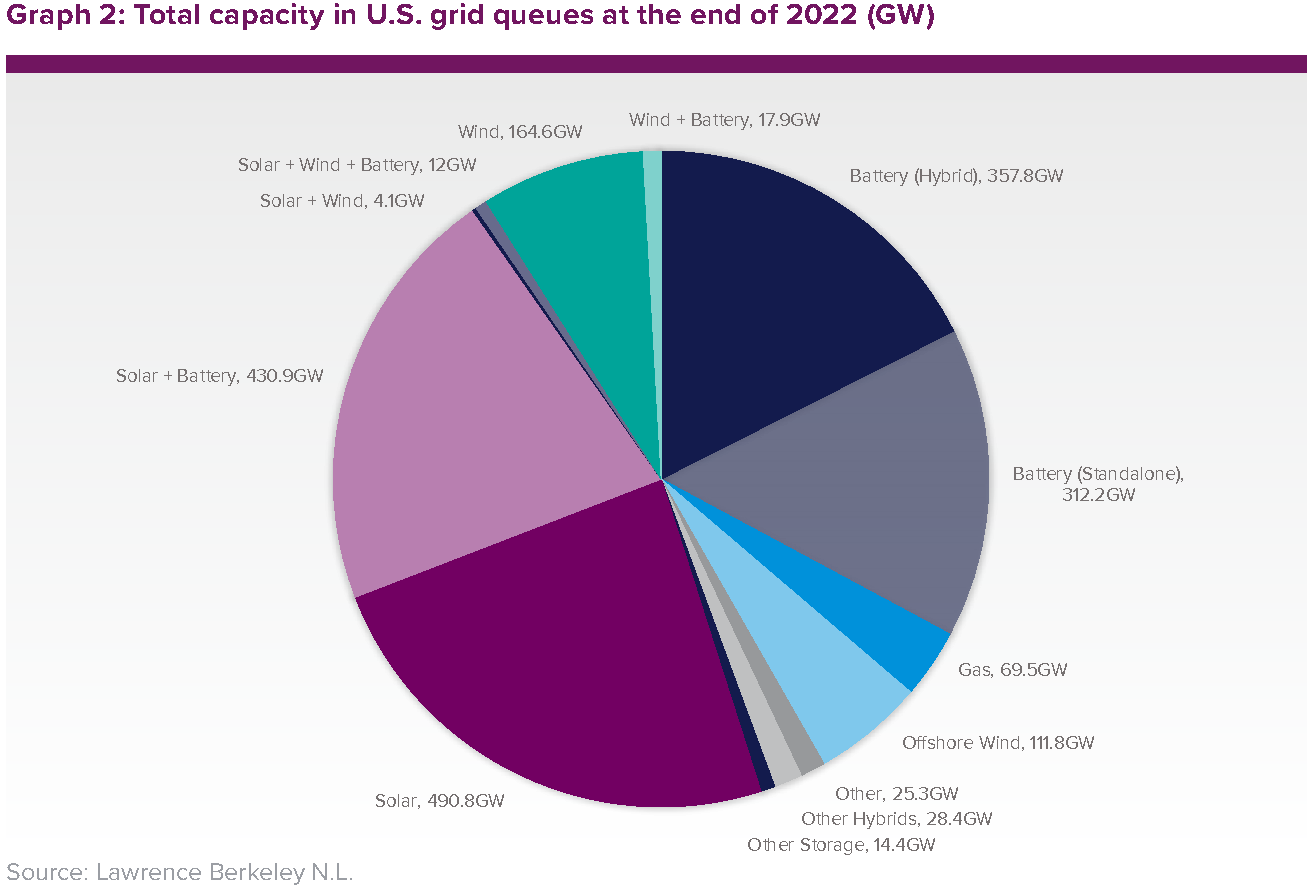
In April 2023, LBNL reported that projects totalling more than 2TW were in queues for grid interconnections in the U.S. at the end of 2022. Projects with a battery element made up 1.1TW of these, or 55% of the capacity of projects in U.S. grid queues (graph 2).
These include 325GW of standalone battery projects; 430.9GW solar and battery projects; and 387.7GW where batteries are paired with wind, multiple technologies, or other unspecified forms of generation. Batteries and other types of storage will also be vital to support the standalone solar (490.8GW) and wind (164.6GW) projects.
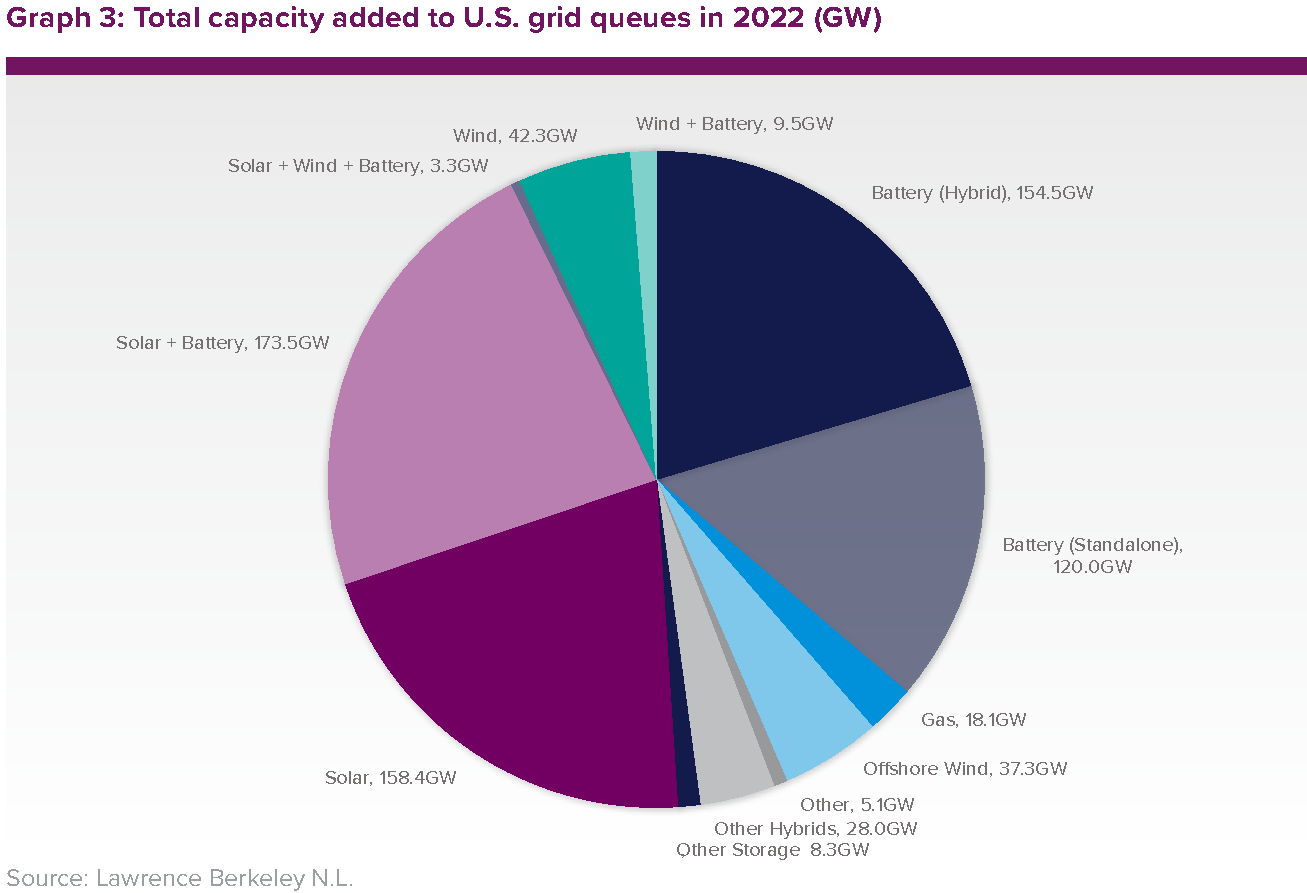
Batteries also accounted for a large proportion of the 758.3GW projects entering U.S. grid queues in 2022 (see graph 3).
LBNL reported that this included 173.5GW of solar and battery projects; 120GW of standalone batteries; and 167.3GW of projects where batteries are paired with wind, multiple technologies, or other unspecified forms of generation. This means batteries are either the sole element or an important element of the headline capacity of 61% of projects that entered U.S. grid queues in 2022.
These long queues have increased average wait times between connection requests and project commissioning from two years to four years, although there are wide variations among independent system operators. Developers have responded by speculatively adding early-stage projects to grid queues, which further blocks the system. This is a vicious cycle, and the system is in urgent need of reform, with LBNL warning that the IRA would worsen the problem by adding new projects into the mix.
The best the industry can hope for is reform of a system that was set up to deal with connection requests from large, centralized power plants, rather than the mix of small solar, wind, and storage projects they have to deal with today.
However, companies have reasons to remain optimistic.
In 2022, there were attempts to reform federal laws on the permitting of infrastructure projects, including grid links, and there have been further moves to get Congress or the Federal Energy Regulatory Commission (FERC) to tackle the issue.
In June 2022, FERC issued a Notice of Proposed Rulemaking (Docket No. RM22-14) proposing major reforms aimed at streamlining the interconnection process. This has generated huge industry interest and a great deal of comment, and remains pending. FERC Chairman Willie Phillips, who took up the role in January 2023, recently said he is looking to act on significant rulemakings that were initiated by his predecessor, which presumably includes the proposed rules for interconnections.
The most notable proposed reform would be to implement a “first ready, first served” cluster study process, rather than separate studies for each individual generating or storage facility. The industry should pay attention to FERC action on this rulemaking.
For now, in the absence of transformative FERC or congressional action, developers of some battery projects may be unable to secure the grid connections they need.
Ken-Ichi Hino, portfolio manager for energy storage at UBS Asset Management, says this is a challenge for the U.S. government in achieving its IRA goals.
“We’ve been talking about queue reform for five, six, or even seven years, but it still hasn’t happened. The deployment timelines in a lot of markets keep getting extended, and that is not just an energy storage problem. It is an issue for all kinds of generation — wind, solar, thermal, hydro, etc. as well,” he says.
If solar and wind projects are delayed, then the economic opportunity for utility-scale batteries gets delayed. Hino also warns that a lack of transparency on development timelines would make it tougher for battery manufacturers, particularly those focused on technologies outside of transportation applications, to decide when to invest in building or expanding factories. Developers may have grown accustomed to dealing with this system, but the ambitions of the IRA extend to portions of the value chain upstream of renewable energy deployment as well, which amplifies the benefits queue reform could have on the impacts of the IRA.
In addition, one interviewee warns that there is a risk that developers will undermine the economics of projects by paying too much to secure grid interconnections.
However, one part of the battery market is not affected by lengthy grid queues: developers of smaller projects in select markets. In California, it is possible for sub-3MW projects to avoid queues, and in Texas it applies to sub-10MW projects.
James Beach, co-founder and managing partner of EnerSmart Storage, develops small battery projects in California. He explains that the “only downside” of avoiding the grid queues in California is that it cannot sell valuable resource adequacy services that support the state’s grid until around a year after the project is commissioned.
However, he adds that the firm can participate in energy markets immediately, and says the IRA has helped EnerSmart to manage rising technology costs.
For developers of larger projects, the main hope is systemic reform.
As Marco Terruzzin, chief commercial officer at Energy Vault, puts it: “There must be simplification in the interconnection process because, at one point, the pressure from lobbyists to simplify will be too high. The regulator will step in.”
4) Concerns over growing skills gaps
The IRA has encouraged developers to dust off plans for battery projects that might otherwise have been uneconomical. This added 10GW of battery projects to the U.S. development pipeline, according to the EIA, which is up 58% from the pre-IRA figure.
Developers can also gain higher tax credits if they pay workers ‘prevailing wages’ at projects and utilize apprentices from registered apprenticeship programs to perform a required percentage of the total construction labor hours. The Biden administration has promised that the IRA would create millions of jobs in the clean energy sector in the next decade, with BW Research putting the figure at 537,000 annually, but that will not be easy to achieve and will not solve short-term gaps.
Companies face three main problems. First, the rapid expansion of solar and wind in the U.S. means there are already gaps in the availability of skilled workers to build and maintain projects. Storage is trying to grow in a sector where skills were already tight.
Second, battery storage is a new sector, and it will take time to train new entrants with the skills they need to unblock industry bottlenecks.
And third, the U.S. has a historically low unemployment rate — 3.4% in April 2023 — that will pose an extra challenge in finding workers.
This is visible throughout the sector. Consultants are reporting that developers are turning to them to help assess early-stage projects and bring in extra bandwidth. Jason Goodhand, global business leader for energy storage at DNV, has seen an increase in these inquiries since the IRA was announced.
“Companies need extra capacity from people who understand batteries and can do some tasks around development. We’re seeing a lot more of that,” he says.
External consultants are not always the cheapest option for outsourcing, but Goodhand adds: “There’s so much demand in the industry, and so much difficulty for everyone to staff up, that we are being hired, in some cases, not only for our expertise but to also help with bandwidth.”
Developers are also expressing concerns about the availability of contractors to build projects. One director at a leading developer says he is concerned about the availability of engineers and construction workers: “There are shortages of engineers and it’s hard to find labor,” he says.
He adds that the IRA’s provisions on apprenticeships should help deepen the pool of skilled workers in U.S. battery storage, but it will not happen overnight: “It may help on the labor supply side, but it’s not going to happen very quickly,” he says.
This issue will give developers and investors a few sleepless nights, particularly in the next two to three years.
5) Continued lack of clarity on policy
It is normal for transformative legislation such as the IRA to be followed by a series of administrative guidance spelling out how the legislation will work. Here are three topics where developers are either awaiting clarification or interpreting recent guidance:
Tax credit transferability
One eye-catching aspect of the IRA was the proposal to let developers sell all or part of the tax credits associated with their project to a third party. This is seeking to open the tax credit market to a broader range of investors, which was previously limited to those that could maintain an equity interest in a project, and should lead to innovative project finance structures. But companies are waiting on guidance from the Internal Revenue Service (IRS) about how transferability will work in practice.
The IRA created another opportunity for tax equity investors to invest in standalone battery projects now that batteries may earn a tax credit even if not co-located with wind or solar.
Dan Barbeau, director at CohnReznick Capital, says the biggest challenge for battery owners and tax equity investors is that standalone batteries are not generating assets like solar or wind farms, where tax equity is linked to project cashflow from energy production. Batteries have different revenue streams that will pose a challenge for the market.
“Storage is not a generating asset. It’s a market maker, and there are two parts of the market that are developing. There are mostly merchant or fully merchant standalone storage projects, and there are storage projects where the power output is fully sold for, say, 20 years. Those are drastically different revenue risk profiles, and mean very different things from a traditional project finance approach,” he says.
Barbeau expects projects where the power output is fully sold to get to a stage where tax equity investors are comfortable underwriting those projects using traditional tax equity structures. However, he says merchant storage projects are more likely to use transfer mechanisms, as they rely more on fluctuating demand and pricing of energy.
Investment in ‘energy communities’
In the IRA, projects built in so-called “energy communities” — such as old mining areas — can qualify for an extra 10% tax credit. The IRS has sought to clarify the definition of energy community in Notice 2023-29, published on April 4, 2023.
The notice provided some user-friendly guides for identifying energy communities, by virtue of a coal mine or plant closure, or which had a history of significant fossil fuel employment, and some safe harbors for qualifying brownfield sites. Developers and investors will now be looking at whether this opens new sites for development, especially in metropolitan areas.
Before the publication of Notice 2023-29, one leading developer indicated that guidance could potentially open huge areas for new utility-scale battery developments: “Depending on how those definitions are interpreted and what resources can be developed to easily screen for those sites, this could lead to a giant increase in the number of projects that qualify for that extra 10%,” he said. With the release of Notice 2023-29, those opportunities are now beginning to emerge.
Combining ITC and PTC
A final area where storage developers and investors need more clarity is whether they could use a storage ITC for the battery portion of a hybrid project and the PTC for the generation part. Anne Loomis, partner at Troutman Pepper, says this should be an option for hybrid projects but the industry needs further clarification.
She explains: “Our view is those two things can happen separate from each other, and we think that view is supported by the legislative history. There’s a statement in the Congressional Record, from the House Ways & Means Committee, when they passed the IRA that addresses this question. However, that is not always viewed as authoritative, so it would be good to have more guidance from the IRS.”
These three points are by no means exhaustive — and any outstanding questions on the IRA have the potential to delay development and investment activity.
What happens next: U.S. storage investment trends
The IRA is transformational legislation, and while we have focused on the market constraints, there is no getting away from the fact that this is a very exciting time for the U.S. storage industry. Other parts of the world are now looking enviously at U.S. climate policies and seeking to respond with their own.
Here are five post-IRA investment trends that Troutman Pepper forecasts will affect the U.S. storage industry in the coming years:
1) Inward investment from established markets
The IRA has positioned the U.S. at the forefront of cleantech investment globally, and we expect significant inflows into the U.S. battery sector — and the wider renewables world — from institutional investors, manufacturers, and suppliers. This will include firms from established renewables markets in Europe, Asia, and South America, which will also bring expertise that can help to build the integrated battery supply chain within the U.S. and North America. Queue delays, rather than lack of investment interest, remain the principal obstacle to speeding up storage deployment.
2) U.S.-China relations will bring short-term volatility
Until the U.S. establishes a strong battery supply chain, firms will continue to rely on a handful of suppliers in Asia, especially China, for batteries and raw materials. This means that battery developers and investors in the U.S. will be exposed to trade disputes between the U.S. and China until 2025 and beyond. However, companies should take heart that U.S. developers such as NextEra are reporting that they are no longer experiencing delays in receiving solar panels from southeast Asia, as this success can be replicated in the battery sector.
3) Co-location still attractive despite standalone rush
The standalone storage ITC has sparked major growth in standalone batteries since the publication of the IRA, but we still see strong prospects in the hybrid market for projects where storage is co-located with solar or wind generation. As with new-build schemes, we also expect the owners of operational solar and wind farms to add energy storage to their existing sites so they can take advantage of existing grid interconnection and optimize their project monetization.
4) Large institutional investors enter tax credit market
The idea behind tax credit transferability, introduced in the IRA, is to broaden the pool of companies that can benefit from tax credits in renewable energy and battery projects. The tax equity market for batteries is still developing, but with the new standalone storage tax credit and transferability as an alternative to tax equity, we expect large institutional investors to take advantage of the opportunity and back large battery projects. However, this may bring with it extra due diligence as they seek to get comfortable with this investment area.
5) Growth of long-duration storage
Utility-scale battery storage projects, predominantly using lithium-ion batteries, have been the early winner of the IRA. This is understandable given that this is an established technology with a head start over other forms of long-duration energy storage. In the coming years, though, we expect to see developers and investors look at how they can apply the IRA rules to projects with emerging technologies.
The IRA was a long time in gestation, but its impact is undeniable. We look forward to working with you on the opportunities and challenges it raises in the years ahead.
Strategies helps businesses and individuals solve the complexities of dealing with the government at every level. Our team of specialists concentrate exclusively on government affairs, representing clients nationwide who need assistance with public policy, advocacy, and government relations strategies.
Troutman Pepper Locke’s program for Startup and Early-Stage Entrepreneurial Development
This unique program provides innovative and affordable opportunities to startups and early-stage emerging companies with a solid technology or scientific foundation. We help companies that have a quality management team in place and do not have other significant legal representation.
Market leading eDiscovery and data management services.
eMerge’s lawyers and technologists work together to deliver strategic end-to-end eDiscovery and data management solutions for litigation, investigations, due diligence, and compliance matters. We help clients discover the information necessary to resolve disputes, respond to investigations, conduct due diligence, and comply with legal requirements.