Strategies helps businesses and individuals solve the complexities of dealing with the government at every level. Our team of specialists concentrate exclusively on government affairs, representing clients nationwide who need assistance with public policy, advocacy, and government relations strategies.
Troutman Pepper Locke’s program for Startup and Early-Stage Entrepreneurial Development
This unique program provides innovative and affordable opportunities to startups and early-stage emerging companies with a solid technology or scientific foundation. We help companies that have a quality management team in place and do not have other significant legal representation.
Market leading eDiscovery and data management services.
eMerge’s lawyers and technologists work together to deliver strategic end-to-end eDiscovery and data management solutions for litigation, investigations, due diligence, and compliance matters. We help clients discover the information necessary to resolve disputes, respond to investigations, conduct due diligence, and comply with legal requirements.
This article was originally published on Law360 and is republished here with permission as it originally appeared on April 20, 2026.
On Jan. 27, the U.S. Government Accountability Office released a report on the status of efforts to reorganize the Consumer Financial Protection Bureau that offers a detailed snapshot of the CFPB’s ongoing downsizing and restructuring.[1]
This is the first of two GAO reports that focus on the CFPB’s reorganization and its ability to fulfill its statutory functions going forward.
Between February and August 2025, CFPB leadership pursued significant reductions in staff, contracts, supervision and enforcement activity while Congress moved to cut the bureau’s funding cap.
The report, requested by senior Democratic members of the U.S. Senate Banking Committee and U.S. House of Representatives Financial Services Committee, describes these actions, and previews a future GAO report on how they affect the CFPB’s ability to carry out its statutory mandate.
A Smaller CFPB by Design
In 2010, the Dodd‑Frank Act created the CFPB to consolidate federal consumer financial protection authorities primarily under one federal agency, supervise covered institutions and monitor markets for risks to consumers.
According to a sworn declaration submitted by Mark Paoletta, the CFPB’s chief legal officer, to the U.S. District Court for the District of Columbia in early 2025, bureau leadership has been reassessing how to carry out its duties “as a smaller, more efficient operation,” in response to President Donald Trump’s executive orders.
Beginning in early 2025, the CFPB issued stop‑work orders, closed supervisory examinations, terminated employees and contractors, and shifted its enforcement posture. Many of these steps quickly became the subject of litigation.
Courts across multiple circuits considered challenges to terminations and other downsizing actions, and those cases remain an important backdrop for the bureau’s reorganization.
At the same time, Congress acted directly on the CFPB’s finances. On July 4, 2025, Trump signed the reconciliation bill commonly known as the One Big Beautiful Bill Act, which reduced the bureau’s statutory funding cap from 12% to 6.5% of the Federal Reserve’s 2009 operating expenses, adjusted for labor costs.
That change effectively halves the maximum amount the CFPB can draw from the Federal Reserve to fund its operations.
Against this backdrop, the GAO was asked to describe how stop‑work orders, workforce reductions, contract terminations and related actions have affected the bureau’s ability to perform its statutory functions. The January report is the first installment; the GAO expects to analyze the actual impact on the CFPB’s performance in a subsequent report.
Highlights From the GAO Report
The GAO’s report is descriptive, not evaluative. It focuses on what the CFPB has done and how through a series of charts, facts, data and timelines, rather than whether those choices represent sound policy.
To compile the report, the GAO relied on court dockets, Federal Register notices, statutes, executive orders, Office of Personnel Management and Office of Management and Budget memoranda, and certain internal CFPB documents.
The GAO notes that it repeatedly sought meetings, data and documents from the CFPB regarding workforce changes, contracts, supervision and enforcement. However, the bureau declined to meet, and did not provide any substantive responses, citing ongoing litigation, despite multiple extensions and opportunities to comment on draft materials provided by the GAO.
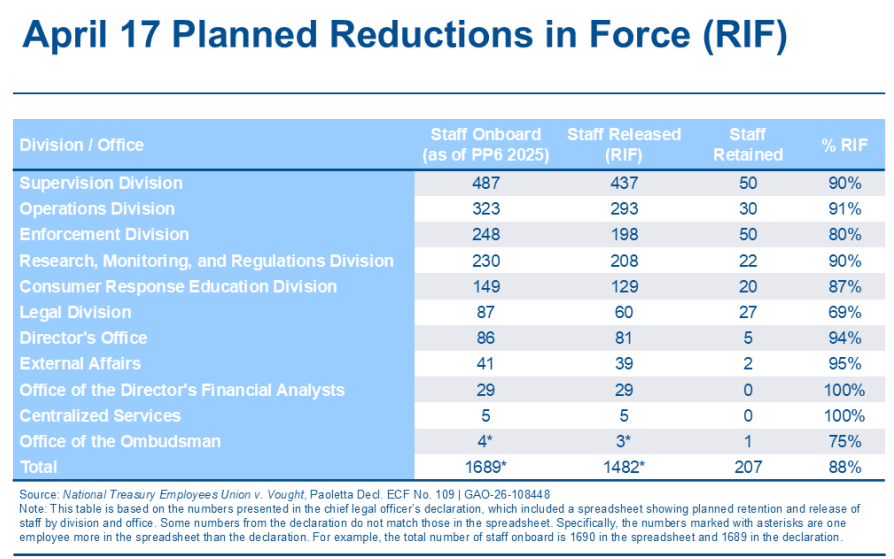
One key element is a table describing the CFPB’s planned reductions in force as of April 17, 2025. The figures show substantial planned RIFs across core divisions, including Supervision; Enforcement; Research, Monitoring and Regulations; and Consumer Response and Education, as well as reductions in the Legal Division and other offices.
Some divisions would retain only a fraction of the staff it had at the time. The GAO cautions that these numbers reflect plans and remain subject to litigation, but they underscore the intended staggering scale of the transformation.
The GAO also documents that the CFPB has closed or curtailed supervisory examinations, terminated or sought to terminate certain contracts, and moved to dismiss or resolve some enforcement actions and petitions to enforce civil investigative demands, while seeking to vacate or terminate a number of existing consent orders.
On the policy side, the bureau has withdrawn or rescinded multiple guidance documents, interpretive rules, policy statements, advisory opinions and other guidance, as well as several proposed rules and certain rules of agency organization adopted in the prior administration.
In June 2025, the CFPB told the U.S. District Court for the Eastern District of Kentucky that a final rule exceeded the agency’s authority, and requested a stay of litigation while it pursues a new rulemaking.
The bureau’s written response to the draft report, reproduced as an enclosure, sharply criticizes the GAO’s work as inaccurate, biased and incomplete, and asserts that ongoing litigation constrained its ability to provide information.
The GAO, in turn, states that it acted under its statutory audit authority, that litigation does not negate the CFPB’s obligation to provide information, and that its report is grounded in publicly verifiable sources. The GAO expressly disclaims any position on the policy merits of bureau leadership’s views or on the appropriate size of the agency.
Implications and Next Steps
The GAO report confirms that the CFPB is undergoing a deliberate and significant downsizing and restructuring effort, but does not suggest that the bureau has stepped away from its statutory mandate. The Dodd‑Frank Act’s underlying consumer protection authorities remain unchanged.
Instead, the report points to a CFPB with fewer resources, aggressive efforts to reshape its workforce and docket, and heightened legal and political scrutiny of how those efforts are carried out.
In the near term, this likely means that the bureau will continue to exercise its powers, but with sharper choices about where to deploy staff and litigation resources. A smaller, reorganized CFPB may concentrate on particular products, practices or institutions that align with current leadership’s priorities, while deemphasizing other areas.
The statutory funding cut under the One Big Beautiful Bill Act is a durable constraint. Regardless of how litigation over personnel and organizational changes is resolved, a lower ceiling on the bureau’s independent funding stream will shape its capacity over time, and may influence decisions about staffing, supervision and enforcement portfolios.
Congress’ willingness to legislate directly on the CFPB’s funding also suggests that broader structural changes to the bureau could be revisited.
The GAO has signaled that this report is only the first step. Its next phase will examine the effects of the reorganization on the CFPB’s ability to fulfill its statutory functions. That analysis could feed directly into congressional oversight, future legislation, and further debate over the size, scope and role of the bureau.
Strategies helps businesses and individuals solve the complexities of dealing with the government at every level. Our team of specialists concentrate exclusively on government affairs, representing clients nationwide who need assistance with public policy, advocacy, and government relations strategies.
Troutman Pepper Locke’s program for Startup and Early-Stage Entrepreneurial Development
This unique program provides innovative and affordable opportunities to startups and early-stage emerging companies with a solid technology or scientific foundation. We help companies that have a quality management team in place and do not have other significant legal representation.
Market leading eDiscovery and data management services.
eMerge’s lawyers and technologists work together to deliver strategic end-to-end eDiscovery and data management solutions for litigation, investigations, due diligence, and compliance matters. We help clients discover the information necessary to resolve disputes, respond to investigations, conduct due diligence, and comply with legal requirements.